
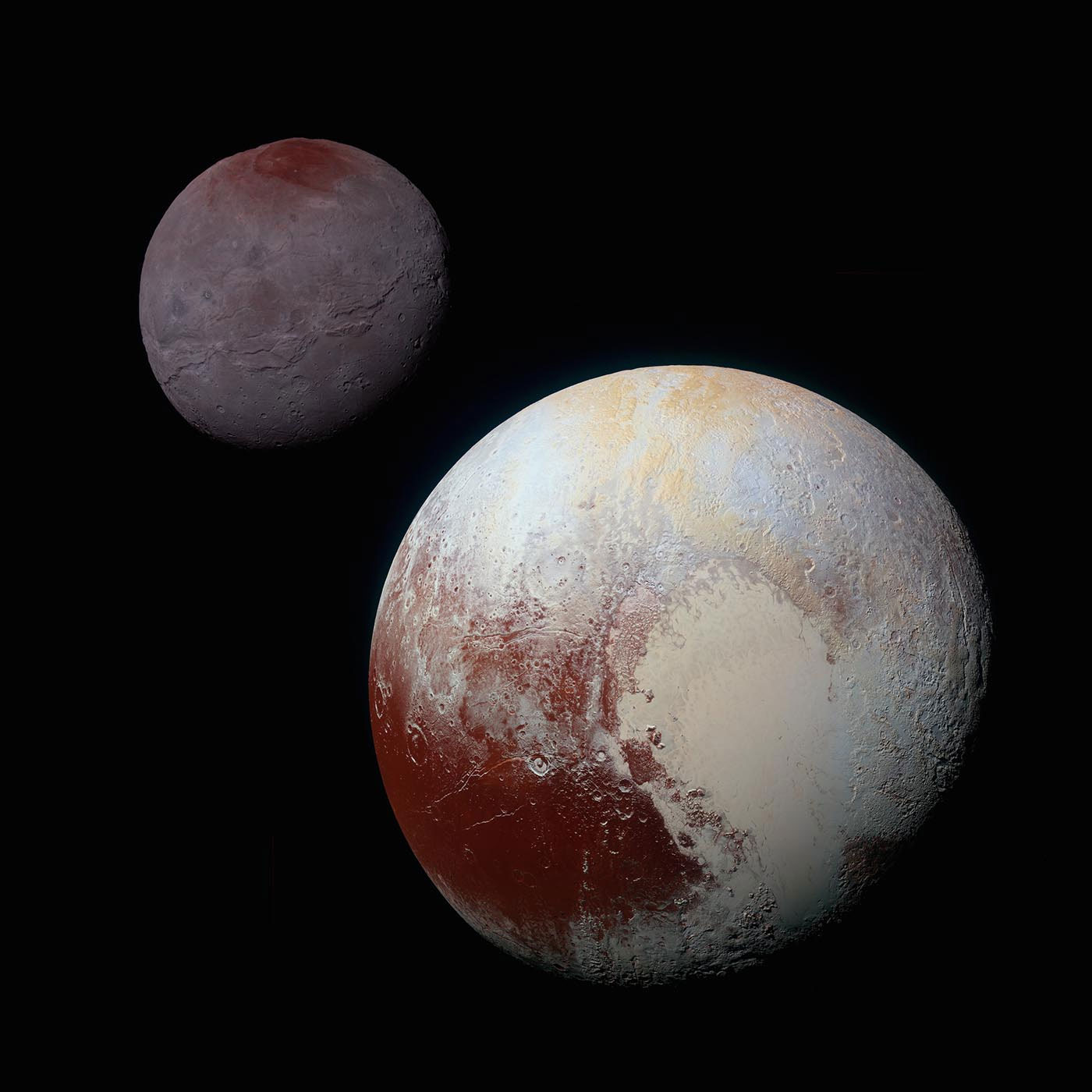
Pluto hogs the spotlight in the continuing scientific debate over what is and what is not a planet, but a less conspicuous argument rages on about the planetary status of massive objects outside our solar system. The dispute is not just about semantics, as it is closely related to how giant planets like Jupiter form.
Johns Hopkins University astrophysicist Kevin Schlaufman aims to settle the dispute.
In a paper just published by the Astrophysical Journal, Schlaufman has set the upper boundary of planet mass between four and 10 times the mass of the planet Jupiter. (The paper is also archived here.)
Schlaufman, an assistant professor in the university’s Department of Physics and Astronomy, says setting a limit is possible now mainly due to improvements in the technology and techniques of astronomical observation. The advancements have made it possible to discover many more planetary systems outside our solar system and therefore possible to see robust patterns that lead to new revelations.
“While we think we know how planets form in a big-picture sense, there’s still a lot of detail we need to fill in,” Schlaufman said. “An upper boundary on the masses of planets is one of the most prominent details that was missing.”
The conclusions in the new paper are based on observations of 146 solar systems, Schlaufman said. Almost all the data he used was measured in a uniform way, he said. The data are more consistent from one solar system to the next, and so more reliable.
Defining a planet, distinguishing it from other celestial objects, is a bit like narrowing down a list of criminal suspects. It’s one thing to know you’re looking for someone who is taller than 5-foot-8, it’s another to know your suspect is between 5-foot-8 and 5-foot-10.
In this instance, investigators want to distinguish between two suspects: a giant planet and a celestial object called a brown dwarf. Brown dwarfs are more massive than planets, but less massive than the smallest stars. They are thought to form as stars do.
For decades brown dwarfs have posed a problem for scientists: how to distinguish low-mass brown dwarfs from especially massive planets? Mass alone isn’t enough to tell the difference between the two, Schlaufman said. Some other property was needed to draw the line.
In Schlaufman’s new argument, the missing property is the chemical makeup of a solar system’s own sun. He says you can know your suspect, a planet, not just by its size, but also by the company it keeps. Giant planets such as Jupiter are almost always found orbiting stars that have more iron than our sun. Brown dwarfs are not so discriminating.
That’s where his argument engages the idea of planet formation. Planets like Jupiter are formed from the bottom up by first building up a rocky core that is subsequently enshrouded in a massive gaseous envelope. It stands to reason that they would be found near stars heavy with elements that make rocks, as those elements provide the seed material for planet formation. Not so with brown dwarfs.
Brown dwarfs and stars form from the top down as clouds of gas collapse under their own weight.
Schlaufman’s idea was to find the mass at which objects stop caring about the composition of the star they orbit. He found that objects more massive than about 10 times the mass of Jupiter do not prefer stars with lots of elements that make rocks and therefore are unlikely to form like planets.
For that reason, and while it’s possible that new data could change things, he has proposed that objects in excess of 10 Jupiter masses should be considered brown dwarfs, not planets.
Reference: “Evidence of an Upper Bound on the Masses of Planets and Its Implications for Giant Planet Formation” by Kevin C. Schlaufman, 22 January 2018, The Astrophysical Journal.
DOI: 10.3847/1538-4357/aa961c
Never miss a breakthrough: Join the SciTechDaily newsletter.
Follow us on Google and Google News.
1 Comment
This definition means that objects between 10 and 13 Jupiter masses that are not massive enough to undergo Deuterium fusion would still be considered Brown Dwarfs. So what happens to the Sub-Brown dwarf star class, those objects between 1 and 13 Jupiter Masses