
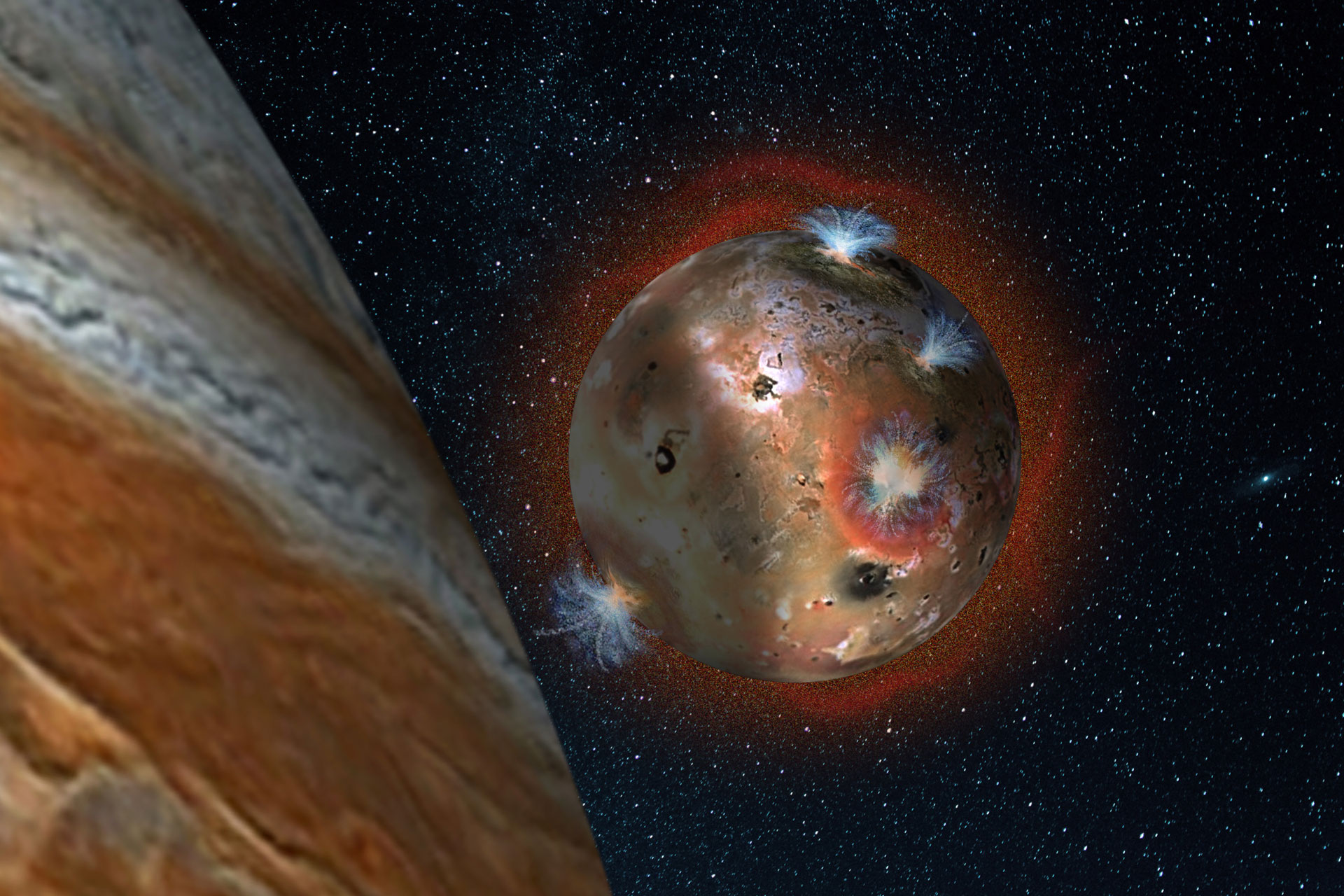
A newly published study from NASA reveals that Jupiter’s volcanic moon Io has a thin atmosphere that collapses in the shadow of Jupiter, condensing as ice. The study shows the freezing effects of Jupiter’s shadow during daily eclipses on the moon’s volcanic gases.
“This research is the first time scientists have observed this remarkable phenomenon directly, improving our understanding of this geologically active moon,” said Constantine Tsang, a scientist at the Southwest Research Institute in Boulder, Colorado. The study was published in the Journal of Geophysical Research.
Io is the most volcanically active object in the solar system. The volcanoes are caused by tidal heating, the result of gravitational forces from Jupiter and other moons. These forces result in geological activity, most notably volcanoes that emit umbrella-like plumes of sulfur dioxide gas that can extend up to 300 miles (480 kilometers) above Io and produce extensive basaltic lava fields that can flow for hundreds of miles.
The new study documents atmospheric changes on Io as the giant planet casts its shadow over the moon’s surface during daily eclipses. Io’s thin atmosphere, which consists primarily of sulfur dioxide (SO2) gas emitted from volcanoes, collapses as the SO2 freezes onto the surface as ice when Io is shaded by Jupiter, then is restored when the ice warms and sublimes (i.e. transforms from solid back to gas) when the moon moves out of eclipse back into sunlight.
The study used the large eight-meter Gemini North telescope in Hawaii and an instrument called the Texas Echelon Cross Echelle Spectrograph (TEXES). Data showed that Io’s atmosphere begins to “deflate” when the temperatures drop from -235 degrees Fahrenheit (-125 degrees Celsius) in sunlight to -270 degrees Fahrenheit (-168 degrees Celsius) during the eclipse. Eclipse occurs two hours of every Io day (1.7 Earth days). In full eclipse, the atmosphere effectively collapses, as most of the sulfur dioxide gas settles as frost on the moon’s surface. The atmosphere redevelops as the surface warms once the moon returns to full sunlight.
“This confirms that Io’s atmosphere is in a constant state of collapse and repair, and shows that a large fraction of the atmosphere is supported by sublimation of SO2 ice,” said John Spencer, a co-author of the new study, also at the Southwest Research Institute. “Though Io’s hyperactive volcanoes are the ultimate source of the SO2, sunlight controls the atmospheric pressure on a daily basis by controlling the temperature of the ice on the surface. We’ve long suspected this, but can finally watch it happen.”
Prior to the study, no direct observations of Io’s atmosphere in eclipse had been possible because Io’s atmosphere is difficult to observe in the darkness of Jupiter’s shadow. This breakthrough was possible because TEXES measures the atmosphere using heat radiation, not sunlight, and the giant Gemini telescope can sense the faint heat signature of Io’s collapsing atmosphere.
The observations occurred over two nights in November 2013, when Io was more than 420 million miles (675 million kilometers) from Earth. On both occasions, Io was observed moving into Jupiter’s shadow for a period of about 40 minutes before and after the start of the eclipse.
The research was funded by NASA’s Solar System Workings and Solar System Observations programs.
Reference: “The collapse of Io’s primary atmosphere in Jupiter eclipse” by Constantine C. C. Tsang, John R. Spencer, Emmanuel Lellouch, Miguel A. Lopez-Valverde and Matthew J. Richter, 2 August 2016, Journal of Geophysical Research: Planets.
DOI: 10.1002/2016JE005025
Never miss a breakthrough: Join the SciTechDaily newsletter.
Follow us on Google and Google News.