
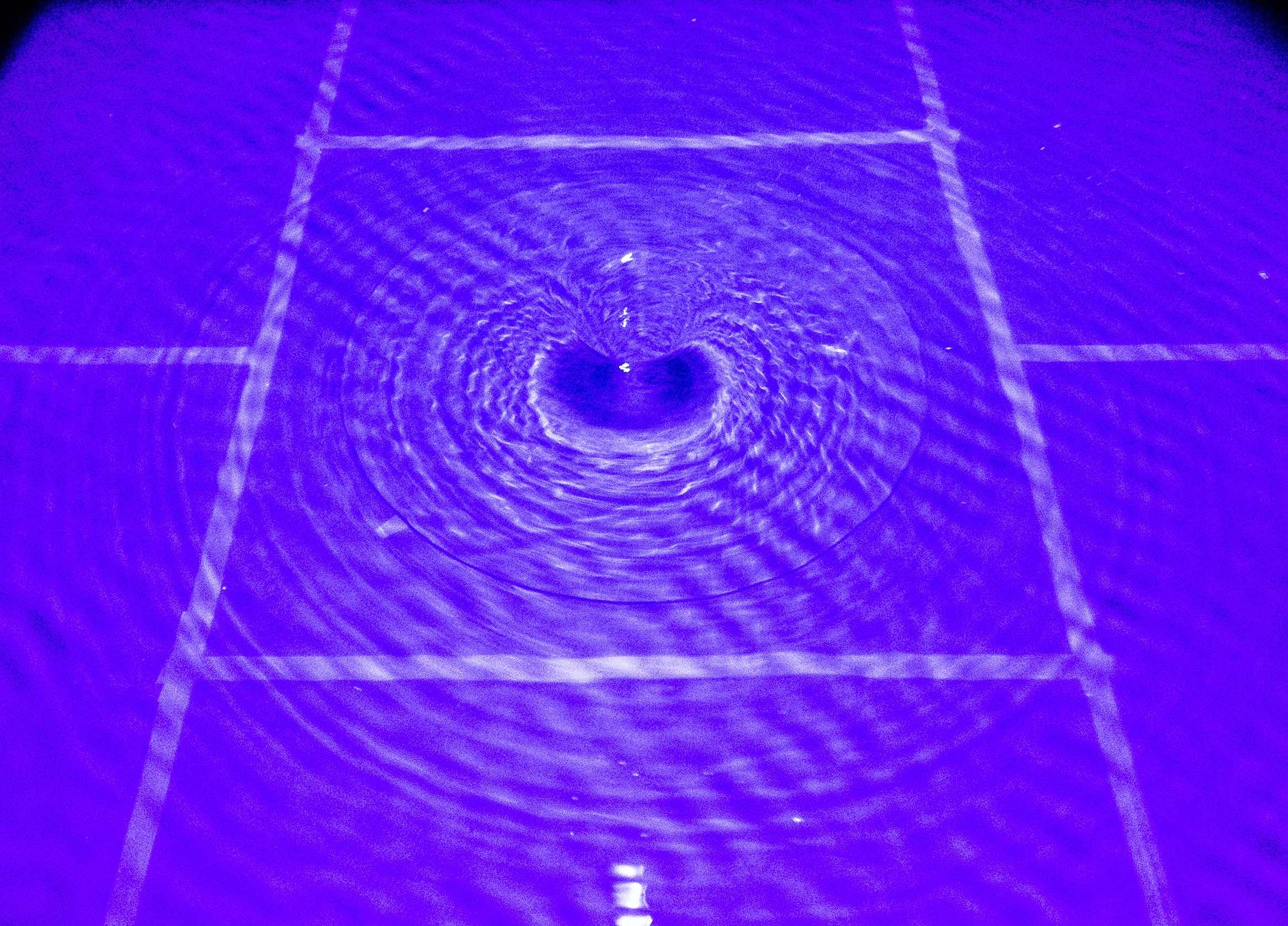
Scientists have revealed new insights into the behavior of black holes with research that demonstrates how a phenomenon called backreaction can be simulated.
The team from the University of Nottingham have used their simulation of a black hole, involving a specially designed water tank, for this latest research published in Physical Review Letters. This study is the first to demonstrate that the evolution of black holes resulting from the fields surrounding them can be simulated in a laboratory experiment.
The researchers used a water tank simulator consisting of a draining vortex, like the one that forms when you pull the plug in the bath. This mimics a black hole since a wave that comes too close to the drain gets dragged down the drain, unable to escape. Systems like these have grown increasingly popular over the past decade as a means to test gravitational phenomena in a controlled laboratory environment. In particular, Hawking radiation has been observed in an analog black hole experiment involving quantum optics.
Backreaction Observed for the First Time
Using this technique the researchers showed for the first time that when waves are sent into an analog black hole, the properties of the black hole itself can change significantly. The mechanism underlying this effect in their particular experiment has a remarkably simple explanation. When waves come close to the drain, they effectively push more water down the drain causing the total amount of water contained in the tank to decrease. This results in a change in the water height, which in the simulation corresponds to a change in the properties of the black hole.
Lead author, Post-doctoral researcher Dr. Sam Patrick from the University of Nottingham School of Mathematical Sciences explains: “For a long time, it was unclear whether the backreaction would lead to any measurable changes in analog systems where the fluid flow is driven, for example, using a water pump. We have demonstrated that analog black holes, like their gravitational counterparts, are intrinsically backreacting systems. We showed that waves moving in a draining bathtub push water down the drain, modifying significantly the drain speed and consequently changing the effective gravitational pull of the analog black hole.
What was really striking for us is that the backreaction is large enough that it causes the water height across the entire system to drop so much that you can see it by eye! This was really unexpected. Our study paves the way to experimentally probing interactions between waves and the spacetimes they move through. For example, this type of interaction will be crucial for investigating black hole evaporation in the laboratory.”
Black hole research at the University of Nottingham has recently received a £4.3 million funding boost for a three-year project that aims to provide further insights into the physics of the early universe and black holes.
The research team will use quantum simulators to mimic the extreme conditions of the early universe and black holes. The Nottingham team will be using a new state laboratory to set up a novel hybrid superfluid optomechanical system to mimic quantum black hole processes in the laboratory.
Reference: “Backreaction in an Analogue Black Hole Experiment” by Sam Patrick, Harry Goodhew, Cisco Gooding and Silke Weinfurtner, 29 January 2021, Physical Review Letters.
DOI: 10.1103/PhysRevLett.126.041105
Never miss a breakthrough: Join the SciTechDaily newsletter.
Follow us on Google and Google News.
10 Comments
E disse Deus: haja um firmamento no meio das águas, e haja separação entre águas e águas.
Fez, pois, Deus o firmamento, e separou as águas que estavam debaixo do firmamento das que estavam por cima do firmamento. E assim foi.
“We showed that waves moving in a draining bathtub push water down the drain, modifying significantly the drain speed”
$4.3 million in additional funding for this great achievement.
Sigh..
This still field we can’t prove however I will not stop trying to learn all their secrets
I think the same effect can be achieved by flushing a toilet. For free they can stick their head in mine.
Wow. Cutting edge research here. When you remove water from a tub of water, the tub has less water. Yep. All this proves, is that scientists are completely capable of being utterly useless and not smart. No wonder we have flat earthers running rampant. It’s hard to have faith in this system.
What if black holes control the expansion of the universe?
If black holes are drains, and all light and mater the standing water at rest would it not mean blackholes eat tons of mater crush it all up and transport it to the leading edge of the universe where it is black nothing forever as the universe creates and expands through the blackholes they crush up old mater disperse it as new universe building mater. Just thoughts from the throne
U’ALL SIMPLY MUST READ THE EXPLENATION OF
BLACK HOLE SCIENCE EXPLAINED IN VOYAGERS
The Sleeping Abductees 1 + 2 IF U WOULD LIKE A SERIOUS EXPLANATION OF BLACKHOLE MERKABA
MECHANICS ‼️ SERIOUSLY ‼️
Very interesting! One small correction though:
the researchers showed for the first time that when waves are sent into an analog black hole, the properties of the black hole itself can change significantly
–> what you meant was –>
the researchers showed for the first time that when waves are sent into a water vortex in the bathroom, the properties of the water vortex itself can change significantly.
FIFY!
Isn’t this saying that the water’s wave vectors are accelerating and then decelerating the rate of water flow into the vortex, and if the bath is being refilled at a constant rate during the experiment, then the visible effect on the water level is effectively the same as you’d see if you periodically decelerated and re-accelerated the top-up flow, above and below the drainage rate? If so, then I can’t translate this to black holes where there is no container to observe a level. But then again, I haven’t actually got a clue what I’m talking about.