
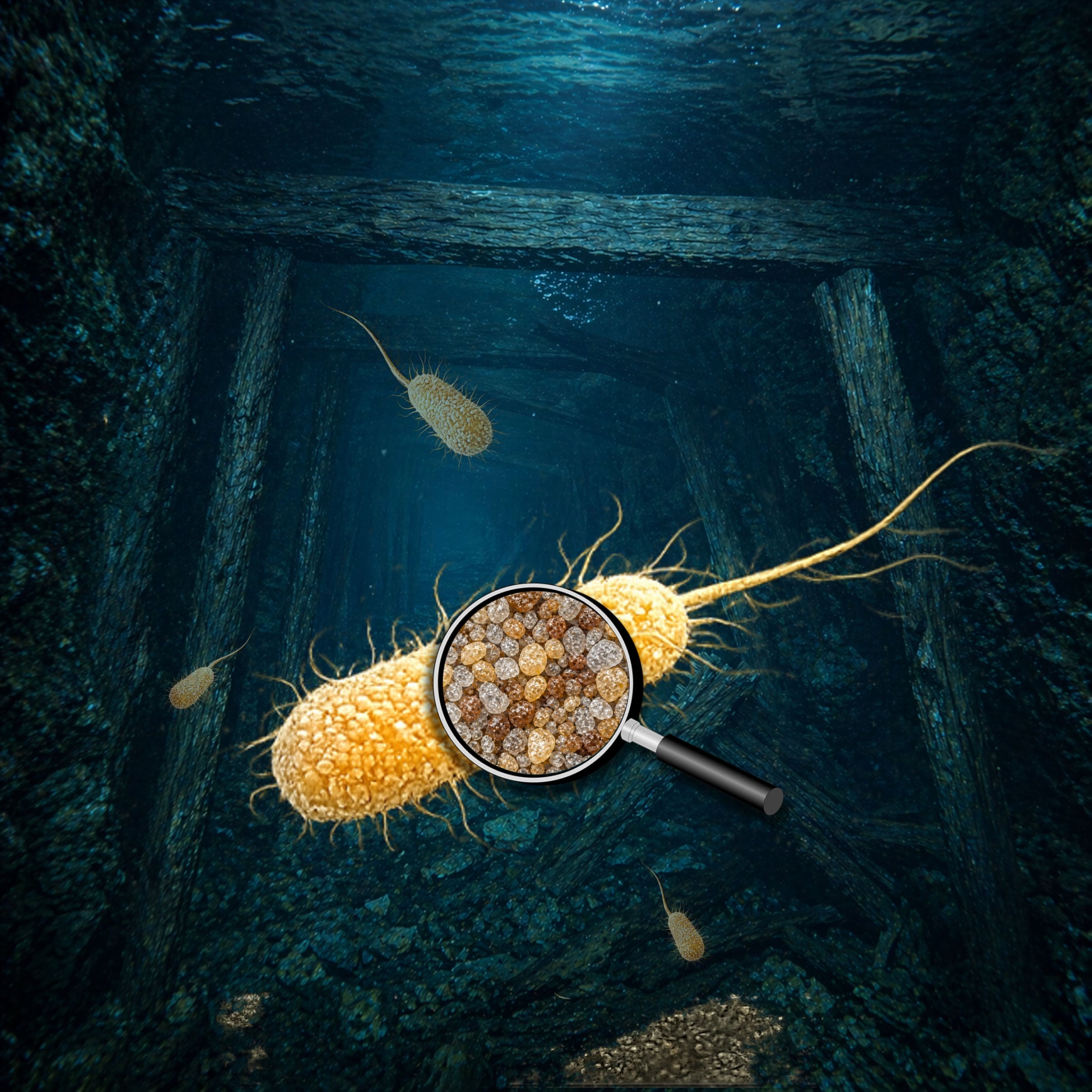
Bacteria may offer an unexpected way to immobilize uranium in contaminated water.
Uranium contamination is difficult to manage because the metal can change chemical form. When uranium remains locked inside minerals, it is relatively immobile. But when environmental conditions or mining activity convert it into a soluble form, it can move through groundwater and spread beyond the original source.
A new study suggests that naturally occurring bacteria may be able to stop some of that movement. Researchers found that microbes living in water from a flooded uranium mine removed nearly all of the dissolved uranium and converted much of it into an unexpectedly stable compound.
The work was carried out by scientists at the Helmholtz-Zentrum Dresden-Rossendorf (HZDR), Wismut GmbH, and the University of Granada in Spain. Their results were published in Nature Communications.
Turning Mobile Uranium Into a More Stable Form
The chemical form of uranium matters because it influences how easily the element moves through soil and water. Some forms dissolve readily, while others become trapped in minerals, sediments, or biological material.
In the new experiments, bacteria converted dissolved uranium into a solid compound after receiving glycerol as a food source. Glycerol is a component of plant and animal fats and can also form naturally when fungi decompose wood.
In the experiments, the uranium entered a pentavalent state, known as uranium(V), which is considered rare and typically short lived under environmental conditions.
Bacteria Already Living in Mine Water
Microorganisms are major drivers of chemical change in soil and groundwater. Some species can process metals and other pollutants as part of their metabolism, altering whether those substances remain mobile or become fixed in place.
“There are bacteria that can metabolically utilize the heavy metal, uranium, which is toxic for humans,” says Dr. Evelyn Krawczyk-Bärsch, a scientist in HZDR’s Terrestrial Microbiology research group and co-author of the study. “Our group’s investigations had already revealed that bacteria can use uranium dissolved in water for their metabolism when they have access to glycerol as a food source.”
The researchers wanted to answer two main questions: how much uranium the bacteria could remove from the water and what chemical forms would appear after the microbes had processed it.
Recreating Conditions Deep Underground
The team used water from a flooded uranium mine in the Ore Mountains operated by Wismut GmbH. The samples already contained a natural community of bacteria adapted to the mine environment.
Researchers added a measured amount of glycerol and kept the samples under oxygen-free conditions. This was intended to reproduce the environment deep inside the mine, where oxygen can be scarce or absent.
“We wanted to create natural conditions for the bacterial community already existing in the mine water because at a depth of approximately 2,000 meters there is usually little or no oxygen in the mine,” explains Dr. Antonio M. Newman-Portela, former doctoral candidate at both HZDR and the Microbiology Department at the University of Granada (Spain), and the lead author of the study.
The mine reached a depth of about 2,000 meters (6,562 feet). Under laboratory conditions favorable to bacterial growth, the microbes used glycerol as a source of carbon and energy.
Most of the Dissolved Uranium Disappeared
After 130 days, only about 5 percent of the dissolved uranium remained in the water.
“After 130 days, only around five percent of the uranium dissolved in the water remained in the samples,” says Newman-Portela. “We suspected that the bacteria had incorporated the uranium in their cell walls. We already knew about accumulation processes from the literature.”
Further analysis confirmed that uranium had accumulated in the bacterial cell walls. That finding showed where much of the metal had gone, but it did not yet reveal the exact compound that had formed.
Detecting an Unusual Oxidation State
To identify the uranium compound, the team used advanced microscopy and spectroscopy. Some of the experiments were conducted at the Rossendorf Beamline (ROBL), which HZDR operates at the European Synchrotron Radiation Facility (ESRF) in Grenoble, France. Additional analyses were carried out at the University of Granada.
The researchers examined the bacterial material to determine uranium’s oxidation state, which reflects how its electrons are arranged and how it can bond with other elements.
“Uranium usually occurs with a valency of 4 or 6. Pentavalent uranium does exist, but it is rare or only transient. Until now, it had been seen in an unstable oxidation state,” explains Newman-Portela. “So, the findings of our study were extremely surprising because in the biomass analyzed from our experimental runs, an unusually high proportion of the uranium identified was also pentavalent uranium.”
A Compound That May Persist for Decades
The pentavalent uranium had combined with iron and oxygen to form FeU(V)O4.
“This uranium compound doesn’t have a name yet as it is comparatively new. It was first demonstrated in a study in 2020 in which soil samples from parts of Croatia contaminated by uranium ammunition were analyzed,” explains Krawczyk-Bärsch. “It was found that even under the influence of atmospheric oxygen this uranium compound had remained stable for more than 25 years. But until now, we didn’t know how this compound is formed in nature or that bacteria play a role in its formation.”
The earlier Croatian finding showed that the compound could remain intact for decades in contaminated soil. The new study offers a possible explanation for how it forms, pointing to bacterial activity as a key part of the process.
The researchers also found that the amount of FeU(V)O4 increased after dried bacterial biomass was exposed to oxygen. This suggests that oxygen did not simply destroy the compound and may instead have supported further formation under those conditions.
A Possible Tool for Uranium Cleanup
The findings could help scientists better understand how uranium behaves in contaminated groundwater, mine water, and waste sites. They may also support research into bioremediation, which uses living organisms to reduce the movement, toxicity, or availability of pollutants.
“Our study has revealed for the first time that bacteria supplied with glycerol as a carbon source can convert toxic uranium dissolved in water into a stable chemical compound,” says Krawczyk-Bärsch. “We still have to investigate to what extent bacteria might help to render uranium harmless for remediation purposes.”
The approach is not yet ready for practical cleanup projects. Researchers still need to determine how reliably the process works outside the laboratory, how long the uranium remains stable, and how environmental changes might affect the compound over time.
Future HZDR studies will focus on uranium-binding bacteria and the biochemical and geochemical reactions that allow the microbes to immobilize the metal.
Reference: “Pentavalent and tetravalent uranium formation via glycerol-stimulated bacteria in mine water” by Antonio M. Newman-Portela, Kristina O. Kvashnina, Elena F. Bazarkina, André Rossberg, Frank Bok, Sean Ting-Shyang Wei, Andrea Kassahun, Thorsten Stumpf, Johannes Raff, Mohamed L. Merroun and Evelyn Krawczyk-Bärsch, 4 May 2026, Nature Communications.
DOI: 10.1038/s41467-026-72560-z
Never miss a breakthrough: Join the SciTechDaily newsletter.
Follow us on Google and Google News.
2 Comments
“The mine reached a depth of about 2,000 meters (6,562 feet).”
You’re converting a measurement with one, maybe two, significant digits with an “about” qualifier to a measurement with four significant digits. Sloppy.
The Earth, like any life-bearing planet, is a complete living organism. Trust nature to find the answers. Just stay out of her way and/or don’t meddle in her processes.