
Researchers have developed a visible-light-driven method that could help chemists build more complex drug-like molecules in fewer steps.
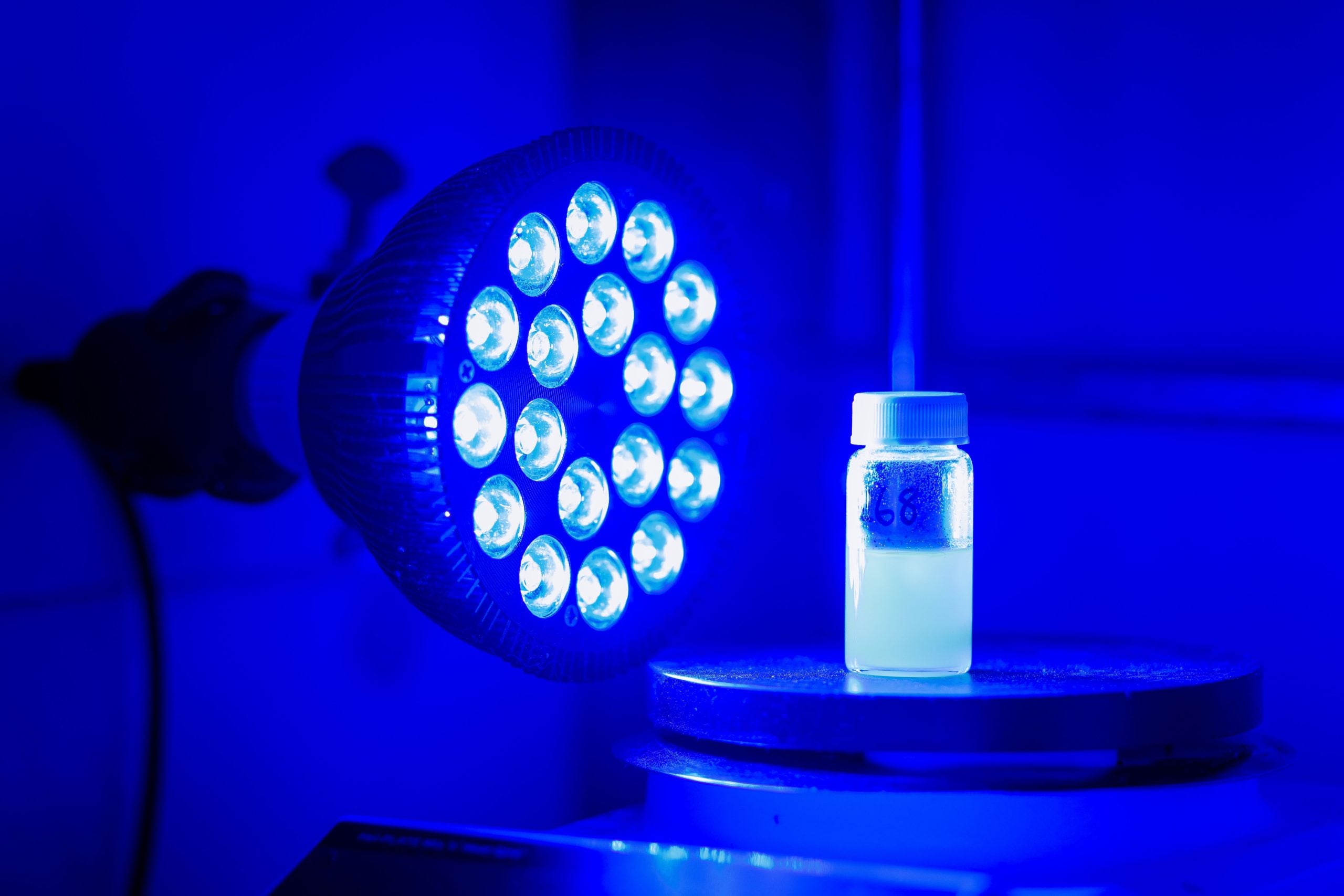
A blue light commonly used in aquariums and indoor gardens could help chemists solve one of drug discovery’s persistent challenges: building more intricate molecules without adding a long series of costly reactions.
Many medicines are based on small carbon-rich molecules whose biological effects depend heavily on their shape. Flat or relatively simple structures can work well, but more three-dimensional molecules may fit biological targets with greater precision. That can improve potency or selectivity, although producing these structures often takes additional time, materials, and chemical steps.
Researchers co-led by the University at Buffalo have now developed a visible-light reaction that makes two neighboring changes to a molecule at once. The study, published in Science, uses blue LEDs, a light-sensitive catalyst, and widely available molecules containing carbon-halogen bonds.
These carbon-halogen compounds are standard tools in organic chemistry. Chemists often remove the halogen and replace it with another group of atoms, allowing them to change a molecule’s properties. Under conventional conditions, however, the reaction typically alters only the carbon atom that held the halogen.
The new method reaches the carbon next to it as well.
When blue light activates the catalyst, the starting molecule briefly enters a more reactive state. During that window, chemists can attach new groups to two adjacent carbon atoms in a single operation. The result is a faster way to increase structural complexity using familiar materials and relatively mild conditions.
“We’ve used the relatively mild conditions of visible light to expand what chemists can do with a longtime organic chemistry staple,” says corresponding author Patricia Z. Musacchio, PhD, assistant professor of chemistry in the UB College of Arts and Sciences. “We hope this gives chemists a faster route to the complex molecules needed in drug discovery.”
Why changing two carbons matters
Carbon atoms form the framework of most small-molecule drugs. The atoms and chemical groups attached to that framework influence a compound’s shape, stability, solubility, and ability to interact with proteins in the body.
For medicinal chemists, each useful modification can help reveal whether a candidate molecule binds more strongly to its target or avoids unwanted interactions elsewhere. But every additional reaction also creates opportunities for low yields, difficult purification, or chemical failure.
Combining two modifications into one reaction could therefore save more than a single laboratory step. It may reduce the number of intermediate compounds that must be produced, isolated, and tested during the search for a promising drug candidate.
“The advantage is getting two modifications from a single reaction, whereas you normally only get one modification,” says the study’s other corresponding author, Jennifer Hirschi, PhD, associate professor of chemistry at Binghamton University. “More changes in fewer steps is crucial when creating small-molecule drugs.”
The chemistry behind the method starts with carbon-halogen bonds, one of the most familiar and useful features in synthetic chemistry. Reactions involving these bonds are commonly introduced in undergraduate courses, yet the light-driven approach allows them to produce a less conventional outcome.
Inside the “Buffalo boxes”
The experiments take place in small illuminated compartments that line the shelves of Musacchio’s laboratory. The team calls them “Buffalo boxes.”
Each box contains blue LEDs similar to those sold for fish tanks and indoor gardens. Vials placed inside receive controlled light exposure, which activates the catalyst and starts the reaction.
The use of visible light is important. Some photochemical reactions rely on higher-energy ultraviolet (UV) light, which can damage sensitive organic compounds or trigger unwanted side reactions.
“UV light could degrade or decompose the organic molecules that we’re making, so the visible light is a much more mild approach,” Musacchio says.
Visible-light chemistry has become an increasingly useful strategy for controlling reactions that may be difficult to achieve with heat alone. Instead of raising the temperature of an entire mixture, light can transfer energy through a photocatalyst and temporarily unlock new reaction pathways.
That pathway gives chemists access to a neighboring carbon atom that would normally remain unchanged.
Possible uses beyond one reaction
The researchers believe the strategy could eventually support other types of molecular transformations. They also plan to work with pharmaceutical companies to investigate whether the reaction can be adapted to compounds designed for particular drug targets.
“The hope is to not only make drugs faster, but also make more complex drugs that can target more challenging medicinal goals,” she says.
Reference: “Vicinal disubstitution of alkyl C–X synthons via alkene radical cation generation” by Yufei Zhang, Tamal Das, Zi Xuan, Mrinmoy Das, Hammed O. Bisiriyu, Alon Nudler, Ben D. Parasch, Matthew D. Resmini, Aubrey E. Graham, David F. Watson, Jennifer S. Hirschi and Patricia Z. Musacchio, 9 July 2026, Science.
The work was conducted with Worcester Polytechnic Institute, where Musacchio previously worked, and Binghamton University. It was supported by the National Institute of General Medical Sciences, part of the National Institutes of Health, and the National Science Foundation ACCESS program.
Never miss a breakthrough: Join the SciTechDaily newsletter.
Follow us on Google and Google News.