
Close Menu
    Facebook X (Twitter) Instagram
    SciTechDaily
    • Biology
    • Chemistry
    • Earth
    • Health
    • Physics
    • Science
    • Space
    • Technology
    Facebook X (Twitter) Pinterest YouTube RSS
    SciTechDaily
    Home»Chemistry»Amino Acid Organocatalyst Halves Synthesis of Prostaglandin-Class Drugs
    Chemistry

    Amino Acid Organocatalyst Halves Synthesis of Prostaglandin-Class Drugs

    By SciTechDailyAugust 16, 2012No Comments2 Mins Read
    Facebook Twitter Pinterest Telegram LinkedIn WhatsApp Email Reddit
    Share
    Facebook Twitter LinkedIn Pinterest Telegram Email Reddit
    Prostaglandin-shortcut-drug
    Using an amino acid organocatalyst cuts the synthesis of prostaglandin-class drugs in half.

    Prostaglandin class drugs are a class of hormone-like chemicals that influence processes including blood circulation and inflammation. Their use offers a way to churn out different versions of the molecules thanks to organocatalysis, an organic chemistry discipline that speeds up chemical reactions with the help of carbon-based molecules to avoid the drawbacks of metal catalysts.

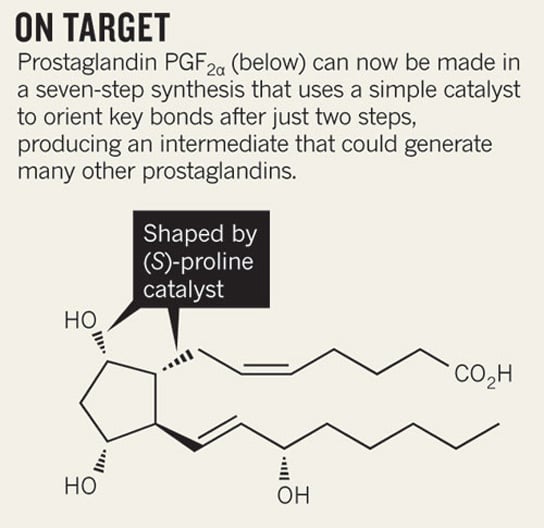
    The findings, published in the journal Nature, provide with researchers an easier way of accessing the family of molecules that includes prostaglandin. Previously, it took as much as 20 chemical steps to synthesize these types of drugs. The new synthesis described could build a prostaglandin molecule in as little as seven steps. Synthetic chemist Varinder Aggarwal, of the University of Bristol in the UK, realized that he could simplify the process by using the amino acid (S)-proline as an organocatalyst to make sure that the end result had the exact same shape.
    Prostaglandin-pfg-2-alpha

    The synthesized molecule in Aggarwal’s reaction could be used as a foundation to build the whole family of prostaglandin drugs. The reaction was even to create PGF2α, the most complicated prostaglandin. It’s also specific enough to produce left- or right-handed versions of the molecule, which is crucial in making an effective drug.

    The reaction is viable commercially since it doesn’t use any expensive and toxic metals as catalysts. However, further development is needed before it can be used to produce drugs on vaster scales.

    Reference: “Stereocontrolled organocatalytic synthesis of prostaglandin PGF2α in seven steps” by Graeme Coulthard, William Erb and Varinder K. Aggarwal, 15 August 2012, Nature.
    DOI: 10.1038/nature11411

    Never miss a breakthrough: Join the SciTechDaily newsletter.
    Follow us on Google and Google News.

    Biochemistry Cancer Catalysts Drugs
    Share. Facebook Twitter Pinterest LinkedIn Email Reddit

    Related Articles

    Breakthrough: Catalyzing a Zero-Carbon World by Harvesting Energy From Living Cells

    Ultra-Efficient Catalyst: Making Biodiesel From Dirty Old Cooking Oil Just Got Way Easier

    These Enzyme-Mimicking Polymers May Have Helped Start Life on Earth

    Scientists See the Inner Workings of the Enzyme Telomerase for the First Time

    Scientists Identify Specific Enzyme Related to Colon Cancer

    Yale Study Reveals Why BRCA Gene Resists Cancer Treatment

    Newly Discovered Protein Offers Vast Potential for Cancer Treatment

    New Drug Candidate Kills Cancer Cells Better Than Cisplatin

    Working to Recycle Greenhouse Gases

    Leave A Reply Cancel Reply

    • Facebook
    • Twitter
    • Pinterest
    • YouTube

    Don't Miss a Discovery

    Subscribe for the Latest in Science & Tech!

    Trending News

    Scientists Discover 132-Million-Year-Old Dinosaur Tracks on South Africa’s Coast

    Scientists Uncover the Secret Ingredient Behind the Spark That May Have Started Life on Earth

    Physicists Observe Matter in Two Places at Once in Mind-Bending Quantum Experiment

    Stanford Scientists Discover Hidden Brain Circuit That Fuels Chronic Pain

    New Study Reveals Why Ozempic Works Better for Some People Than Others

    Climate Change Is Altering a Key Greenhouse Gas in a Way Scientists Didn’t Expect

    New Study Suggests Gravitational Waves May Have Created Dark Matter

    Scientists Discover Why the Brain Gets Stuck in Schizophrenia

    Follow SciTechDaily
    • Facebook
    • Twitter
    • YouTube
    • Pinterest
    • Newsletter
    • RSS
    SciTech News
    • Biology News
    • Chemistry News
    • Earth News
    • Health News
    • Physics News
    • Science News
    • Space News
    • Technology News
    Recent Posts
    • New “Nanozyme Hypothesis” Could Rewrite the Story of Life’s Origins
    • Anatomy Isn’t Finished: The Human Body Still Holds Secrets
    • Researchers Discover Long-Lost Words of Ancient Greek Philosopher After 2,000 Years
    • New Study Warns: Asia’s Lifeline Water Source Is Rapidly Draining
    • 100 Times Worse? Thawing Permafrost May Be More Dangerous Than Previously Thought
    Copyright © 1998 - 2026 SciTechDaily. All Rights Reserved.
    • Science News
    • About
    • Contact
    • Editorial Board
    • Privacy Policy
    • Terms of Use

    Type above and press Enter to search. Press Esc to cancel.