
Close Menu
    Facebook X (Twitter) Instagram
    SciTechDaily
    • Biology
    • Chemistry
    • Earth
    • Health
    • Physics
    • Science
    • Space
    • Technology
    Facebook X (Twitter) Pinterest YouTube RSS
    SciTechDaily
    Home»Physics»Brand New Physics of Superconducting Metals – Busted
    Physics

    Brand New Physics of Superconducting Metals – Busted

    By Lancaster UniversityMay 12, 20211 Comment3 Mins Read
    Facebook Twitter Pinterest Telegram LinkedIn WhatsApp Email Reddit
    Share
    Facebook Twitter LinkedIn Pinterest Telegram Email Reddit
    Atoms Electrons Concept
    Scientists have found evidence supporting a simple explanation for the field effect in superconducting metals, involving electron injection without the need for novel physics.

    Physicists at Lancaster University have shown that the recently reported “electrostatic field effect” in superconductors is not a groundbreaking discovery but rather a result of hot electron injection.

    Lancaster scientists have demonstrated that other physicists’ recent “discovery” of the field effect in superconductors is nothing but hot electrons after all.

    A team of scientists in the Lancaster Physics Department has found new and compelling evidence that the observation of the field effect in superconducting metals by another group can be explained by a simple mechanism involving the injection of the electrons, without the need for novel physics.

    Dr. Sergey Kafanov, who initiated this experiment, said: “Our results unambiguously refute the claim of the electrostatic field effect claimed by the other group. This gets us back on the ground and helps maintain the health of the discipline.”

    The experimental team also includes Ilia Golokolenov, Andrew Guthrie, Yuri Pashkin, and Viktor Tsepelin.

    Their work is published in the latest issue of Nature Communications.
    Superconducting Circuit Information Processing
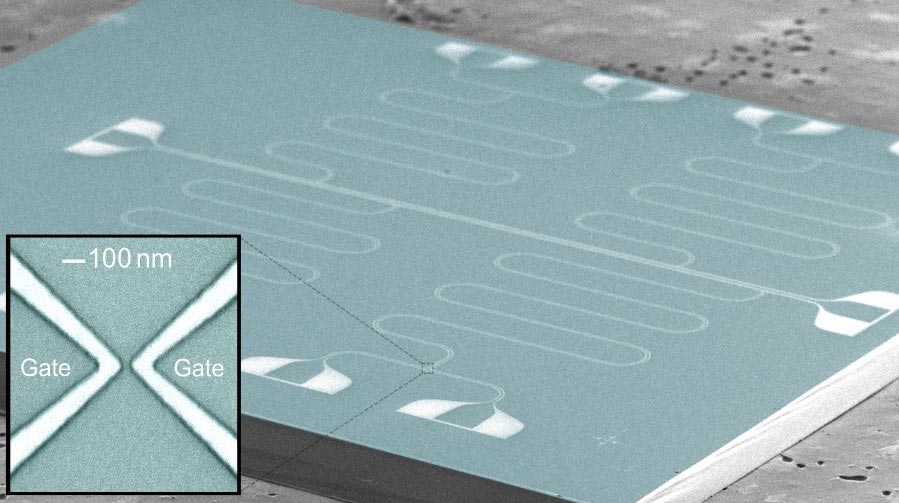
    Superconducting circuits find applications in sensing and information processing. Credit: Lancaster University

    Superconductivity and Electric Fields

    When certain metals are cooled to a few degrees above absolute zero, their electrical resistance vanishes — a striking physical phenomenon known as superconductivity. Many metals, including vanadium, which was used in the experiment, are known to exhibit superconductivity at sufficiently low temperatures.

    For decades it was thought that the exceptionally low electrical resistance of superconductors should make them practically impervious to static electric fields, owing to the way the charge carriers can easily arrange themselves to compensate for any external field.

    It therefore came as a shock to the physics community when a number of recent publications claimed that sufficiently strong electrostatic fields could affect superconductors in nanoscale structures — and attempted to explain this new effect with corresponding new physics. A related effect is well known in semiconductors and underpins the entire semiconductor industry.

    Precision Experiment in a Microwave Cavity

    The Lancaster team embedded a similar nanoscale device into a microwave cavity, allowing them to study the alleged electrostatic phenomenon at much shorter timescales than previously investigated. At short timescales, the team could see a clear increase in the noise and energy loss in the cavity — the properties strongly associated with the device temperature. They propose that at intense electric fields, high-energy electrons can “jump” into the superconductor, raising the temperature and therefore increasing the dissipation.

    This simple phenomenon can concisely explain the origin of the “electrostatic field effect” in nanoscale structures, without any new physics.

    Reference: “On the origin of the controversial electrostatic field effect in superconductors” by I. Golokolenov, A. Guthrie, S. Kafanov, Yu. A. Pashkin and V. Tsepelin, 12 May 2021, Nature Communications.
    DOI: 10.1038/s41467-021-22998-0

    Never miss a breakthrough: Join the SciTechDaily newsletter.
    Follow us on Google and Google News.

    Electromagnetics Lancaster University Nanotechnology Popular Superconductor
    Share. Facebook Twitter Pinterest LinkedIn Email Reddit

    Related Articles

    Scientists Just Found a Mind-Bending Way to Control Electrons

    MIT Physicists Discover a Family of “Magic” Superconducting Graphene Structures

    Physicist’s Radical Solution to Century Old Problem of Radiation Reaction – With Controversial Implications

    MIT Physicists Discover “Magic-Angle” Trilayer Graphene May Be a Rare, Magnet-Proof Superconductor

    Manipulating Magnets at the Atomic Scale for Fast and Energy-Efficient Future Data Processing

    Harvard Scientists Trilayer Graphene Breakthrough Opens the Door for High Temperature Superconductors

    Exotic Particles: Why There Is No Speed Limit in the Superfluid Universe

    A New Phase of Matter Known As “Time Crystals” Observed Interacting for the First Time Ever

    Researchers Surprised When Nano-Guitar String Plays Itself – Nano-Electronic Circuit Vibrates Without Any External Force

    1 Comment

    1. xABBAAA on May 12, 2021 10:02 am

      … capillary in a tree what a Universe of possibilities….

      Reply
    Leave A Reply Cancel Reply

    • Facebook
    • Twitter
    • Pinterest
    • YouTube

    Don't Miss a Discovery

    Subscribe for the Latest in Science & Tech!

    Trending News

    Breakthrough Bowel Cancer Trial Leaves Patients Cancer-Free for Nearly 3 Years

    Natural Compound Shows Powerful Potential Against Rheumatoid Arthritis

    100,000-Year-Old Neanderthal Fossils in Poland Reveal Unexpected Genetic Connections

    Simple “Gut Reset” May Prevent Weight Gain After Ozempic or Wegovy

    2.8 Days to Disaster: Scientists Warn Low Earth Orbit Could Suddenly Collapse

    Common Food Compound Shows Surprising Power Against Superbugs

    5 Simple Ways To Remember More and Forget Less

    The Atomic Gap That Could Cost the Semiconductor Industry Billions

    Follow SciTechDaily
    • Facebook
    • Twitter
    • YouTube
    • Pinterest
    • Newsletter
    • RSS
    SciTech News
    • Biology News
    • Chemistry News
    • Earth News
    • Health News
    • Physics News
    • Science News
    • Space News
    • Technology News
    Recent Posts
    • Scientists Print Artificial Neurons That Can Talk to the Brain
    • Bowel and Ovarian Cancers Are Dramatically Rising in Young Adults and Scientists Aren’t Sure Why
    • Alzheimer’s May Begin Decades Earlier Than You Think, New Mayo Clinic Study Finds
    • The Hidden Risk of Taking Breaks From Weight-Loss Drugs Like Ozempic
    • Total Solar Eclipse Made Cities Go Eerily Quiet Beneath the Surface
    Copyright © 1998 - 2026 SciTechDaily. All Rights Reserved.
    • Science News
    • About
    • Contact
    • Editorial Board
    • Privacy Policy
    • Terms of Use

    Type above and press Enter to search. Press Esc to cancel.