
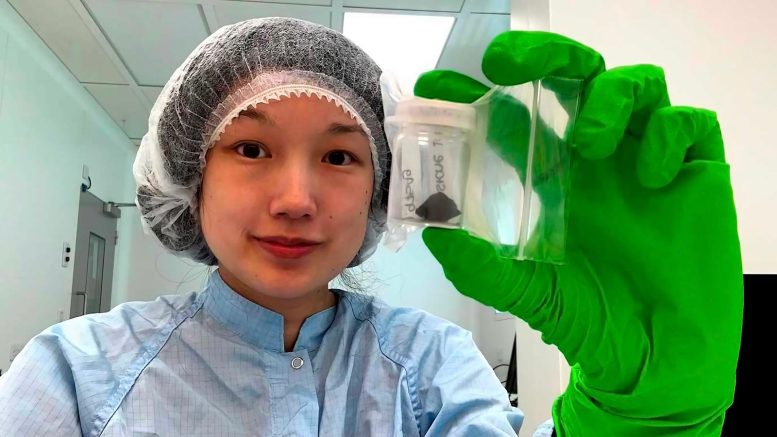
New research has been published on the organic analysis of the Winchcombe meteorite which crashed landed onto a driveway in Winchcombe, Gloucestershire, England in 2021. The research, led by Dr. Queenie Chan, from the Department of Earth Sciences at Royal Holloway, University of London, found organic compounds from space which holds the secrets to the origin of life.
In the study, the analysis found a range of organic matter which reveals that the meteorite was once from part of an asteroid where liquid water occurred, and if that asteroid had been given access to the water, a chemical reaction could have occurred leading to more molecules turning into amino acids and protein — the building blocks of life.
The Winchcombe meteorite is a rare carbon-rich chondritic meteorite (approximately four percent of all recovered meteorites, containing up to 3.5 weight percent of carbon) and is the first-ever meteorite of this type to be found in the UK with an observed meteorite fall event, with more than 1,000 eyewitnesses and numerous footages of the fireball.
The amino acid abundance of Winchcombe is ten times lower than other types of carbonaceous chondritic meteorites and was a challenge to study due to the limited detection of amino acids, but with the meteorite so promptly recovered and curated, the team was able to study the organic content of the meteorite prior to its interaction with the Earth’s environment. The organic matter suggests the meteorite could represent a class of unique, weak meteorites not previously studied.
Dr. Queenie Chan, at Royal Holloway, University of London, said: “Meteorite fall happens all year round, however, what makes this meteorite fall so unique is that this is the first meteorite to have been observed by numerous eyewitnesses, recorded, and recovered in the UK in the last 30 years.
“Winchcombe belongs to a rare type of carbonaceous meteorite which typically contains a rich inventory of organic compounds and water. The first Winchcombe meteorite stone was recovered within 12 hours of the fireball observation event and properly curated to restrict any terrestrial contamination. This allowed us to study the organic signature truly essential to the meteorite itself.
Unlocking the Origins of Life Through Organic Analysis
“Studying the organic inventory of the Winchcombe meteorite provided us with a window into the past, how simple chemistry kick-started the origin of life at the birth of our solar system. Discovering these life’s precursor organic molecules allowed us to comprehend the fall of similar material to the surface of the Earth, prior to the emergence of life on our own planet.
“It was an honor to be leading the team on the organic analysis of the first-ever successful carbonaceous meteorite recovery in the United Kingdom. It was a pleasure and an exciting journey to be working with highly skilled and enthusiastic scientists across the country.”
Reference: “The amino acid and polycyclic aromatic hydrocarbon compositions of the promptly recovered CM2 Winchcombe carbonaceous chondrite” by Queenie H. S. Chan, Jonathan S. Watson, Mark A. Sephton, Áine C. O’Brien and Lydia J. Hallis, 9 January 2023, Meteoritics & Planetary Science.
DOI: 10.1111/maps.13936
The wider research of the organic analysis of the Winchcombe meteorite in this study involved collaborations with Imperial College London and the University of Glasgow.
Never miss a breakthrough: Join the SciTechDaily newsletter.
Follow us on Google and Google News.
5 Comments
Not sure how these scientists can claim it didn’t interact with Earth’s environment after falling through the atmosphere and crashing into the ground. The meteorite weighs only two pounds – not much material to shield the inside.
There is a constant flow of organic material coming into our atmosphere. Recent tests have proved it. It’s not rare either, it rains down on us constantly.
If ever a meteorite DOESN’T “crash land,” we’ll know the end is near.
Uh, no. Unless it has phosphates no life will form – that is life as we understand it capable of novelty through DNA expression. This is a joke.
No self-replicating cell, no life.