
Close Menu
    Facebook X (Twitter) Instagram
    SciTechDaily
    • Biology
    • Chemistry
    • Earth
    • Health
    • Physics
    • Science
    • Space
    • Technology
    Facebook X (Twitter) Pinterest YouTube RSS
    SciTechDaily
    Home»Space»Cassini Views Objects Creating Holes in Saturn’s F Ring
    Space

    Cassini Views Objects Creating Holes in Saturn’s F Ring

    By Jia-Rui C. Cook, Jet Propulsion LaboratoryApril 24, 2012No Comments4 Mins Read
    Facebook Twitter Pinterest Telegram LinkedIn WhatsApp Email Reddit
    Share
    Facebook Twitter LinkedIn Pinterest Telegram Email Reddit
    Cassini Saturn’s F Ring
    Images from NASA’s Cassini spacecraft have revealed half-mile-sized (kilometer-sized) objects punching through parts of Saturn’s F ring, leaving glittering trails behind them. These trails in the rings, which scientists are calling “mini-jets,” fill in a missing link in our story of the curious behavior of the F ring. Credit: NASA

    Scientists working with images from NASA’s Cassini spacecraft have discovered strange half-mile-sized (kilometer-sized) objects punching through parts of Saturn’s F ring, leaving glittering trails behind them. These trails in the rings, which scientists are calling “mini-jets,” fill in a missing link in our story of the curious behavior of the F ring. The results will be presented tomorrow at the European Geosciences Union meeting in Vienna, Austria.

    Saturn's F ring
    This set of six images obtained by NASA’s Cassini spacecraft shows trails that were dragged out from Saturn’s F ring by objects about a half mile (1 kilometer) in diameter. Scientists have seen more than 500 of these kinds of trails in over 20,000 images collected by Cassini from 2004 to 2011. The trails seen in this set are typical of the entire collection. From left to right in the top row, the trails in these images are 18, 85, and 96 miles long (29, 136, and 155 kilometers long). In the bottom row from left to right, the trails are 43, 129, and 32 miles long (69, 207, and 51 kilometers long). Credit: NASA/JPL-Caltech/SSI/QMUL

    “I think the F ring is Saturn’s weirdest ring, and these latest Cassini results go to show how the F ring is even more dynamic than we ever thought,” said Carl Murray, a Cassini imaging team member based at Queen Mary University of London, England. “These findings show us that the F ring region is like a bustling zoo of objects from a half mile [kilometer] in size to moons like Prometheus a hundred miles [kilometers] in size, creating a spectacular show.”

    Scientists have known that relatively large objects like Prometheus (as long as 92 miles, or 148 kilometers, across) can create channels, ripples and snowballs in the F ring. But scientists didn’t know what happened to these snowballs after they were created, Murray said. Some were surely broken up by collisions or tidal forces in their orbit around Saturn, but now scientists have evidence that some of the smaller ones survive, and their differing orbits mean they go on to strike through the F ring on their own.
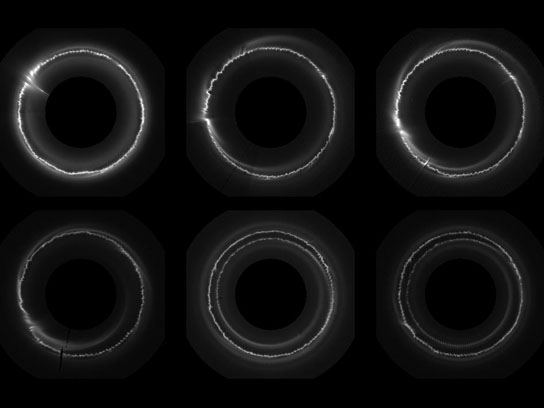
    constant change in Saturn's wavy, wiggly F ring
    The constant change in Saturn’s wavy, wiggly F ring is on display in this set of images obtained by NASA’s Cassini spacecraft. Credit: NASA/JPL-Caltech/SSI/QMUL

    These small objects appear to collide with the F ring at gentle speeds – something on the order of about 4 mph (2 meters per second). The collisions drag glittering ice particles out of the F ring with them, leaving a trail typically 20 to 110 miles (40 to 180 kilometers) long. Murray’s group happened to see a tiny trail in an image from Jan. 30, 2009, and tracked it over eight hours. The long footage confirmed the small object originated in the F ring, so they went back through the Cassini image catalog to see if the phenomenon was frequent.

    “The F ring has a circumference of 550,000 miles [881,000 kilometers], and these mini-jets are so tiny they took quite a bit of time and serendipity to find,” said Nick Attree, a Cassini imaging associate at Queen Mary. “We combed through 20,000 images and were delighted to find 500 examples of these rogues during just the seven years Cassini has been at Saturn.”

    In some cases, the objects traveled in packs, creating mini-jets that looked quite exotic, like the barb of a harpoon. Other new images show grand views of the entire F ring, showing the swirls and eddies that ripple around the ring from all the different kinds of objects moving through and around it.

    “Beyond just showing us the strange beauty of the F ring, Cassini’s studies of this ring help us understand the activity that occurs when solar systems evolve out of dusty disks that are similar to, but obviously much grander than, the disk we see around Saturn,” said Linda Spilker, Cassini project scientist based at NASA’s Jet Propulsion Laboratory, Pasadena, California. “We can’t wait to see what else Cassini will show us in Saturn’s rings.”

    Never miss a breakthrough: Join the SciTechDaily newsletter.
    Follow us on Google and Google News.

    Cassini-Huygens Mission JPL NASA Saturn
    Share. Facebook Twitter Pinterest LinkedIn Email Reddit

    Related Articles

    New Cassini Image of Saturn and Its Rings

    NASA’s Cassini Spots Lightning in Saturn’s Northern Hemisphere

    Cassini Data Reveals Likely Subsurface Ocean on Titan

    Heat from Within the Planet Powers Saturn’s Jet Streams

    The Mysterious Dusty Plasma Plumes of Saturn’s Moon Enceladus

    Saturn’s Moon Phoebe Has Planet-Like Qualities

    Cassini Explores Titan’s Lake, Similarities to Etosha Salt Pan

    Cassini Views Saturn’s Moons Enceladus and Tethys

    Cassini Data Helps Explain Saturn’s Stress on Enceladus

    Leave A Reply Cancel Reply

    • Facebook
    • Twitter
    • Pinterest
    • YouTube

    Don't Miss a Discovery

    Subscribe for the Latest in Science & Tech!

    Trending News

    One of the Universe’s Largest Stars May Be Getting Ready To Explode

    Scientists Discover Enzyme That Could Supercharge Ozempic-Like Weight Loss Drugs

    Popular Sweetener Linked to DNA Damage – “It’s Something You Should Not Be Eating”

    Ancient “Rock” Microbes May Reveal How Complex Life Began

    Researchers Capture Quantum Interference in One of Nature’s Rarest Atoms

    “A Plague Is Upon Us”: The Mass Death That Changed an Ancient City Forever

    Scientists Discover Game-Changing New Way To Treat High Cholesterol

    This Small Change to Your Exercise Routine Could Be the Secret to Living Longer

    Follow SciTechDaily
    • Facebook
    • Twitter
    • YouTube
    • Pinterest
    • Newsletter
    • RSS
    SciTech News
    • Biology News
    • Chemistry News
    • Earth News
    • Health News
    • Physics News
    • Science News
    • Space News
    • Technology News
    Recent Posts
    • New Study Challenges 40-Year Puzzle About Childhood Body Fat
    • 20-Year Study Finds Daily Multivitamins Don’t Extend Lifespan
    • Landmark Study Links Never Marrying to Significantly Higher Cancer Risk
    • Revolutionary Imaging Technique Unlocks Secrets of Matter at Extreme Speeds
    • Where Does Mass Come From? Scientists Find Evidence of a New Exotic Nuclear State
    Copyright © 1998 - 2026 SciTechDaily. All Rights Reserved.
    • Science News
    • About
    • Contact
    • Editorial Board
    • Privacy Policy
    • Terms of Use

    Type above and press Enter to search. Press Esc to cancel.