
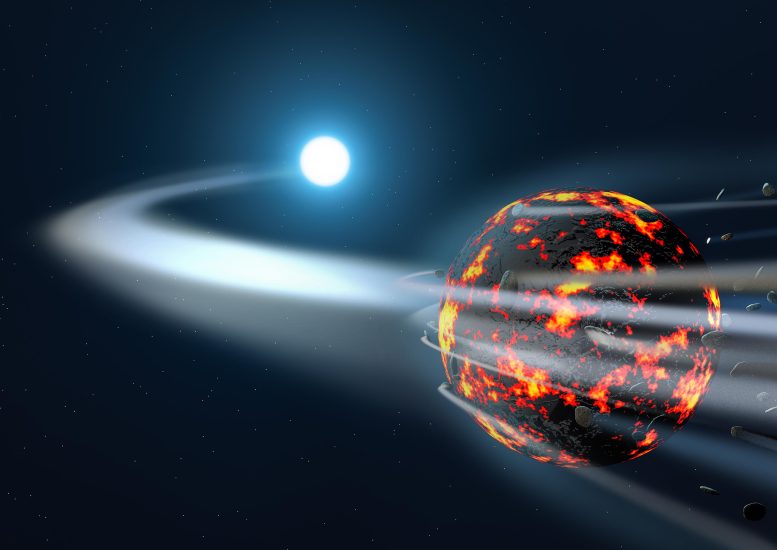
Astronomers have discovered that planet formation in our young Solar System began far earlier than previously thought, with planet building blocks growing at the same time as their parent star.
According to a study of some of the oldest stars in the Universe, the building blocks of planets like Jupiter and Saturn likely begin to form while a young star is growing. It had been thought that planets only form once a star has reached its final size, but new results, published in the journal Nature Astronomy, suggest that stars and planets ‘grow up’ together.
“Some white dwarfs are amazing laboratories, because their thin atmospheres are almost like celestial graveyards.” Amy Bonsor
The research, led by the University of Cambridge, changes our understanding of how planetary systems, including our own Solar System, formed, potentially solving a major puzzle in astronomy.
“We have a pretty good idea of how planets form, but one outstanding question we’ve had is when they form: does planet formation start early, when the parent star is still growing, or millions of years later?” said Dr. Amy Bonsor from Cambridge’s Institute of Astronomy, the study’s first author.
To attempt to answer this question, Bonsor and her colleagues studied the atmospheres of white dwarf stars – the ancient, faint remnants of stars like our Sun – to investigate the building blocks of planet formation. The study also involved researchers from the University of Oxford, the Ludwig-Maximilians-Universität in Munich, the University of Groningen, and the Max Planck Institute for Solar System Research, Gottingen.
“Some white dwarfs are amazing laboratories, because their thin atmospheres are almost like celestial graveyards,” said Bonsor.
Investigating Planet Formation Through Polluted White Dwarfs
Normally, the interiors of planets are out of reach of telescopes. But a special class of white dwarfs – known as ‘polluted’ systems – have heavy elements such as magnesium, iron, and calcium in their normally clean atmospheres.
These elements must have come from small bodies like asteroids left over from planet formation, which crashed into the white dwarfs and burned up in their atmospheres. As a result, spectroscopic observations of polluted white dwarfs can probe the interiors of those torn-apart asteroids, giving astronomers direct insight into the conditions in which they formed.
Planet formation is believed to begin in a protoplanetary disc – made primarily of hydrogen, helium, and tiny particles of ices and dust – orbiting a young star. According to the current leading theory on how planets form, the dust particles stick to each other, eventually forming larger and larger solid bodies. Some of these larger bodies will continue to accrete, becoming planets, and some remain as asteroids, like those that crashed into the white dwarfs in the current study.
Evidence of Early Differentiation in Asteroids
The researchers analyzed spectroscopic observations from the atmospheres of 200 polluted white dwarfs from nearby galaxies. According to their analysis, the mixture of elements seen in the atmospheres of these white dwarfs can only be explained if many of the original asteroids had once melted, which caused heavy iron to sink to the core while the lighter elements floated on the surface. This process, known as differentiation, is what caused the Earth to have an iron-rich core.
“The cause of the melting can only be attributed to very short-lived radioactive elements, which existed in the earliest stages of the planetary system but decay away in just a million years,” said Bonsor. “In other words, if these asteroids were melted by something which only exists for a very brief time at the dawn of the planetary system, then the process of planet formation must kick off very quickly.”
The study suggests that the early-formation picture is likely to be correct, meaning that Jupiter and Saturn had plenty of time to grow to their current sizes.
“Our study complements a growing consensus in the field that planet formation got going early, with the first bodies forming concurrently with the star,” said Bonsor. “Analyses of polluted white dwarfs tell us that this radioactive melting process is a potentially ubiquitous mechanism affecting the formation of all extrasolar planets.
“This is just the beginning – every time we find a new white dwarf, we can gather more evidence and learn more about how planets form. We can trace elements like nickel and chromium and say how big an asteroid must have been when it formed its iron core. It’s amazing that we’re able to probe processes like this in exoplanetary systems.”
Reference: “Rapid formation of exoplanetesimals revealed by white dwarfs” by Amy Bonsor, Tim Lichtenberg, Joanna Dra̧żkowska and Andrew M. Buchan, 14 November 2022, Nature Astronomy.
DOI: 10.1038/s41550-022-01815-8
Amy Bonsor is a Royal Society University Research Fellow at the University of Cambridge. The research was supported in part by the Royal Society, the Simons Foundation, and the European Research Council.
Never miss a breakthrough: Join the SciTechDaily newsletter.
Follow us on Google and Google News.
10 Comments
These findings also confirm yet another prediction of plasma cosmology which postulated years ago that the stars and planets formed simultaneously from plasma filaments. We all need to be at least suspicious of the standard model and open to the fact that we may have taken a wrong path over 100 years ago even though that may unravel much of what we thought we knew.
Instead of impacts could these heavy elements instead have come from Birkland Current foci? Unraveling this ‘standard’ science explanation has already taken decades longer after electrical revelations, and at this rate it will never be scientifically corrected.
I’ve read that science is only replaced upon the death of its proponents, and isn’t the rest of the world far ahead of the US in working hypotheses?
noice
noice
We’re no strangers to love
You know the rules and so do I (do I)
A full commitment’s what I’m thinking of
You wouldn’t get this from any other guy
I just wanna tell you how I’m feeling
Gotta make you understand
Never gonna give you up
Never gonna let you down
Never gonna run around and desert you
Never gonna make you cry
Never gonna say goodbye
Never gonna tell a lie and hurt you
We’ve known each other for so long
Your heart’s been aching, but you’re too shy to say it (say it)
Inside, we both know what’s been going on (going on)
We know the game and we’re gonna play it
And if you ask me how I’m feeling
Don’t tell me you’re too blind to see
Never gonna give you up
Never gonna let you down
Never gonna run around and desert you
Never gonna make you cry
Never gonna say goodbye
Never gonna tell a lie and hurt you
Never gonna give you up
Never gonna let you down
Never gonna run around and desert you
Never gonna make you cry
Never gonna say goodbye
Never gonna tell a lie and hurt you
We’ve known each other for so long
Your heart’s been aching, but you’re too shy to say it (to say it)
Inside, we both know what’s been going on (going on)
We know the game and we’re gonna play it
I just wanna tell you how I’m feeling
Gotta make you understand
Never gonna give you up
Never gonna let you down
Never gonna run around and desert you
Never gonna make you cry
Never gonna say goodbye
Never gonna tell a lie and hurt you
Never gonna give you up
Never gonna let you down
Never gonna run around and desert you
Never gonna make you cry
Never gonna say goodbye
Never gonna tell a lie and hurt you
Never gonna give you up
Never gonna let you down
Never gonna run around and desert you
Never gonna make you cry
Never gonna say goodbye
Never gonna tell a lie and hurt you
Source: Musixmatch
no rick roll
heheheheheheheehehehheehehehheheh
what do you want to learn about today
space
why
idk
well i guess i cant teach you
then leave
principals office now
whatever
i love you baby and if it’s quite alright
i need you baby
if you don’t shut your mouth im gonna shut it for you
PUNK!
The Sun and Planets all grow larger at an ever increasing rate. The grow on a Cycle that is N.354 Net Galactic Rotational Cycles of 186.598 million years per cycle.
You take a Base Number that starts with 1.003 XXX xxx and raise it to the elapsed time in millions of year and this equals the Radius in meters.
( Base # ) ^ ( elapsed age ) = Radius (meters). Te Sun is 31.354 X 186.598 = 5850.593692 million years old. The Radius is 695,508,000 meters, so you can solve for the Base Number by using Natural Logs of both sides of the equation. The older the sphere, the bigger the base number. After numerous attempts, I finally decided that I must use two orbs that are vastly different in age, so going to the other end, Adrastea is a puny orb of Jupiter, and it is only 14.354 X 186.598 million years old, and has a radius of just under 8,227.5 meters, so it’s Base number is smaller, but still starts with the 1.003 XXX xxx. Now all you have to do is group all the other orbs by age. There a just under 90 of them, and do the calculation, and find the base number for each group. I am not going to do all the work for you