

A seemingly quiet star just gave up one of the universe’s best-kept secrets: a massive gas giant forming in its dusty disc.
For years, MP Mus appeared featureless—no planets, no gaps, no drama. But when scientists used deeper ALMA imaging and paired it with stellar wobble data from Gaia, a dramatic picture emerged: a planet up to 10 times the size of Jupiter, hiding in plain sight. This marks the first time such a hidden world was detected using this method, suggesting many more young, camouflaged planets could be waiting in the fog around other stars.
Hidden Giant: A Massive Planet Discovered in a Dusty Disc
Astronomers have discovered a massive planet, estimated to be between three and ten times the size of Jupiter, hidden within the thick disc of gas and dust surrounding a young star.
The star, known as MP Mus, was previously believed to be alone, with no signs of orbiting planets. Earlier observations showed nothing more than a smooth, featureless cloud encircling it.
But new data paints a very different picture. Using detailed observations from the Atacama Large Millimeter/submillimeter Array (ALMA), along with measurements from the European Space Agency’s Gaia mission, scientists found evidence of a giant planet orbiting the star.
Led by researchers at the University of Cambridge, the international team detected a gas giant embedded in what’s called a protoplanetary disc — a flat, rotating band of gas, ice and dust where new planets begin to form. This is the first time that data from Gaia has been used to identify a planet inside such a disc. The findings, published in Nature Astronomy, point to a promising new method for finding young planets still in the process of forming.
How Planets Form in Protoplanetary Discs
Studying the formation of planets inside protoplanetary discs helps scientists better understand how our own Solar System came to be. In a process called core accretion, small particles are pulled together by gravity, gradually building up into larger objects like asteroids and planets. As new planets grow, they disturb the disc around them, carving out noticeable gaps—similar to grooves on a vinyl record.
However, observing these young planets is extremely challenging, due to the interference from the gas and dust in the disc. To date, only three robust detections of young planets in a protoplanetary disc have been made.
Dr. Álvaro Ribas from Cambridge’s Institute of Astronomy, who led the research, specialises in studying protoplanetary discs. “We first observed this star at the time when we learned that most discs have rings and gaps, and I was hoping to find features around MP Mus that could hint at the presence of a planet or planets,” he said.
An Unexpectedly Boring Disc Raises Questions
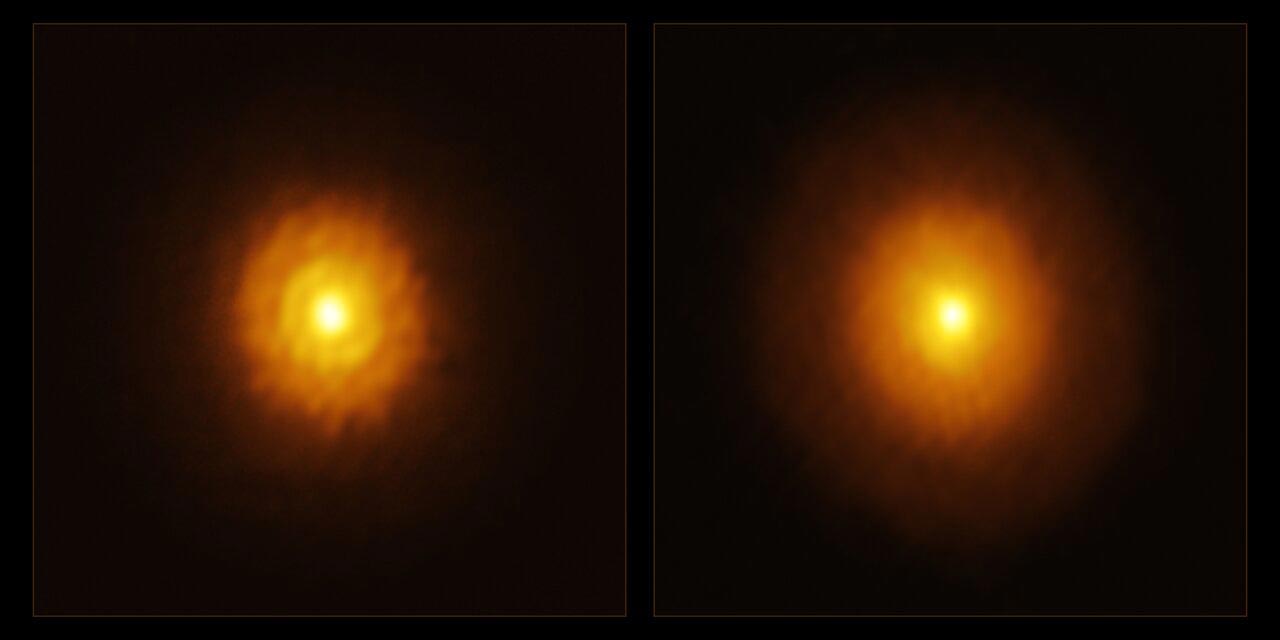
Using ALMA, Ribas observed the protoplanetary disc around MP Mus (PDS 66) in 2023. The results showed a young star seemingly all alone in the universe. Its surrounding disc showed none of the gaps where planets might be forming, and was completely flat and featureless.
“Our earlier observations showed a boring, flat disc,” said Ribas. “But this seemed odd to us, since the disc is between seven and ten million years old. In a disc of that age, we would expect to see some evidence of planet formation.”
Now, Ribas and his colleagues from Germany, Chile, and France have given MP Mus another chance. Once again using ALMA, they observed the star at the 3mm range, a longer wavelength than the earlier observations, allowing them to probe deeper into the disc.
The new observations turned up a cavity close to the star and two gaps further out, which were obscured in the earlier observations, suggesting that MP Mus may not be alone after all.
At the same time, Miguel Vioque, a researcher at the European Southern Observatory (ESO), was uncovering another piece of the puzzle. Using data from Gaia, he found MP Mus was ‘wobbling’.
“My first reaction was that I must have made a mistake in my calculations, because MP Mus was known to have a featureless disc,” said Vioque. “I was revising my calculations when I saw Álvaro give a talk presenting preliminary results of a newly-discovered inner cavity in the disc, which meant the wobbling I was detecting was real and had a good chance of being caused by a forming planet.”
Using a combination of Gaia and ALMA observations, along with computer modeling, the researchers say the wobbling is likely caused by a gas giant, less than ten times the mass of Jupiter, orbiting the star at a distance between one and three times the distance of Earth from the Sun.
“Our modeling work showed that if you put a giant planet inside the newfound cavity, you can also explain the Gaia signal,” said Ribas. “And using the longer ALMA wavelengths allowed us to see structures we couldn’t see before.”
This is the first time an exoplanet embedded in a protoplanetary disc has been indirectly discovered in this way – by combining precise star movement data from Gaia with deep observations of the disc. It also means that many more hidden planets might exist in other discs, just waiting to be found.
“We think this might be one of the reasons why it’s hard to detect young planets in protoplanetary discs, because in this case, we needed the ALMA and Gaia data together,” said Ribas. “The longer ALMA wavelength is incredibly useful, but to observe at this wavelength requires more time on the telescope.”
Ribas says that upcoming upgrades to ALMA, as well as future telescopes such as the next generation Very Large Array (ngVLA), may be used to look deeper into more discs and better understand the hidden population of young planets, which could, in turn, help us learn how our own planet may have formed.
Reference: “A young gas giant and hidden substructures in a protoplanetary disk” by Álvaro Ribas, Miguel Vioque, Francesco Zagaria, Cristiano Longarini, Enrique Macías, Cathie J. Clarke, Sebastián Pérez, John Carpenter, Nicolás Cuello and Itziar de Gregorio-Monsalvo, 14 July 2025, Nature Astronomy.
DOI: 10.1038/s41550-025-02576-w
The research was supported in part by the European Union’s Horizon Program, the European Research Council, and the UK Science and Technology Facilities Council (STFC), part of UK Research and Innovation (UKRI).
Never miss a breakthrough: Join the SciTechDaily newsletter.
Follow us on Google and Google News.
3 Comments
THese articles are very interesting . Thank you.
If we could detect whether these exoplanets had poly aromatic hydrocarbons and crystalline water, as opposed to amorphous water, that would be insightful.
From the paper: “The detection of dust substructures in MP Mus, thanks to the lower optical depths at longer wavelengths, suggests that rings and gaps are even more abundant than previously thought.”