

Close Menu
    Facebook X (Twitter) Instagram
    SciTechDaily
    • Biology
    • Chemistry
    • Earth
    • Health
    • Physics
    • Science
    • Space
    • Technology
    Facebook X (Twitter) Pinterest YouTube RSS
    SciTechDaily
    Home»Space»The Final Puzzle Piece: Mysterious Missing Component in the Clouds of Venus Revealed
    Space

    The Final Puzzle Piece: Mysterious Missing Component in the Clouds of Venus Revealed

    By University of CambridgeJanuary 27, 2024No Comments3 Mins Read
    Facebook Twitter Pinterest Telegram LinkedIn WhatsApp Email Reddit
    Share
    Facebook Twitter LinkedIn Pinterest Telegram Email Reddit
    Mysterious Component Clouds
    Recent research by the University of Cambridge has unveiled the mystery behind Venus’s cloud compositions, identifying a combination of rhomboclase and acid ferric sulfate as the cause of unique UV absorption patterns. Credit: SciTechDaily.com

    Researchers may have identified the missing component in the chemistry of the Venusian clouds that would explain their color and ‘splotchiness’ in the UV range, solving a longstanding mystery.

    What are the clouds of Venus made of? Scientists know they are mainly made of sulfuric acid droplets, with some water, chlorine, and iron. Their concentrations vary with height in the thick and hostile Venusian atmosphere. But until now they have been unable to identify the missing component that would explain the clouds’ patches and streaks, only visible in the UV range.

    Breakthrough in Venusian Research

    In a study published in Science Advances, researchers from the University of Cambridge synthesized iron-bearing sulfate minerals that are stable under the harsh chemical conditions in the Venusian clouds. Spectroscopic analysis revealed that a combination of two minerals, rhomboclase, and acid ferric sulfate, can explain the mysterious UV absorption feature on our neighboring planet.
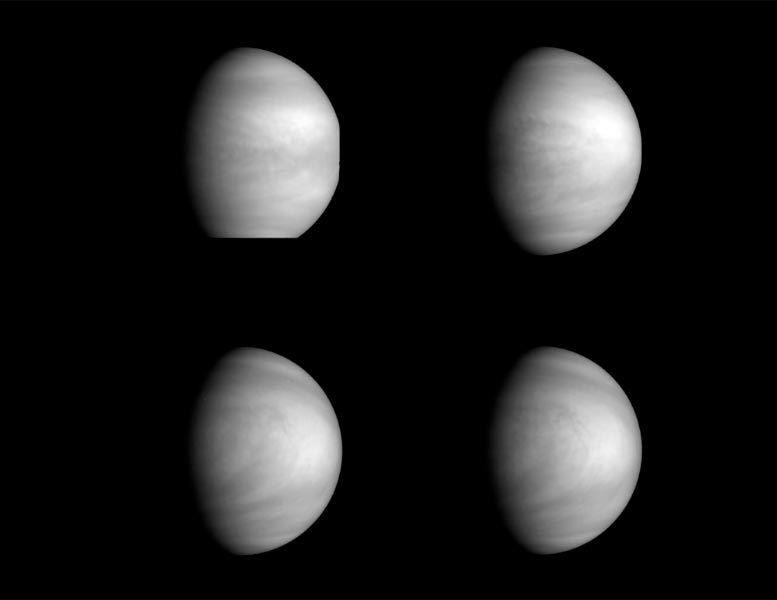
    Venus High-Level Clouds
    Multiple Views of Venus’ High-level Clouds. Credit: NASA/JPL

    The Quest for Answers

    “The only available data for the composition of the clouds were collected by probes and revealed strange properties of the clouds that so far we have been unable to fully explain,” said Paul Rimmer from the Cavendish Laboratory and co-author of the study. “In particular, when examined under UV light, the Venusian clouds featured a specific UV absorption pattern. What elements, compounds, or minerals are responsible for such observation?”

    Formulated on the basis of Venusian atmospheric chemistry, the team synthesized several iron-bearing sulfate minerals in an aqueous geochemistry laboratory in the Department of Earth Sciences. By suspending the synthesized materials in varying concentrations of sulfuric acid and monitoring the chemical and mineralogical changes, the team narrowed down the candidate minerals to rhomboclase and acid ferric sulfate, of which the spectroscopic features were examined under light sources specifically designed to mimic the spectrum of solar flares (Rimmer’s FlareLab; Cavendish Laboratory).

    Researchers from Harvard University provided measurements of the UV absorbance patterns of ferric iron under extreme acidic conditions, in an attempt to mimic the even more extreme Venusian clouds. The scientists are part of the newly established Origins Federation, which promotes such collaborative projects.

    “The patterns and level of absorption shown by the combination of these two mineral phases are consistent with the dark UV-patches observed in Venusian clouds,” said co-author Clancy Zhijian Jiang, from the Department of Earth Sciences, Cambridge. “These targeted experiments revealed the intricate chemical network within the atmosphere, and shed light on the elemental cycling on the Venusian surface.”

    Future Venusian Explorations

    “Venus is our nearest neighbor, but it remains a mystery,” said Rimmer. “We will have a chance to learn much more about this planet in the coming years with future NASA and ESA missions set to explore its atmosphere, clouds, and surface. This study prepares the grounds for these future explorations.”

    Reference: “Iron-sulfur chemistry can explain the ultraviolet absorber in the clouds of Venus” by Clancy Zhijian Jiang, Paul B. Rimmer, Gabriella G. Lozano, Nicholas J. Tosca, Corinna L. Kufner, Dimitar D. Sasselov and Samantha J. Thompson, 3 January 2024, Science Advances.
    DOI: 10.1126/sciadv.adg8826

    The research was supported by the Simons Foundation, and the Origins Federation.

    Never miss a breakthrough: Join the SciTechDaily newsletter.
    Follow us on Google and Google News.

    Astronomy Astrophysics Atmospheric Science Planets Popular University of Cambridge Venus
    Share. Facebook Twitter Pinterest LinkedIn Email Reddit

    Related Articles

    Hunting Venus 2.0: Scientists Zero In on 5 Planets Beyond Our Solar System

    Why Venus Rotates, Slowly, Despite Sun’s Powerful Gravitational Pull

    New Findings Suggest Venus Never Had Oceans, Conditions Needed for Life

    Astronomers Show How “Tatooine” Planets Form in Binary Systems Without Getting Crushed

    Space-Based Infrared Imaging Reveals the Nighttime Weather on Venus

    Evidence of Explosive Volcanic Activity on Venus

    Life on Venus? Scientists Shed More Light on Molecules Linked to Life on Other Planets

    Purported Phosphine – An Indicator of Life – On Venus More Likely to Be Ordinary Sulfur Dioxide

    If It Wasn’t for Jupiter, Venus Might Be Habitable Today

    Leave A Reply Cancel Reply

    • Facebook
    • Twitter
    • Pinterest
    • YouTube

    Don't Miss a Discovery

    Subscribe for the Latest in Science & Tech!

    Trending News

    Scientists May Have Found the Key to Jupiter and Saturn’s Moon Mystery

    Scientists Uncover Brain Changes That Link Pain to Depression

    Saunas May Do More Than Raise Body Temperature – They Activate Your Immune System

    Exercise in a Pill? Metformin Shows Surprising Effects in Cancer Patients

    Hidden Oceans of Magma Could Be Protecting Alien Life

    New Study Challenges Alzheimer’s Theories: It’s Not Just About Plaques

    Artificial Sweeteners May Harm Future Generations, Study Suggests

    Splashdown! NASA Artemis II Returns From Record-Breaking Moon Mission

    Follow SciTechDaily
    • Facebook
    • Twitter
    • YouTube
    • Pinterest
    • Newsletter
    • RSS
    SciTech News
    • Biology News
    • Chemistry News
    • Earth News
    • Health News
    • Physics News
    • Science News
    • Space News
    • Technology News
    Recent Posts
    • Physicists Discover a Strange New Kind of One-Dimensional Particle
    • Scientists Discover Unexpected Climate Benefit Hidden in Forest Soils
    • The Grand Canyon’s “Swiss Cheese” Rocks Hold a Critical Secret
    • Scientists Discover 430,000-Year-Old Wooden Tools, Rewriting Human History
    • Scientists Make Breakthrough on 40-Year-Old 2D Physics Puzzle
    Copyright © 1998 - 2026 SciTechDaily. All Rights Reserved.
    • Science News
    • About
    • Contact
    • Editorial Board
    • Privacy Policy
    • Terms of Use

    Type above and press Enter to search. Press Esc to cancel.