
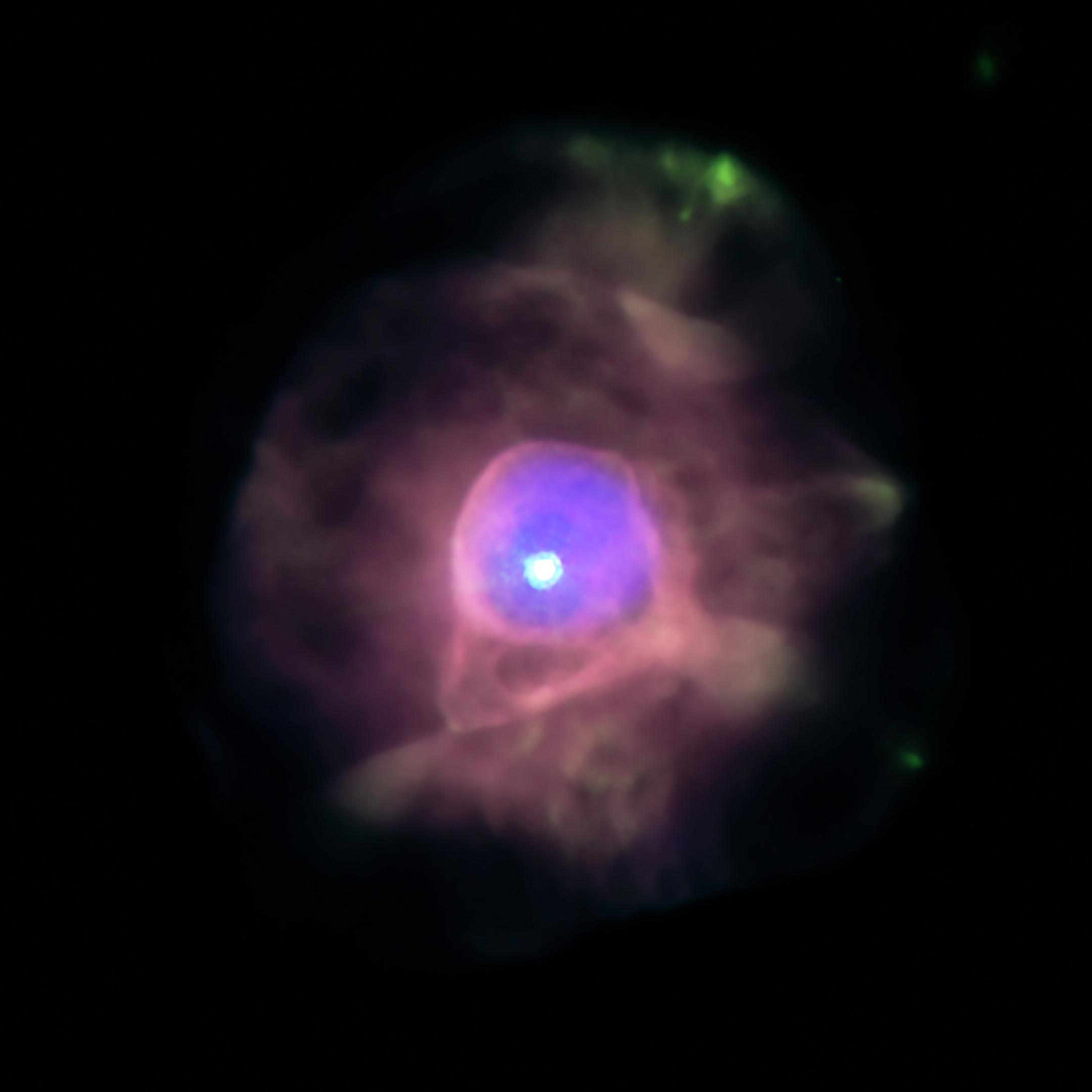
- Chandra has found a bubble of ultra-hot gas at the center of a planetary nebula.
- Planetary nebulas are formed when Sun-like stars run out of fuel, shedding their outer layers while the star’s core shrinks.
- This image contains X-rays from Chandra (purple) and optical light data from Hubble (pink and green).
- IC 4593 is at a distance of about 7,800 light-years from Earth, which is the farthest planetary nebula detected by Chandra.
On Earth, amethysts can form when gas bubbles in lava cool under the right conditions. In space, a dying star with a mass similar to the Sun is capable of producing a structure on par with the appeal of these beautiful gems.
As stars like the Sun run through their fuel, they cast off their outer layers and the core of the star shrinks. Using NASA’s Chandra X-ray Observatory, astronomers have found a bubble of ultra-hot gas at the center of one of these expiring stars, a planetary nebula in our galaxy called IC 4593. At a distance of about 7,800 light-years from Earth, IC 4593 is the most distant planetary nebula yet detected with Chandra.
This new image of IC 4593 has X-rays from Chandra in purple, invoking similarities to amethysts found in geodes around the globe. The bubble detected by Chandra is from gas that has been heated to over a million degrees. These high temperatures were likely generated by material that blew away from the shrunken core of the star and crashed into gas that had previously been ejected by the star.
This composite image also contains visible light data from the Hubble Space Telescope (pink and green). The pink regions in the Hubble image are the overlap of emission from cooler gas composed of a combination of nitrogen, oxygen, and hydrogen, while the green emission is mainly from nitrogen.
IC 4593 is what astronomers call a “planetary nebula,” a deceptive-sounding name because this class of objects has nothing to do with planets. (The name was given about two centuries ago because they looked like the disk of a planet when viewed through a small telescope.) In fact, a planetary nebula is formed after the interior of a star with about the mass of the Sun contracts and its outer layers expand and cool. In the case of the Sun, its outer layers could extend as far as the orbit of Venus during its red giant phase several billion years in the future.
In addition to the hot gas, this study also finds evidence for point-like X-ray source at the center of IC 4593. This X-ray emission has higher energies than the bubble of hot gas. The point source could be from the star that discarded its outer layers to form the planetary nebula or it could be from a possible companion star in this system.
A paper describing these results appears in the April 2020 issue of the Monthly Notices of the Royal Astronomical Society. The authors are Jesús A. Toalá (Instituto de Radioastronomía y Astrofísica (IRyA) in Michoacan, Mexico); M. A. Guerrero (Instituto de Astrofísica de Andalucía in Granada, Spain); L. Bianchi (The Johns Hopkins University, in Baltimore, Maryland); Y.-H. Chu (Institute of Astronomy and Astrophysics, Academia Sinica (ASIAA) in Taipei, Taiwan, Republic of China); and O. De Marco (Macquarie University, in Sydney, Australia).
Reference: “Chandra observations of the planetary nebula IC 4593” by J. A. Toalá, M. A. Guerrero, L. Bianchi, Y.-H. Chu and O. De Marco, 21 April 2020, Monthly Notices of the Royal Astronomical Society.
DOI: 10.1093/mnras/staa1024
arXiv: 2004.04542
NASA’s Marshall Space Flight Center manages the Chandra program. The Smithsonian Astrophysical Observatory’s Chandra X-ray Center controls science and flight operations from Cambridge and Burlington, Massachusetts.
Never miss a breakthrough: Join the SciTechDaily newsletter.
Follow us on Google and Google News.