

CMIP6 models show improvements but still cannot fully explain the 1998–2013 warming slowdown.
A recent study led by Dr. Wei and Dr. Qiao from the First Institute of Oceanography, Ministry of Natural Resources provides an evaluation of the performance of the newly released CMIP6 models in simulating the global warming slowdown observed in the early 2000s. This study reveals that the key in simulating and predicting near-term temperate change is to correctly separate and simulate the two distinct signals, i.e., the human-induced long-term warming trend and natural variabilities, especially those at interannual, interdecadal, and multidecadal scales. This work was online published in Science China Earth Sciences.
After the unprecedented warming over the last quarter of the 20th century, the global surface temperature growth slowed unexpectedly during 1998-2013 despite the sharp increase in greenhouse gas emissions; this phenomenon is termed the global warming hiatus or slowdown to be more precise. The global warming slowdown challenges the existing scientific understanding of global temperature change mechanisms, thus has been one of the most concerning issues in recent climate research and even the public.
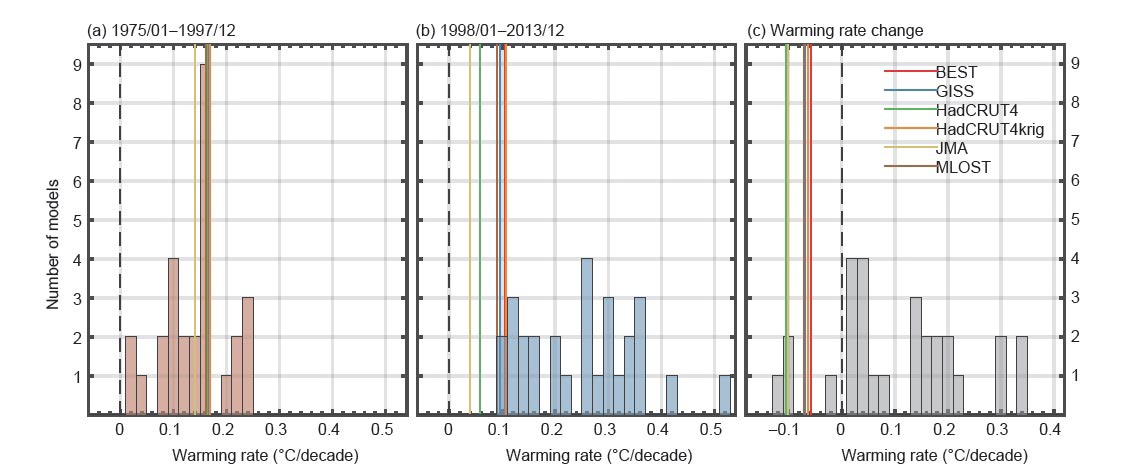
However, the sophisticated and advanced climate models in CMIP5 could not simulate this warming slowdown. During 1998-2013, the models mostly present a rapidly warming surge which greatly deviates from the observed flat temperature time series. The models considerably overestimate the observed warming rate of the recent period. IPCC AR5 stated: “Almost all CMIP5 historical simulations do not reproduce the observed recent warming hiatus”. Therefore, the simulation and prediction ability of sophisticated climate models have been questioned.
Expectations for CMIP6 and New Improvements
Now the CMIP6 model data are gradually released since 2020. The newly developed models include a better understanding of the global temperature change mechanisms, especially more reasonable physical processes of natural variabilities. Successful simulations of the global warming slowdown are expected in the new-generation models. As the data of 28 new models become available, it is necessary to timely examine the ability of the CMIP6 models on presenting the recent warming slowdown.
By comparison to six widely used global surface temperature datasets, research team from First Institute of Oceanography, Ministry of Natural Resources evaluates the performance of the 28 newly released CMIP6 models in simulating the recent warming slowdown, and finds that most CMIP6 models still fail to reproduce the warming slowdown, although they present some encouraging improvements when compared with CMIP5 models (Figure 1).
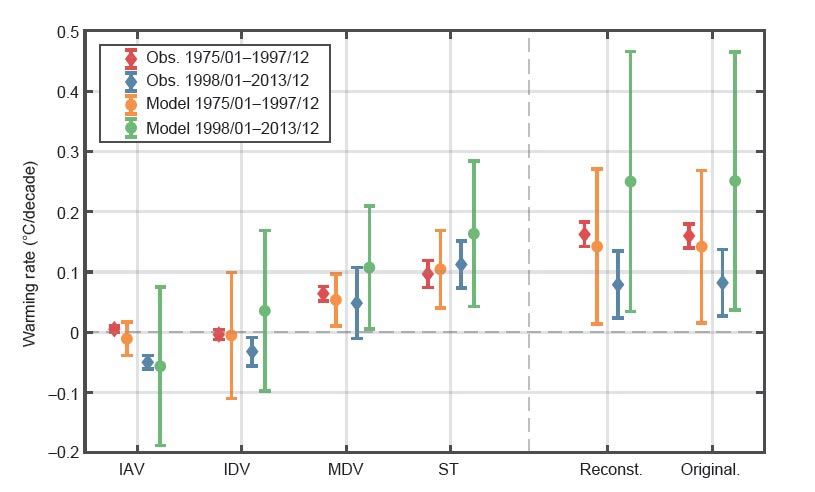
Further, they explored the possible reasons for the difficulty of CMIP6 models in simulating the recent warming slowdown. They reveal that it is associated with the models’ deficiencies in simulating the distinct temperature change signals from the human-induced long-term warming trend and/or the three crucial natural variabilities at interannual, interdecadal, and multidecadal scales (Figure 2).
Toward Better Climate Predictions
This study reveals that the key in simulating and predicting near-term temperate change is to correctly separate and simulate the two distinct signals, i.e., the human-induced long-term warming trend and natural variabilities, especially those at interannual, interdecadal and multidecadal scales. This suggests that the key-scale variabilities require more attention in the models, considering their vital roles in modulating the warming rate change at decadal to multidecadal scales. This result can provide important insight for the simulation and prediction of near-term climate changes.
Reference: “Could CMIP6 climate models reproduce the early-2000s global warming slowdown?” by Meng Wei, Qi Shu, Zhenya Song, Yajuan Song, Xiaodan Yang, Yongqing Guo, Xinfang Li and Fangli Qiao, 15 April 2021, Science China Earth Sciences.
DOI: 10.1007/s11430-020-9740-3
This research was funded by the National Natural Science Foundation of China (Nos. 41806043 & 41821004).
Never miss a breakthrough: Join the SciTechDaily newsletter.
Follow us on Google and Google News.
5 Comments
The problem with models is that they are not reality (scientists don’t claim they are reality).
The temptation is to keep tweaking the parameters until the model tells the story the modeler wants to be told.
“This study reveals that the key in simulating and predicting near-term temperate change is to correctly separate and simulate the two distinct signals, …”
I think that it would be more accurate and humble to replace “reveals” with something along the line of “suggests” or “claims.”
Technologically challenged individuals often forget how climate models are tested.
Their ability to predict the future is limited. This will always be true (ask anyone who understands applied chaos theory). That’s not the point.
The way climate models are tested is by running simulations of weather and climate behavior from the past. As the climate models improve, they predict the past more accurately.
Once the models are sufficiently accurate predicting any given number of years of past weather and climate, then they can predict the future with increasing levels of accuracy.
“Once the models are sufficiently accurate …”
That seems to be an unwarranted faith in climate modeling, considering your familiarity with chaos theory, and acknowledgement that “Their ability to predict the future is limited.”
“Climate Models Can’t Reproduce the Early-2000s Global Warming Slowdown”
“After the unprecedented warming over the last quarter of the 20th century, the global surface temperature growth slowed unexpectedly during 1998-2013 despite the sharp increase in greenhouse gas emissions;”
“They reveal that it is associated with the models’ deficiencies in simulating the distinct temperature change signals from the human-induced long-term warming trend and/or the three crucial natural variabilities at interannual, interdecadal, and multidecadal scales.”
What I can deduce from this is that the models are overestimating the effects human activities that induce climate change, like many people keep saying but are called deniers and much worse.
SCIENCE!!!