
Close Menu
    Facebook X (Twitter) Instagram
    SciTechDaily
    • Biology
    • Chemistry
    • Earth
    • Health
    • Physics
    • Science
    • Space
    • Technology
    Facebook X (Twitter) Pinterest YouTube RSS
    SciTechDaily
    Home»Space»Colossal Stellar Explosion Near Earth Revealed by Layers of Manganese Crust
    Space

    Colossal Stellar Explosion Near Earth Revealed by Layers of Manganese Crust

    By Technical University of Munich (TUM)October 3, 20201 Comment4 Mins Read
    Facebook Twitter Pinterest Telegram LinkedIn WhatsApp Email Reddit
    Share
    Facebook Twitter LinkedIn Pinterest Telegram Email Reddit
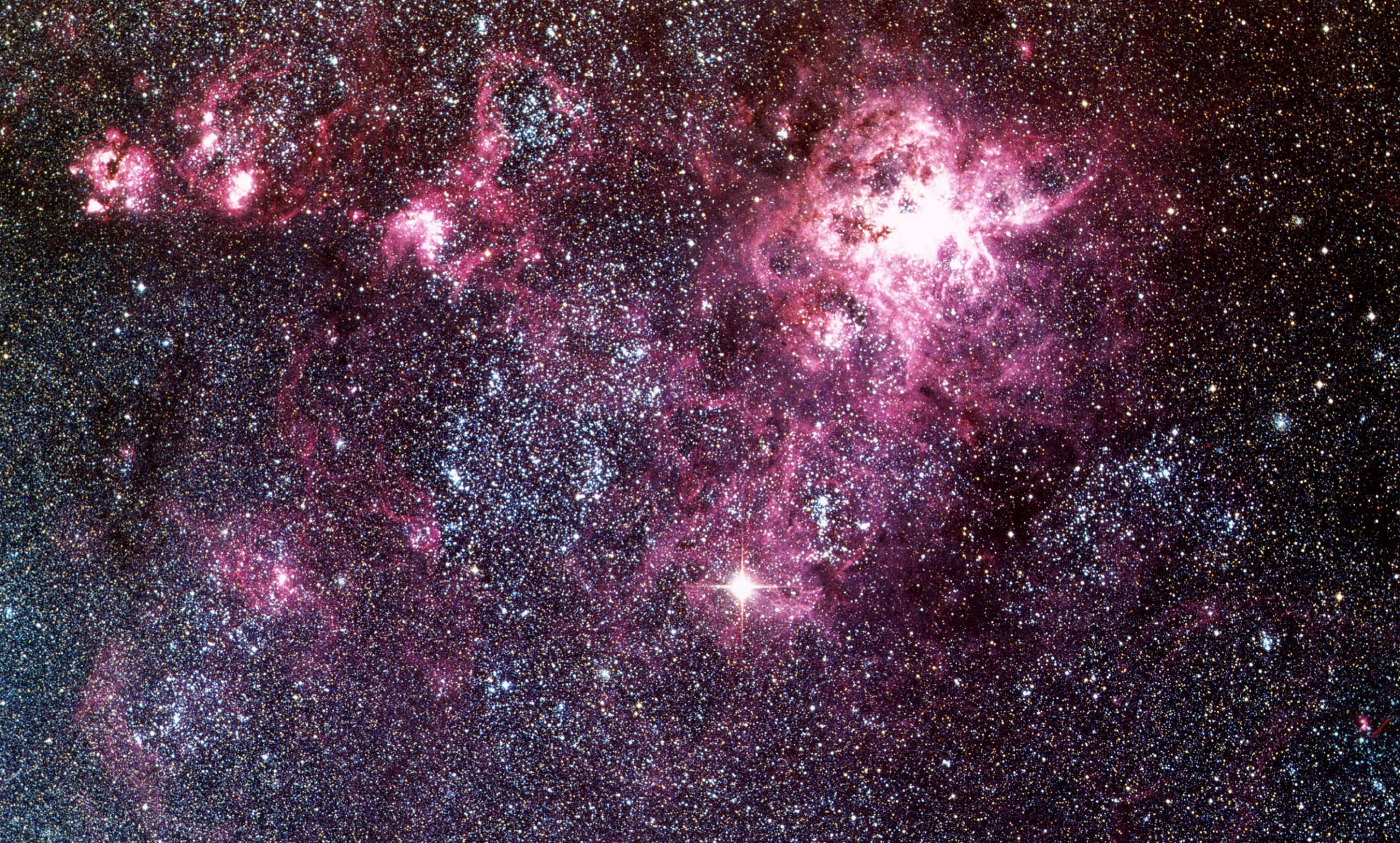
    Stellar Explosion SN 1987A
    The stellar explosion, SN 1987A, located in the Large Magellanic Cloud, was one of the brightest supernovae in more than 400 years. Credit: ESO

    Discovery of iron-60 and manganese-53 substantiates supernova 2.5 million years ago.

    When the brightness of the star Betelgeuse dropped dramatically a few months ago, some observers suspected an impending supernova – a stellar explosion that could also cause damage on Earth. While Betelgeuse has returned to normal, physicists from the Technical University of Munich (TUM) have found evidence of a supernova that exploded near the Earth around 2.5 million years ago.

    The life of stars with a mass more than ten times that of our sun ends in a supernova, a colossal stellar explosion. This explosion leads to the formation of iron, manganese, and other heavy elements.

    In layers of a manganese crust that are around two and a half million years old, a research team has now confirmed the existence of both iron-60 and manganese-53. The scientists were led by physicists from the Technical University of Munich.

    “The increased concentrations of manganese-53 can be taken as the “smoking gun” – the ultimate proof that this supernova really did take place,” says first author Dr. Gunther Korschinek.
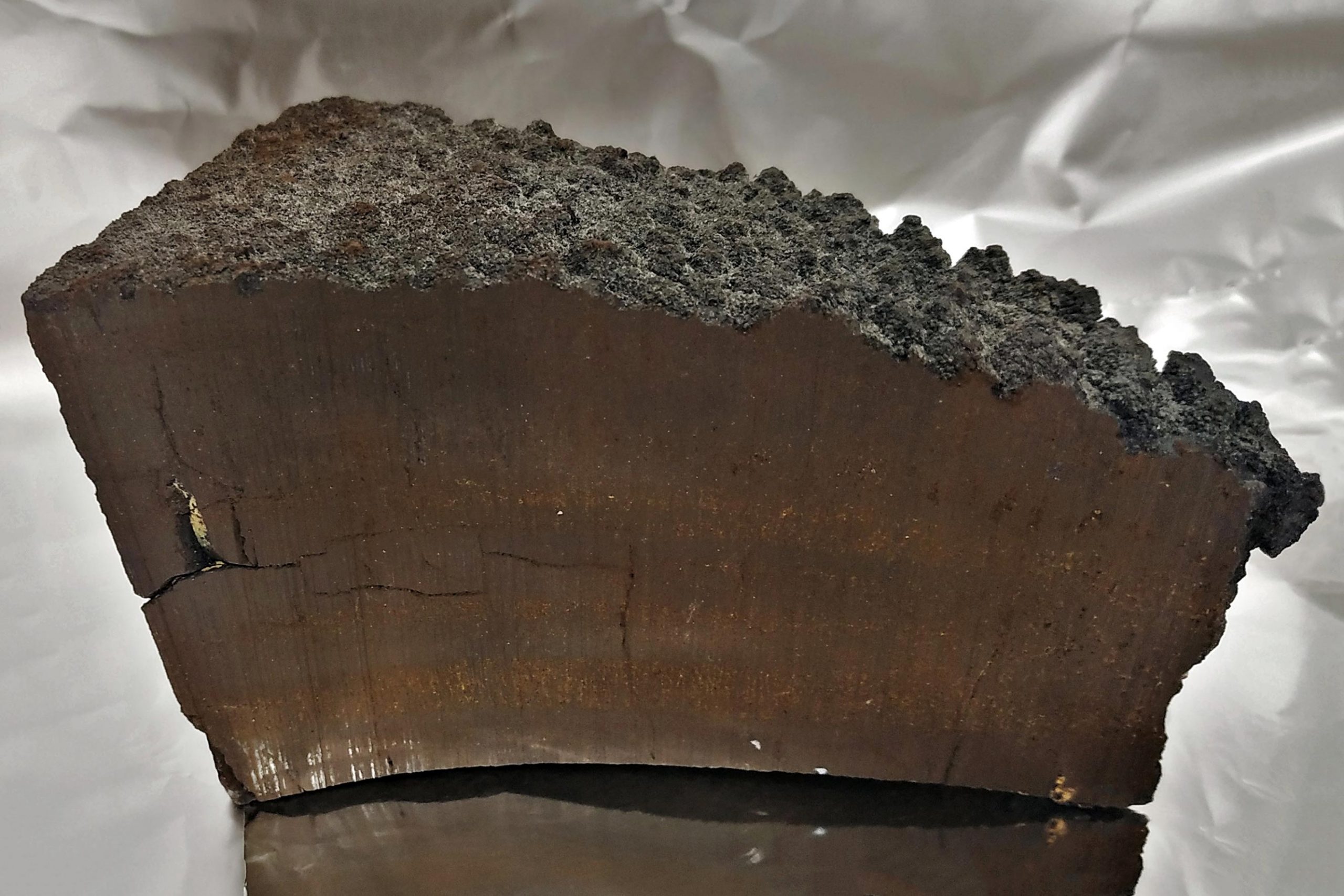
    Manganese Crust
    This manganese crust started to grow about 20 million years ago. It grew layer by layer until it was retrieved a few years ago and analyzed in the Maier-Leibnitz-Laboratory at the Technical University of Munich. In layers that are around 2.5 million years old, the researchers found iron-60 and elevated levels of manganese-53. Their occurrence is evidence of a near-Earth supernova 2.5 million years ago. Credit: Dominik Koll / TUM

    While a very close supernova could inflict massive harm to life on Earth, this one was far enough away. It only caused a boost in cosmic rays over several thousand years. “However, this can lead to increased cloud formation,” says co-author Dr. Thomas Faestermann. “Perhaps there is a link to the Pleistocene epoch, the period of the Ice Ages, which began 2.6 million years ago.”

    Ultra-trace analysis

    Typically, manganese occurs on earth as manganese-55. Manganese-53, on the other hand, usually stems from cosmic dust, like that found in the asteroid belt of our solar system. This dust rains down onto the earth continuously; but only rarely do we perceive larger specks of dust that glow as meteorites.

    New sediment layers that accumulate year after year on the sea floor preserve the distribution of the elements in manganese crusts and sediment samples. Using accelerator mass spectrometry, the team of scientists has now detected both iron-60 and increased levels of manganese-53 in layers that were deposited about two and a half million years ago.

    “This is investigative ultra-trace analysis,” says Korschinek. “We are talking about merely a few atoms here. But accelerator mass spectrometry is so sensitive that it even allows us to calculate from our measurements that the star that exploded must have had around 11 to 25 times the size of the sun.”

    The researchers were also able to determine the half-life of manganese-53 from comparisons to other nuclides and the age of the samples. The result: 3.7 million years. To date, there has only been a single measurement to this end worldwide.

    Reference: “Supernova-Produced 53Mn on Earth” by G. Korschinek, T. Faestermann, M. Poutivtsev, A. Arazi, K. Knie, G. Rugel, and A. Wallner, 17 July 2020, Physics Review Letters.
    DOI: 10.1103/PhysRevLett.125.031101

    The research was funded by the German Research Foundation as part of the Cluster of Excellence “Origin and Structure of the Universe”. In addition to the Technical University of Munich, the Laboratorio TANDAR, the Comisión Nacional de Energía Atómica, San Martín (Argentina), the Consejo Nacional de Investigaciones Científicas y Tecnicas (CONICET), Buenos Aires (Argentina) and the Helmholtz Center in Dresden-Rossendorf were participated in the research.

    Never miss a breakthrough: Join the SciTechDaily newsletter.
    Follow us on Google and Google News.

    Geophysics Popular Supernova Technical University of Munich
    Share. Facebook Twitter Pinterest LinkedIn Email Reddit

    Related Articles

    Massive Explosions of Energy Far From Earth May Have Left Traces in Our Planet’s Biology and Geology

    SAPHiR Multi-Anvil Press Solves Mystery of the Solar System: How Stony-Iron Meteorites Form

    Scientists Challenge Pulsar ‘Glitch’ Theory

    Study Challenges the Idea That a Supernova Prompted the Formation of the Solar System

    Exploding Star Could Shed New Light on the Nature of Dark Energy

    12 Billion-Year Old Supernova Discovered by Astronomers

    Cloud of Hydrogen and Helium Plunging Toward the Galactic Center

    Astronomers Detect X-rays From the Remains of Supernova SN 1957D

    Data Suggests the Possible Ice on the Moon at Shackleton Crater

    1 Comment

    1. Brian Edwards on October 4, 2020 11:49 pm

      So does that mean there’s a fairly close neutron star of some kind? Would we know if there was a pulsar close if the “beams” were at 90deg to us?

      Reply
    Leave A Reply Cancel Reply

    • Facebook
    • Twitter
    • Pinterest
    • YouTube

    Don't Miss a Discovery

    Subscribe for the Latest in Science & Tech!

    Trending News

    One of the Universe’s Largest Stars May Be Getting Ready To Explode

    Scientists Discover Enzyme That Could Supercharge Ozempic-Like Weight Loss Drugs

    Popular Sweetener Linked to DNA Damage – “It’s Something You Should Not Be Eating”

    Ancient “Rock” Microbes May Reveal How Complex Life Began

    Researchers Capture Quantum Interference in One of Nature’s Rarest Atoms

    “A Plague Is Upon Us”: The Mass Death That Changed an Ancient City Forever

    Scientists Discover Game-Changing New Way To Treat High Cholesterol

    This Small Change to Your Exercise Routine Could Be the Secret to Living Longer

    Follow SciTechDaily
    • Facebook
    • Twitter
    • YouTube
    • Pinterest
    • Newsletter
    • RSS
    SciTech News
    • Biology News
    • Chemistry News
    • Earth News
    • Health News
    • Physics News
    • Science News
    • Space News
    • Technology News
    Recent Posts
    • New Research Uncovers Hidden Side Effects of Popular Weight-Loss Drugs
    • Scientists Rethink Extreme Warming After Surprising Ocean Discovery
    • The Surprising Role of Asteroids in the Origin of Life
    • Scientists Raise Concerns Over Newly Recognized Pollutant Found Everywhere in the Air
    • New Study Challenges 40-Year Puzzle About Childhood Body Fat
    Copyright © 1998 - 2026 SciTechDaily. All Rights Reserved.
    • Science News
    • About
    • Contact
    • Editorial Board
    • Privacy Policy
    • Terms of Use

    Type above and press Enter to search. Press Esc to cancel.