
Effects of the pandemic will be detected in the atmosphere much later — To reach the Paris climate goals, decade-long measures are needed.
Based on current data measured in the energy, industry, and mobility sectors, restrictions of social life during the corona pandemic can be predicted to lead to a reduction of worldwide carbon dioxide emissions by up to eight percent in 2020. According to the Intergovernmental Panel on Climate Change (IPCC), cumulative reductions of about this magnitude would be required every year to reach the goals of the Paris Agreement by 2030. Recent measurements by researchers of Karlsruhe Institute of Technology (KIT) revealed that concentration of carbon dioxide (CO2) in the atmosphere has not yet changed due to the estimated emission reductions. The results are reported in Remote Sensing.
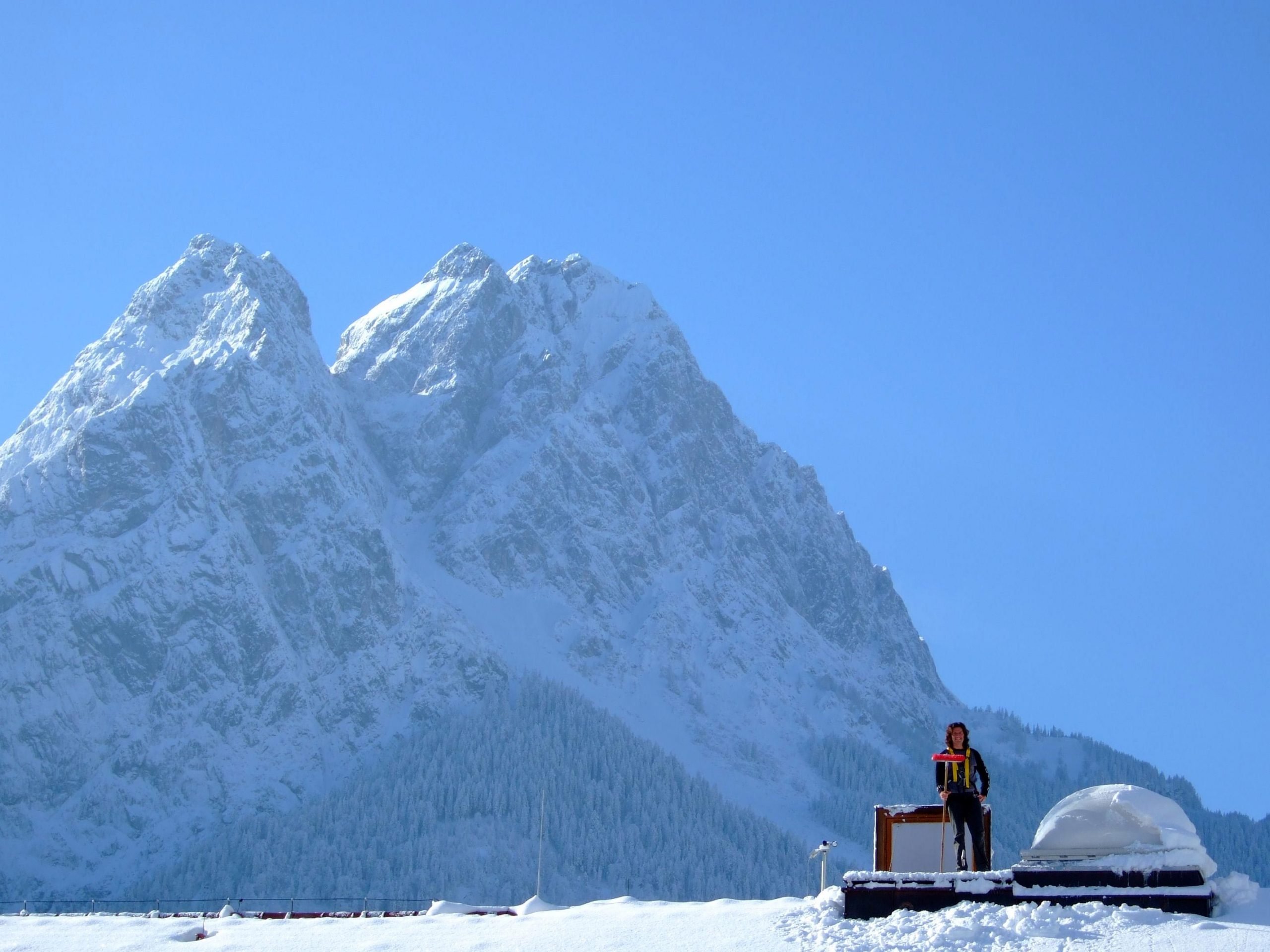
The corona pandemic has changed both our working and our private lives. People increasingly work from home, have video conferences instead of business trips, and spend their holidays in their home country. The lower traffic volume also reduces CO2 emissions. Reductions of up to eight percent are estimated for 2020. “In spite of the reduced emissions, our measurements show that CO2 concentration in the atmosphere has not yet decreased,” says Ralf Sussmann from the Atmospheric Environmental Research Division of KIT’s Institute of Meteorology and Climate Research (IMK-IFU), KIT’s Campus Alpine, in Garmisch-Partenkirchen. “To reduce CO2 concentration in the atmosphere in the long run, restrictions imposed during the corona pandemic would have to be continued for decades. But even this would be far from being sufficient.”
To prove this, researchers additionally studied a long-term scenario that can be controlled well with atmospheric measurements: The goal of the Paris Climate Agreement to limit global warming to 1.5 degrees Celsius can only be reached by an immediate significant reduction of CO2 emissions and a further decrease down to zero by 2055. “The restrictions imposed during the corona crisis, however, are far from being sufficient. They have just resulted in a one-time reduction by eight percent. To reach zero emissions in the coming decades, cumulative reductions of the same magnitude would be required every year, i.e. 16 percent in 2021, 24 percent in 2022, and so on. For this, political measures have to be taken to directly initiate fundamental technological changes in the energy and transport sectors,” Sussmann says.
For the study, the team used data from the Total Carbon Column Observing Network (TCCON). It measured the concentrations in different layers of the atmosphere above Garmisch-Partenkirchen and at other places around the globe. “High-tech infrared spectrometers are applied, which use the sun as a light source. The measurement method is highly precise, uncertainties are in the range of a few thousandths,” Sussmann adds.
Long Life of CO2 Prevents Early Detection
According to the researchers, the long life of CO2 and the high background concentrations that have accumulated since the start of industrialization prevent the changes in the atmosphere from being detected. “But also natural impacts make early detection difficult: Anthropogenic emissions, the main cause of the long-term increase in atmospheric CO2, are superposed by annual fluctuations of the growth rate due to natural climate variabilities of ocean sinks and land vegetation,” Sussmann says. Successful emission reduction, hence, is hard to detect by atmosphere measurements.
For their study, the researchers compared the TCCON measurements with the prognoses of the atmospheric growth rate for 2020 — with and without corona restrictions. “Precision analysis of atmosphere measurements revealed that the impacts of COVID-19 measures on the atmosphere might be measured after little more than six months, if the reference state without COVID-19 would be predicted precisely,” the climate researcher explains. “In any case, we would be able to find out within presumably two and half years, whether global political and social measures will help us find viable alternatives of fossil fuels and reach the goals of the Paris Climate Agreement.”
Reference: “Can We Measure a COVID-19-Related Slowdown in Atmospheric CO2 Growth? Sensitivity of Total Carbon Column Observations” by Ralf Sussmann and Markus Rettinger, 24 July 2020, Remote Sensing.
DOI: 10.3390/rs12152387
Never miss a breakthrough: Join the SciTechDaily newsletter.
Follow us on Google and Google News.
1 Comment
“According to the …(IPCC), cumulative reductions of about this magnitude would be required every year to reach the goals of the Paris Agreement by 2030. Recent measurements by researchers of …(KIT) revealed that concentration of carbon dioxide (CO2) in the atmosphere has not yet changed due to the estimated emission reductions.”
What is wrong with this picture? Ten times zero is still zero. If there was no detectable reduction in CO2 during the initial severe lock-downs, or six months later, what sort of convoluted logic leads the authors to believe that it will show up after a longer period of time? CO2 is considered to be a well-mixed gas, with lag times between photosynthesis reductions and measured reductions being apparently a couple of weeks. With something like an initial 15% reduction in anthropogenic emissions over a three-month period, prior to trees leafing out, when the annual CO2 cycle was increasing, one would expect to see a 15% reduction almost immediately. It is not detectable. The alternative hypothesis is that the annual year-to-year increases are natural and the anthropogenic contributions are negligible (~5%). Therefore, 15% of 5% (0.8%) IS down at the noise level.