
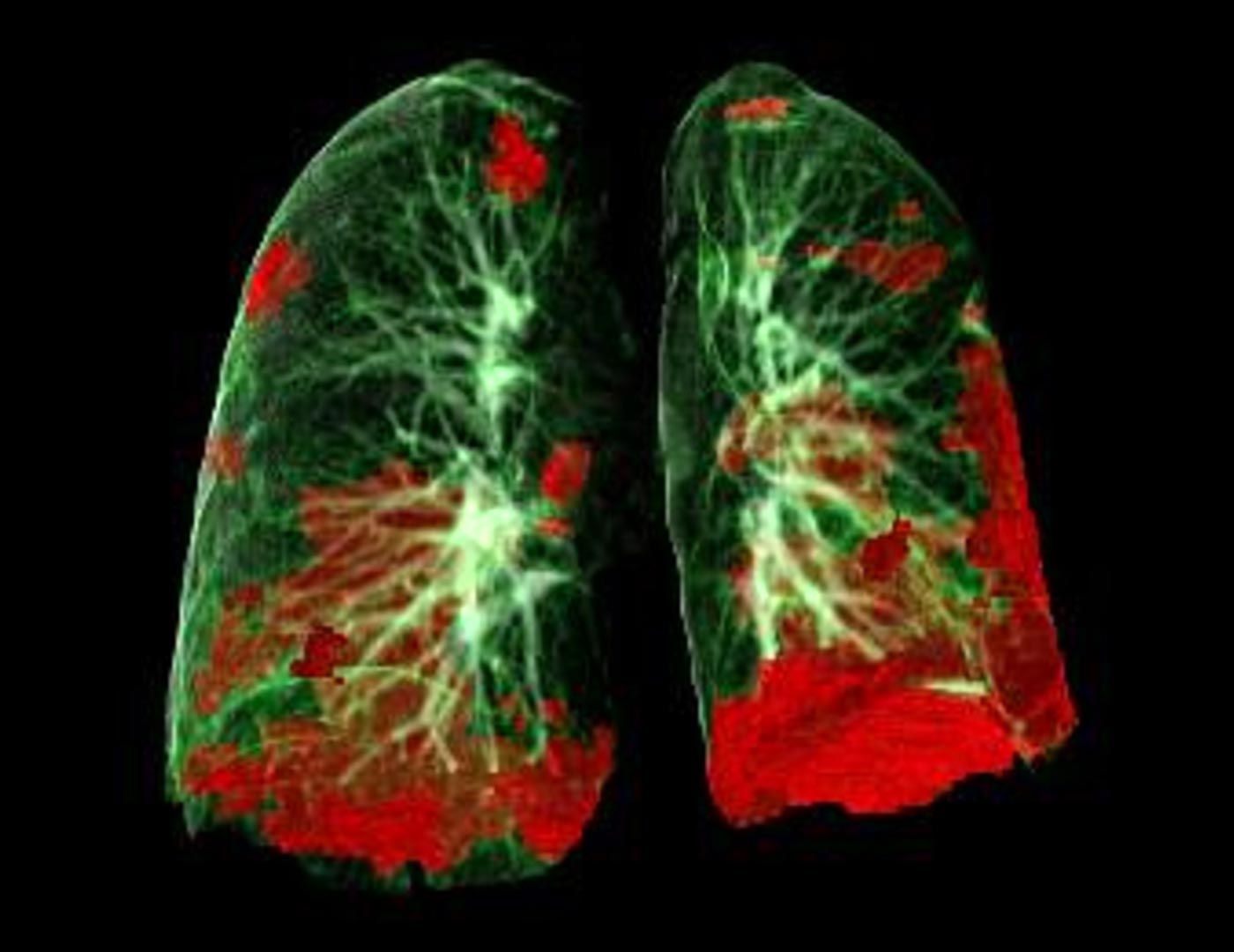
Responding to the COVID-19 pandemic caused by the novel coronavirus, SARS-CoV-2, requires models that can duplicate disease development in humans, identify potential targets, and enable drug testing. Specifically, access to the primary human lung in vitro model systems is a priority since a variety of respiratory epithelial cells are the proposed targets of viral entry.
Now, a team of infectious disease, pulmonary, and regenerative medicine researchers at Boston University, studying human stem cell-derived lung cells called type 2 pneumocytes, infected with SARS-CoV-2, have shown that the virus initially suppresses the lung cells’ ability to call in the help of the immune system with interferons to fight off the viral invaders and instead activates an inflammatory pathway called NFkB. “The infected lung cells pour out inflammatory proteins. In the body of an infected person, those proteins drive up levels of inflammation in the lungs,” explains corresponding author Darrell Kotton, MD, the David C. Seldin Professor of Medicine at BUSM and Director of the BU/BMC Center for Regenerative Medicine (CReM).
According to the researchers, the inflammatory signals initiated by the infected pneumocytes attract an army of immune cells into lung tissue laden with infected and already dead and dying cells. “Our data confirms that SARS-CoV-2 blocks cells from activating one of the anti-viral branches of the immune system early on after infection has set in. The signal the cells would typically send out, a tiny protein called interferon that they exude under threat of disease, are instead delayed for several days, giving SARS-CoV-2 plenty of time to spread and kill cells, triggering a buildup of dead cell debris and other inflammation,” added Kotton.
The data is based on experiments the research team performed in the laboratory of co-senior author Elke Mühlberger, Ph.D., associate professor of microbiology at BUSM and a researcher at BU’s National Emerging Infectious Diseases Laboratories (NEIDL). Kotton and other members of the CReM have developed sophisticated models of human lung tissue–three-dimensional structures of lung cells, called “lung organoids,” grown from human stem cells–which they’ve used at BU and with collaborators elsewhere to study a range of chronic and acute lung diseases.
The research team, led by co-first authors, Jessie Huang, Ph.D., Kristy Abo, BA, Rhiannon Werder, Ph.D. and Adam Hume, Ph.D., adapted an experimental model previously used to study the effects of smoking cigarettes to study the coronavirus in lung tissue. Droplets of live coronavirus were then added on top of the lung cells, infecting them from the air the way the virus infects cells lining the inside of the lungs when air containing the virus is breathed into the body. “This adaptation of human stem cell-derived pneumocytes to air, known as an ‘air-liquid interface’ cell culture was a key advance that allowed us to simulate how SARS-CoV-2 enters cells deep in the lungs of the most severely affected patients,” said co-senior author Andrew Wilson, MD, associate professor of medicine at BUSM. “Type 2 pneumocytes are also infected and injured in patients with COVID-19, making this a clinically meaningful system to understand how the disease injures patient lungs.”
Wilson and Kotton, are also pulmonary and critical care physicians taking care of patients with COVID-19 pneumonia at Boston Medical Center, while also leading their laboratories to produce the human lung cells that were then transported into the NEIDL. There Hume, a senior research scientist in the Mühlberger’s lab, worked in a BSL-4 suit to perform the infections of the cells that the three collaborating teams then analyzed together through weekly zoom calls.
“These cells are an amazing platform to study SARS-CoV-2 infection,” adds Mühlberger. “They likely reflect what is going on in the lung cells of COVID-19 patients. If you look at the damage SARS-CoV-2 inflicts on these cells, you definitely don’t want to get the disease.”
These findings appear online in the journal Cell Stem Cell.
Reference: “SARS-CoV-2 Infection of Pluripotent Stem Cell-derived Human Lung Alveolar Type 2 Cells Elicits a Rapid Epithelial-Intrinsic Inflammatory Response” by Jessie Huang, Adam J. Hume, Kristine M. Abo, Rhiannon B. Werder, Carlos Villacorta-Martin, Konstantinos-Dionysios Alysandratos, Mary Lou Beermann, Chantelle Simone-Roach, Jonathan Lindstrom-Vautrin, Judith Olejnik, Ellen L. Suder, Esther Bullitt, Anne Hinds, Arjun Sharma, Markus Bosmann, Ruobing Wang, Finn Hawkins, Eric J. Burks, Mohsan Saeed, Andrew A. Wilson, Elke Mühlberger and Darrell N. Kotton, 18 September 2020, Cell Stem Cell.
DOI: 10.1016/j.stem.2020.09.013
Funding for this study was provided by Evergrande MassCPR awards, the National Institutes of Health, a CJ Martin Early Career Fellowship from the Australian National Health and Medical Research Council, an I. M. Rosenzweig Junior Investigator Award from the Pulmonary Fibrosis Foundation, a Harry Shwachman Cystic Fibrosis Clinical Investigator Award, the Gilead Sciences Research Scholars Program, Gilda and Alfred Slifka and Gail and Adam Slifka funds, a Cystic Fibrosis Foundation grant, and a Fast Grants award.
Never miss a breakthrough: Join the SciTechDaily newsletter.
Follow us on Google and Google News.