
An earthquake alert system under consideration could have given several Alaska communities valuable advance notice before the powerful magnitude 7.3 earthquake that struck south of Sand Point, near the tip of the Alaska Peninsula, in mid-July.
The assessment comes from Alex Fozkos, a member of the Alaska Earthquake Center’s systems team at the University of Alaska Fairbanks Geophysical Institute.
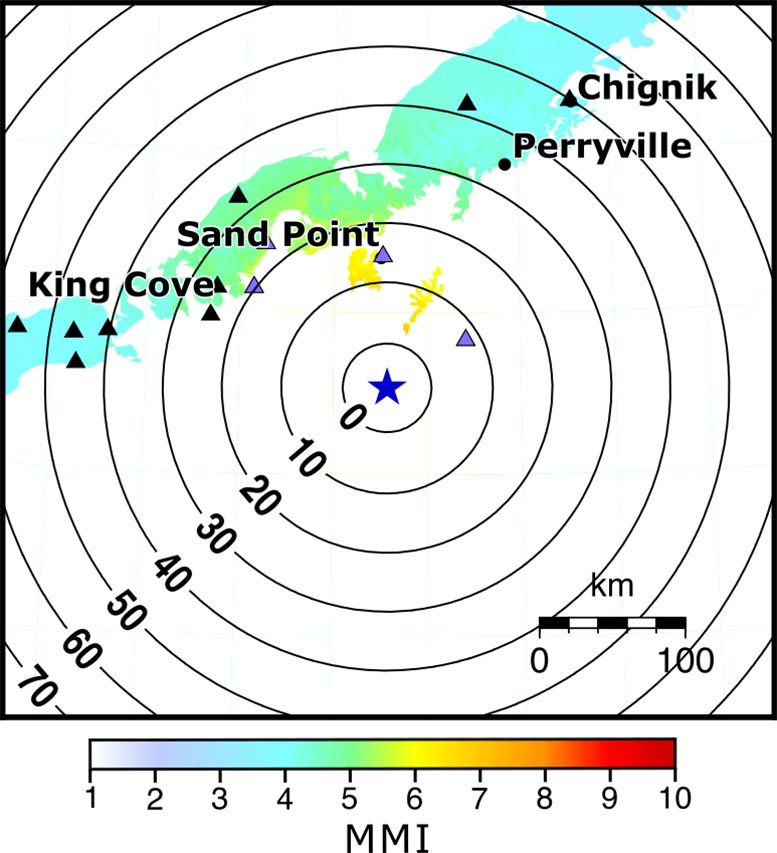
“Individuals in Sand Point could have expected approximately 10 seconds of warning time before shaking increased to its strongest,” Fozkos said. “In King Cove, individuals could have expected a warning of approximately 20 seconds.”
Sand Point lies 55 miles from the quake’s epicenter, while King Cove is slightly farther. Chignik, situated about 140 miles from the epicenter, could have had close to 50 seconds of warning.
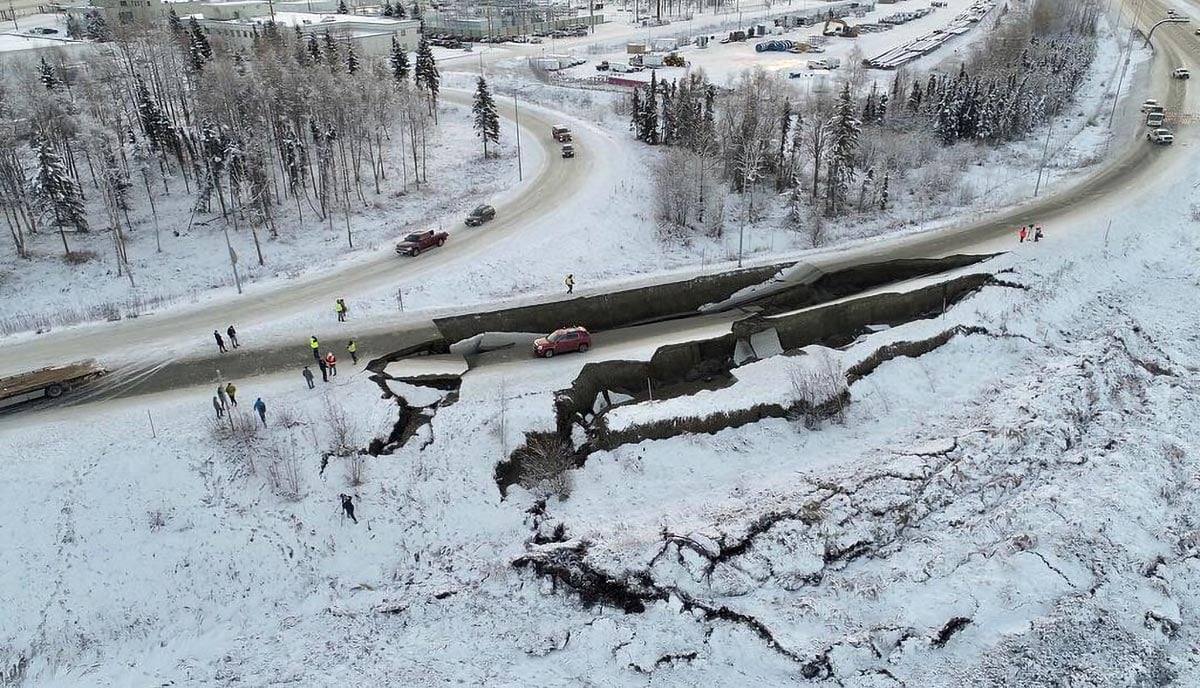
Modeling Shows Real Potential
Fozkos’ analysis for Sand Point is based on a theoretical early warning network. Earlier this year, the Alaska Earthquake Center and the U.S. Geological Survey outlined the initial phase of deploying the proposed USGS ShakeAlert system, which is already operational in California, Oregon, and Washington.
The modeling that made the Sand Point scenario possible was developed by Fozkos and is detailed in the latest issue of the Bulletin of the Seismological Society of America. The Sand Point example itself was produced after the research paper was submitted, so it is not part of that publication.
Michael West, a research professor who serves as the Alaska Earthquake Center’s director and state seismologist, is a co-author of the study.
Scenarios Highlight Possible Benefits
For the research paper, Fozkos ran numerous warning time scenarios in several categories with varying inputs such as locations, magnitudes, and fault configurations.
“This lays the groundwork for showing potential stakeholders how an early warning system could benefit Alaskans and why they should be paying attention,” said Fozkos, who conducted the research at the UAF Geophysical Institute while a graduate student.
Fozkos and West define warning time as the time difference between when a person receives an alert and the arrival of peak ground motion.
Big Quake Simulation Results
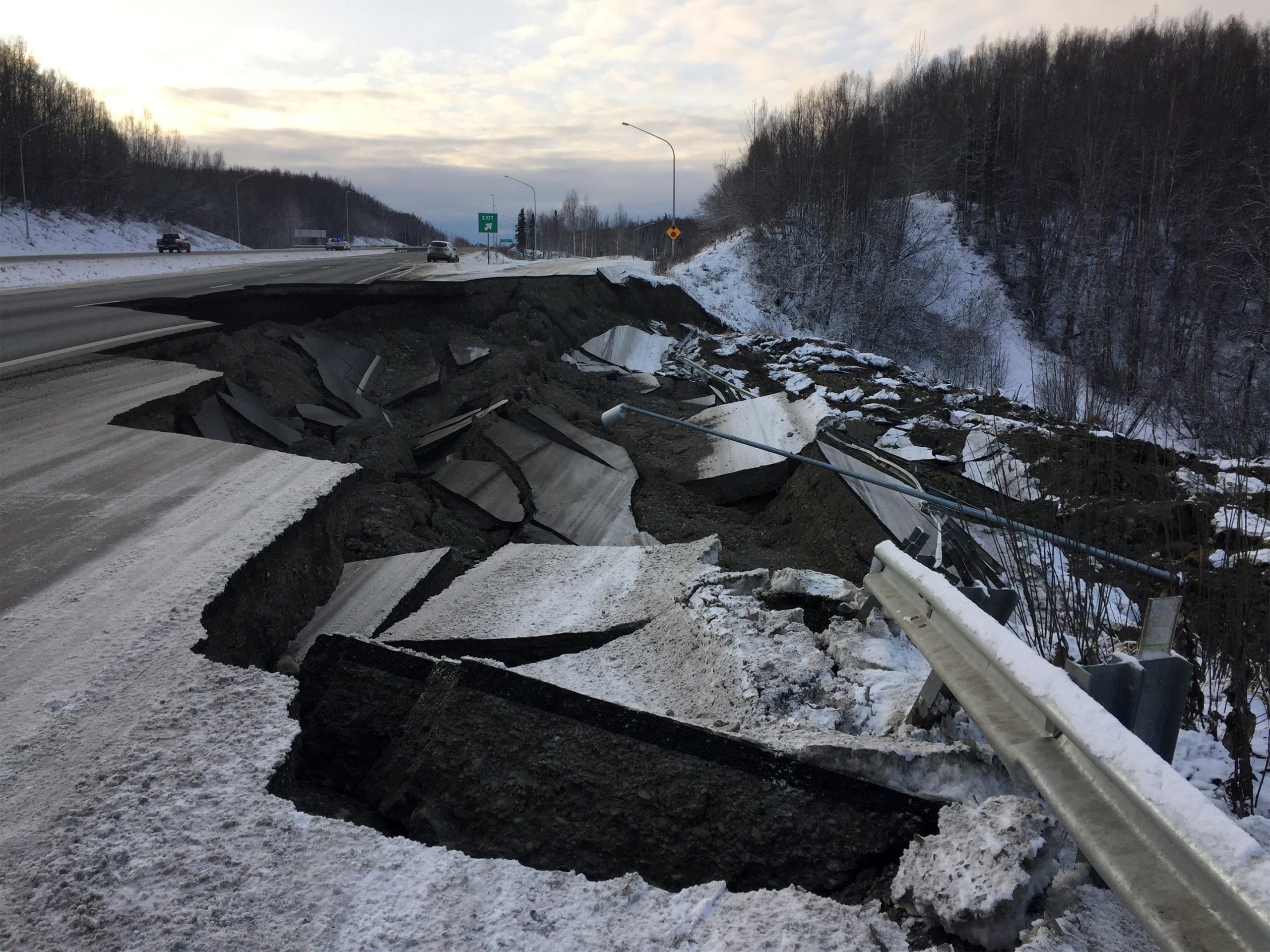
In the research paper’s scenario for the Southcentral and Southeast coasts, Fozkos simulated a magnitude 8.3 earthquake that created shaking intensities of 7 to 8. Shaking at those levels can cause moderate to heavy damage to buildings and would be widely felt.
Magnitude and intensity don’t always correspond. The earthquake magnitude scale measures the energy released at the quake’s source, while the shaking intensity scale describes the strength of ground shaking at specific locations.
Alerts for Southcentral and Southeast residents in that scenario could be issued 10 to 33 seconds after a quake occurs, with an average of 24 seconds, Fozkos writes in the research paper. Alerts would be issued quickest in the Southcentral region, where sensor density is highest.
“Having more stations in an area means an earthquake can be detected faster and a warning can be issued faster,” Fozkos said.
How Early Warnings Work
An early warning system uses a network of seismic sensors to detect an earthquake’s fast-moving primary, or P, waves as soon as they begin. It then calculates the earthquake’s location and magnitude to send alerts before the slower, more-damaging secondary, or S, waves arrive.
Alaska’s initial ShakeAlert phase, if funded, would focus on the Anchorage, Fairbanks, Kodiak, and Prince William Sound regions, which include about 90% of the state’s population.
The federal-state system would consist of 450 real-time Advanced National Seismic System stations. Of those, 20 exist in the state, 270 would be new stations, and 160 would be upgraded existing stations.
Fozkos’ research provides essential information to show how Alaskans could benefit from an earthquake early warning system. His work assumes a generic warning system, but his modeled outcomes are assumed to be comparable to ShakeAlert.
West said the science and support to establish early warning in Alaska has been in the works for several years and that the research paper’s goal is to make it “feel real and accessible.”
“Alaska has so many types of earthquakes that it can be difficult to explain to people what is possible,” he said. “This study takes complicated algorithms and technologies and shows what might happen in real-world situations.”
Alaska’s Unique Earthquake Challenges
Fozkos said Alaska’s tectonic environment is vastly different from that of the West Coast states.
“We have crustal earthquakes, we’ve got the deep earthquakes in the slab, we’ve got the interface earthquakes, there’s strike slip, there’s normal faulting.”
“If we’re going to advocate for an earthquake early warning system, then we owe Alaskans the numbers that are directly tied to Alaska and not to California, Oregon, and Washington,” he said.
Expore Further: Could This New Technology Save Lives in Alaska’s Next Quake?
Reference: “Earthquake Early Warning Scenarios for Alaska” by Alexander M. Fozkos and Michael E. West, 5 August 2025, Bulletin of the Seismological Society of America.
DOI: 10.1785/0120250051
Never miss a breakthrough: Join the SciTechDaily newsletter.
Follow us on Google and Google News.