
Researchers have shown that shallow earthquake ruptures in less rigid plate regions can create much larger tsunamis than magnitude alone would suggest
Earthquakes of similar magnitude can cause tsunamis of greatly varying sizes. This commonly observed, but not well-understood phenomenon has hindered reliable warnings of local tsunamis.
Research led by University of Hawai‘i (UH) at Manoa scientists provides new insight that connects the characteristics of earthquakes—magnitude, depth where two tectonic plates slip past each other and the rigidity of the plates involved—with the potential size of a resulting tsunami.
Previous researchers identified a special class of events known as tsunami earthquakes, which produce disproportionately large tsunamis for their magnitude. Kwok Fai Cheung, professor of Ocean and Resources Engineering in the UH Manoa School of Ocean and Earth Science and Technology (SOEST), Thorne Lay from the University of California – Santa Cruz, and co-authors discovered a straightforward explanation for this conundrum. Their findings were published recently in Nature Geoscience.
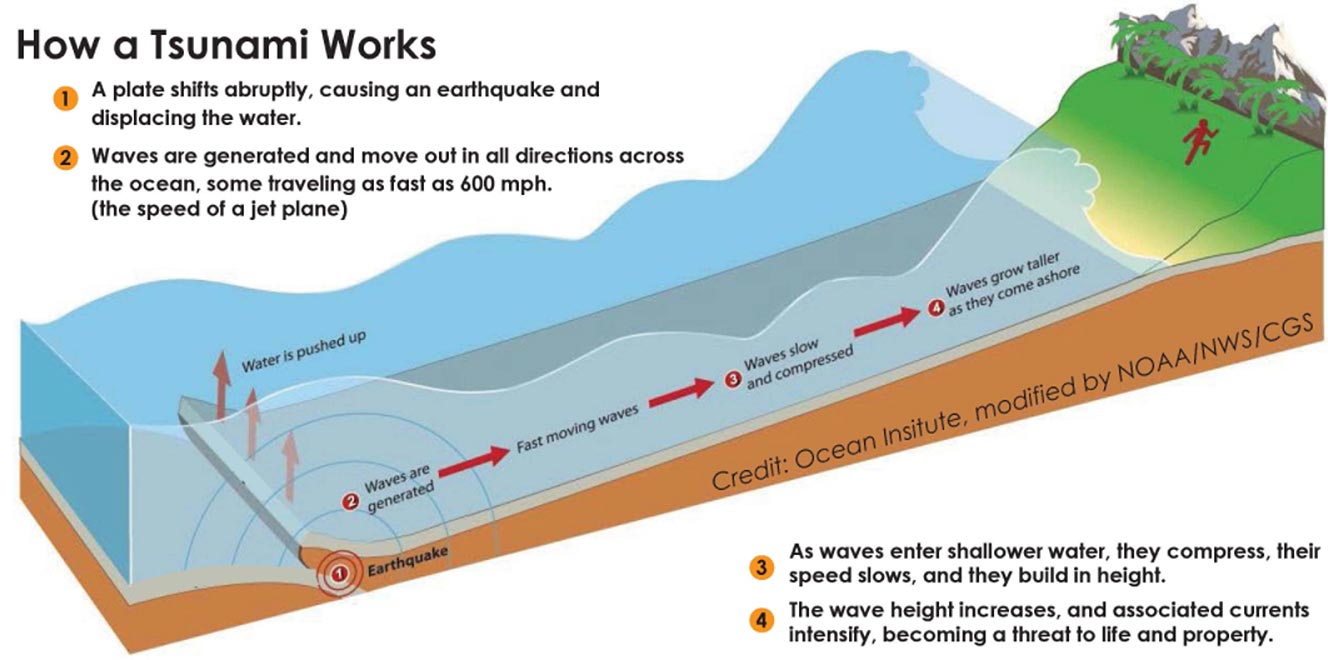
Using computer models, the team incorporated physical processes that produce earthquakes and tsunamis with a wide range of observations of real-world events, including those classified as tsunami earthquakes. The model results demonstrated that for a given earthquake magnitude, if the rupture extends to shallow depth in the less rigid part of the plate, the resulting tsunami is larger than if the rupture is deeper.
“In a subduction zone, the upper plate is thinner and less rigid than the underthrusting plate near the trench,” explained Cheung. “A concentrated near-trench or shallow rupture produces relatively weak ground shaking as recorded by seismometers, but the displaced water in the overlying deep ocean has enhanced energy and produces shorter tsunami waves that amplify at a high rate as they move toward the shore.”
Simplified Modeling Yields Clear Insights
“Earthquake and tsunamigenic processes are complex, involving many factors that vary from one event to another,” said Lay, professor of Earth and Planetary Sciences at UC Santa Cruz. “We utilized a simplified numerical model to isolate key earthquake parameters and evaluate their importance in defining tsunami size.”
Having verified that the presence of shallow earthquake rupture can be a more significant factor than the earthquake magnitude for the resulting tsunami size led the researchers to an important question: Can earthquake magnitude continue to be used as the primary indication of potential tsunami impacts?
“The practice of using earthquake magnitude to estimate potential tsunami threat has led to poor predictive capability for tsunami impacts, and more information about the source is required to do better,” said Cheung.
Toward Faster, More Reliable Early Warning Systems
An important aspect of this interdisciplinary research is the synergy of expertise in seismology, with Lay, and tsunamis, with Cheung’s research group, applied to a large set of observations. This study motivates development of new seismological and seafloor geodesy research that can rapidly detect the occurrence of shallow rupture in order to achieve more reliable tsunami warnings.
While shorelines throughout the Pacific Ocean and along the “Ring of Fire” are vulnerable to tsunamis, the situation is most critical for coastal communities near the earthquake, where the tsunami arrives quickly—when detailed information about the earthquake is not yet available.
Cheung and Lay continue their collaboration to investigate prehistorical, historical, and future tsunami events to better understand the hazards posed to coastal communities and enable more accurate warning systems.
Reference: “Tsunami size variability with rupture depth” by Kwok Fai Cheung, Thorne Lay, Lin Sun and Yoshiki Yamazaki, 13 December 2021, Nature Geoscience.
DOI: 10.1038/s41561-021-00869-z
Never miss a breakthrough: Join the SciTechDaily newsletter.
Follow us on Google and Google News.
1 Comment
They say you can’t PREDICT EARTHQUAKE THEY WRONG ON YOU TUBE THERE A PERSON NAME DUTCHSINSE THAT HAS SHOWN HOW ANYONE CAN PREDICTION OF ANY EARTHQUAKES. SO DONT LIE TOO THE PUBLIC