
An Innovative Method Overcomes Significant Hurdle in Scaling Quantum Prototypes
A practical application for the highly anticipated yet underutilized quantum computing technology is within reach due to an innovative method that overcomes the significant challenge of scaling up these prototypes.
The invention, by a University of Bristol physicist, who gave it the name ‘counterportation’, provides the first-ever practical blueprint for creating in the lab a wormhole that verifiably bridges space, as a probe into the inner workings of the universe.
By deploying a novel computing scheme, revealed in the journal Quantum Science and Technology, which harnesses the basic laws of physics, a small object can be reconstituted across space without any particles crossing. Among other things, it provides a ‘smoking gun’ for the existence of a physical reality underpinning our most accurate description of the world.
Study author Hatim Salih, Honorary Research Fellow at the university’s Quantum Engineering Technology (QET) Labs, and co-founder of the start-up DotQuantum, said: “This is a milestone we have been working towards for a bunch of years. It provides a theoretical as well as practical framework for exploring afresh enduring puzzles about the universe, such as the true nature of spacetime.”
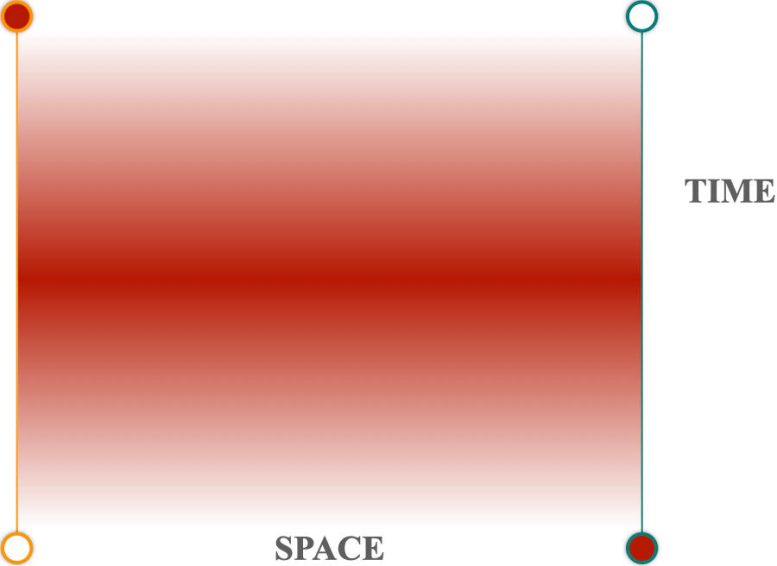
The need for detectable information carriers traveling through when we communicate has been a deeply ingrained assumption among scientists, for instance, a stream of photons crossing an optical fiber, or through the air, allowing people to read this text. Or, indeed, the myriad neural signals bouncing around the brain when doing so.
This holds true even for quantum teleportation, which, Star Trek aside, transfers complete information about a small object, allowing it to be reconstituted elsewhere, so it is indistinguishable in any meaningful way from the original, which disintegrates. The latter ensures a fundamental limit preventing perfect copying. Notably, the recent simulation of a wormhole on Google’s Sycamore processor is essentially a teleportation experiment.
Hatim said: “Here’s the sharp distinction. While counterportation achieves the end goal of teleportation, namely disembodied transport, it remarkably does so without any detectable information carriers traveling across.”
Theoretical Foundations of Counterportation and Wormholes
Wormholes were popularised by the mega-hit movie Interstellar, which included physicist and Nobel laureate Kip Thorne among its crew. But they first came to light about a century ago as quirky solutions to Einstein’s gravity equation, as shortcuts in the fabric of spacetime. The defining task of a traversable wormhole, however, can be neatly abstracted as making space traversable disjunctly; in other words, in the absence of any journey across observable space outside the wormhole.
The pioneering research, fittingly completed to Interstellar’s spine-tingling background music, sets out a way to carry this task out.
“If counterportation is to be realized, an entirely new type of quantum computer has to be built: an exchange-free one, where communicating parties exchange no particles,” Hatim said.
“By contrast to large-scale quantum computers that promise remarkable speed-ups, which no one yet knows how to build, the promise of exchange-free quantum computers of even the smallest scale is to make seemingly impossible tasks – such as counterportation – possible, by incorporating space in a fundamental way alongside time.”
Plans are now in progress, in collaboration with leading UK quantum experts in Bristol, Oxford, and York, to physically build this otherworldly-sounding wormhole in the lab.
“The goal in the near future is to physically build such a wormhole in the lab, which can then be used as a testbed for rival physical theories, even ones of quantum gravity,” Hatim added.
Exploring the Universe with Remote Wormhole Access
“This work will be in the spirit of the multi-billion ventures that exist to witness new physical phenomena, like the Laser Interferometer Gravitational-Wave Observatory (LIGO) and the European Organisation for Nuclear Research (CERN), but at a fraction of the resources. Our hope is to ultimately provide remote access to local wormholes for physicists, physics hobbyists, and enthusiasts to explore fundamental questions about the universe, including the existence of higher dimensions.”
Tim Spiller, Professor of Quantum Information Technologies at the University of York and Director of the Quantum Communications Hub of the UK National Quantum Technologies Programme said: “Quantum theory continues to inspire and astound us. Hatim’s latest work on counterportation provides another example of this, with the added bonus of a pathway towards experimental demonstration.”
John Rarity, Professor of Optical Communication Systems at the University of Bristol, said: “We experience a classical world which is actually built from quantum objects. The proposed experiment can reveal this underlying quantum nature showing that entirely separate quantum particles can be correlated without ever interacting. This correlation at a distance can then be used to transport quantum information (qubits) from one location to another without a particle having to traverse the space, creating what could be called a traversable wormhole.”
Reference: “From counterportation to local wormholes” by Hatim Salih, 2 March 2023, Quantum Science and Technology.
DOI: 10.1088/2058-9565/ac8ecd
The research was funded by the Engineering and Physical Science Research Council (EPSRC).
Never miss a breakthrough: Join the SciTechDaily newsletter.
Follow us on Google and Google News.
8 Comments
People used to talk about the possibility of “hidden feedback” that would, I imagine, unify the collective state of an experimental apparatus such that details of receptiveness to light input at one end would be keyed to one or more conditions at the photon absorbing endpoint(s) of the apparatus.
It seems similar to shining a light on a light-absorbing material and getting an unexpectedly coherent response, with presumably retro-reflective aspects, or at least this article reminds me of recent experiments with SrTi in that respect.
I had very interesting conversations with Arthur Young in 1965 about the existence of what are now referred to as “Black Holes”, and the fact that no energy is lost, as all matter crossing the event horizon would be “sifted”, into a continuously flowing Quantum State, in the timelessness of gravitational waves.
Your comment is very awesome. According to the topological vortex gravitational field theory, the essence of wormholes is the locus of evolution of topological vortices and anti-vortices.
Great study to get more research funding. This isn’t ground breaking and doesn’t add anything new however. I applaud the study for laying a road map toward $$$ investment.
And just before the universe ends, you will hear…”My God…don’t push that button!”
The saddest thing is just as we are finally starting to figure this all out the sun is about to blast us back to the stone age.
Naah…