
Close Menu
    Facebook X (Twitter) Instagram
    SciTechDaily
    • Biology
    • Chemistry
    • Earth
    • Health
    • Physics
    • Science
    • Space
    • Technology
    Facebook X (Twitter) Pinterest YouTube RSS
    SciTechDaily
    Home»Science»Crystals Grown in Microgravity Lead to New Therapeutics for Disease
    Science

    Crystals Grown in Microgravity Lead to New Therapeutics for Disease

    By Laura Niles, International Space Station Program Science Office and Public Affairs OfficeJuly 1, 2015No Comments2 Mins Read
    Facebook Twitter Pinterest Telegram LinkedIn WhatsApp Email Reddit
    Share
    Facebook Twitter LinkedIn Pinterest Telegram Email Reddit
    Crystals Grown in Microgravity Lead to New Therapeutics for Disease
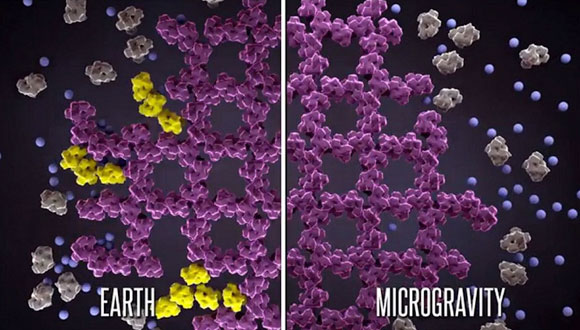
    In microgravity, crystals grow more slowly, but the molecules have time to more perfectly align on the surface of the crystal which returns much better research data. Credit: NASA

    The newest Benefits for Humanity video highlights how high-quality crystals grown in microgravity lead to new therapeutics for disease.

    In one of many direct Earth applications of International Space Station research, the newest Benefits for Humanity video in the Benefits series highlights how the investigation of protein crystals in space is helping to treat Duchenne Muscular Dystrophy (DMD), an incurable genetic disorder affecting the muscles with onset usually in early childhood and primarily in young males.

    Research into a disease like DMD involves the study of the structure of associated proteins by crystallization, which helps researchers better understand protein function. This comprises making millions of copies of that protein and arranging them in three-dimensional rows. Crystals grown on Earth are impacted by gravity, which may affect the way the molecules align on the surface of the crystal. Researchers have discovered that growing crystals aboard the space station allows for slower growth and higher quality crystals.

    Since 2003, scientists with the Japan Aerospace Exploration Agency have conducted protein crystal growth investigations on the space station, including proteins associated with DMD. Having a better understanding of the protein’s shape enabled researchers to design a drug that fits specifically into a location on the protein associated with DMD. The research team estimates that the drug may be able to slow the progression of DMD by half.

    “Studying this protein led to a huge discovery,” said Dr. Yoshihiro Urade, Ph.D., professor at the University of Tsukuba in Tsukuba, Japan. “What we’re talking about is potentially doubling the lifespan of many DMD patients, and it’s all because of research opportunities afforded to us by the International Space Station.”

    With many other protein crystal growth studies occurring or planned aboard the space station, many thousands of other proteins’ structures could be determined. This is yet another way the orbiting laboratory is enabling research Off the Earth, For the Earth

    Never miss a breakthrough: Join the SciTechDaily newsletter.
    Follow us on Google and Google News.

    Disease International Space Station
    Share. Facebook Twitter Pinterest LinkedIn Email Reddit

    Related Articles

    Researchers Continue Biological Research at International Space Station

    New Insight Into HIV Vaccination Strategies

    Onset of Schizophrenia Linked to Elevated Neural Links

    2014 – A look Back on a Significant Year for NASA

    New ScienceCast Video – Jellyfish Flames on the ISS

    Researchers Solve a Long Standing Nano Mystery

    NASA Researchers Plan to Create the Coldest Spot in the Known Universe

    SuperDense Quantum Teleportation Theory to be Tested on Space Station

    Microbicide Tricks HIV into “Popping” Itself into Oblivion

    Leave A Reply Cancel Reply

    • Facebook
    • Twitter
    • Pinterest
    • YouTube

    Don't Miss a Discovery

    Subscribe for the Latest in Science & Tech!

    Trending News

    Artificial Sweeteners May Harm Future Generations, Study Suggests

    Splashdown! NASA Artemis II Returns From Record-Breaking Moon Mission

    What If Consciousness Exists Beyond Your Brain

    Scientists Finally Crack the 100-Million-Year Evolutionary Mystery of Squid and Cuttlefish

    Beyond “Safe Levels”: Study Challenges What We Know About Pesticides and Cancer

    Researchers Have Found a Dietary Compound That Increases Longevity

    Scientists Baffled by Bizarre “Living Fossil” From 275 Million Years Ago

    Your IQ at 23 Could Predict Your Wealth at 27, Study Finds

    Follow SciTechDaily
    • Facebook
    • Twitter
    • YouTube
    • Pinterest
    • Newsletter
    • RSS
    SciTech News
    • Biology News
    • Chemistry News
    • Earth News
    • Health News
    • Physics News
    • Science News
    • Space News
    • Technology News
    Recent Posts
    • What if Dark Matter Has Two Forms? Bold New Hypothesis Could Explain a Cosmic Mystery
    • Researchers Expose Hidden Chemistry of “Ore-Forming” Elements in Biology
    • Geologists Reveal the Americas Collided Earlier Than We Thought
    • 20x Difference: Study Reveals True Source of Airborne Microplastics
    • Scientists Uncover Hidden Force Powering Yellowstone’s Supervolcano
    Copyright © 1998 - 2026 SciTechDaily. All Rights Reserved.
    • Science News
    • About
    • Contact
    • Editorial Board
    • Privacy Policy
    • Terms of Use

    Type above and press Enter to search. Press Esc to cancel.