
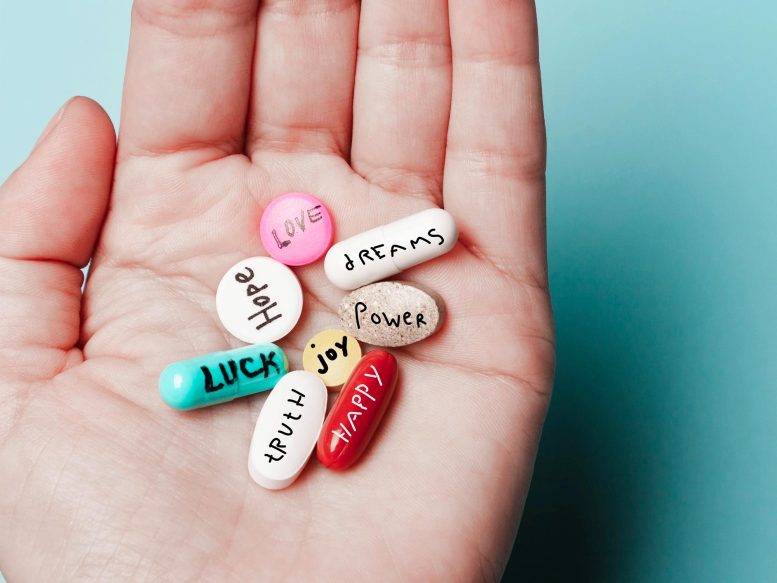
In an opinion article, Australian researchers argue that the ‘placebo effect’ — the idea that we can start to recover from illness after being given a sugar pill, simply because our brains and bodies believe we’ve really been treated — isn’t a real thing. They reviewed the evidence used to support the ideas behind the placebo effect, and say it is all flawed and that placebos only ever have a very small effect on patients. The scientists say they are concerned about the use of placebos in clinical practice, so decided to see if the placebo effect was a myth that needed to be debunked, and their work suggests it may be.
Many people have accepted the idea that taking a placebo – for example, a pill with no active medicine in it – can have powerful effects on the body. The reality is quite different, according to the authors of a Perspective published today by the Medical Journal of Australia.
A placebo is designed to look, taste, smell, and feel like a real treatment; but it does not contain the active ingredient. Examples include a sugar pill, salt water (saline), or a fake surgical procedure.
Placebos have entered popular culture. A good example is the famous M*A*S*H television series episode in which the doctors give the patients placebo capsules filled with the sugar scraped off doughnuts when the supply of morphine runs out.
Professor Christopher Maher, Director of the Institute for Musculoskeletal Health at the University of Sydney, and colleagues wrote that recent commentaries in major medical journals advocating for placebos in clinical care are based on deeply flawed studies.
“Given the recent advocacy for the clinical use of placebos, it is timely to consider the evidence underpinning these claims,” Maher and colleagues wrote.
Debunking Common Placebo Claims
The authors examined the evidence for recent claims such as:
- Placebos provide important treatment effects – “reviews that appropriately measure the placebo effect show that placebos usually only have modest effects”;
- The color and shape of a placebo pill influences the size of the placebo effect – “this idea has mainly come from studies where participants did not have a health condition or even take the placebo pill. The studies simply asked people what pill they thought might work best. And even these flawed studies yielded inconsistent results”;
- Placebos, even when honestly described as inert, create important clinical effects – “These claims are based upon doubtful science. For example, one study that supposedly supports this idea completely ignored the data for the control group.”; and,
- Placebos are getting more effective over time – “it is impossible to manipulate time in a clinical trial so this claim has no basis.”
Maher and colleagues wrote that the above claims were examples of “how much of the current discourse on placebo seems to focus more on enshrining placebos as mysterious and powerful and less on making a practical difference to patient care and outcomes.”
“We know from reviews of the clinical trial evidence that a placebo will provide a small effect, but the real treatment will normally provide better outcomes for the patient. “
“It would be better to dismiss placebos and instead manage patients with real evidence-based treatments.”
Reference: “Placebos in clinical care: a suggestion beyond the evidence” by Christopher G Maher, Adrian C Traeger, Christina Abdel Shaheed and Mary O’Keeffe, 19 September 2021, Medical Journal of Australia.
DOI: 10.5694/mja2.51230
Never miss a breakthrough: Join the SciTechDaily newsletter.
Follow us on Google and Google News.
3 Comments
I think that placebo effect actually works better for things anxiety or sleep disorders, reduced medication doses could also benefit from this effect and provide similar end results.
You can’t write in the headline that the effect is debunked. “Debunked” is definitive. You can write that it is questioned or you could write that it is rebutted. But the authors of the opinion piece provide no evidence to substantiate their claim, they merely question the evidence or lack of it. The placebo effect remains the benchmark for establishing the efficacy of new drugs, which suggests there is something there.
The ability of the mind to generate the symptoms of illness is known as the “nocebo” effect. The nocebo effect is the unpopular twin brother of the placebo effect. Whereas the placebo effect alleviates pain and the symptoms of illness, the nocebo effect does the opposite: it generates pain and symptoms. I found a neat and brief explanation of placebo and nocebo effect in the book by Randy Baker (net-boss org/the-power-of-the-placebo-effect-by-randy-baker)