
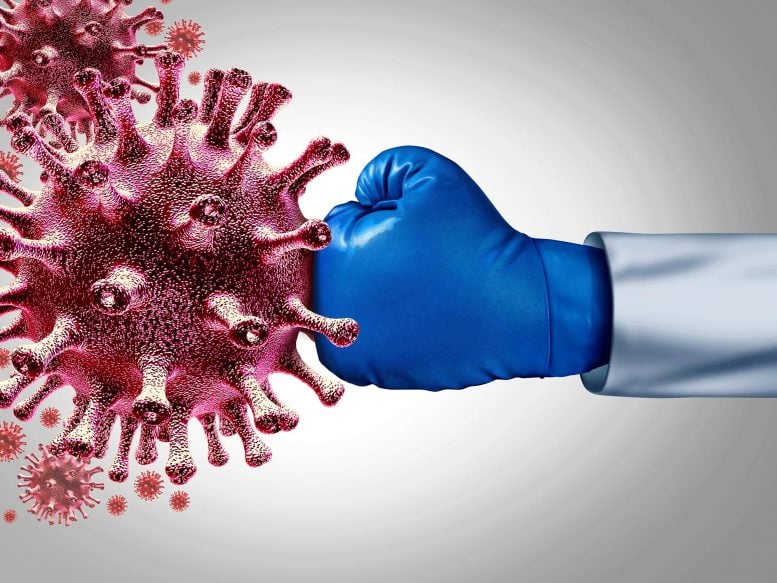
Research at Washington State University has identified the NS2 protein in RSV as crucial for the virus’s survival and the proliferation within cells. Blocking this protein could help prevent the severe inflammation associated with respiratory diseases like pneumonia and might inform treatments for other viruses.
One viral protein may provide clues for preventing pneumonia, which is brought on by the body’s heightened inflammatory response to respiratory viruses like the COVID-19 virus.
According to a study, if the Respiratory Syncytial Virus (RSV) lacks the viral protein NS2, the immune system of the host may eliminate the virus before excessive inflammation starts. The study was completed at Washington State University’s College of Veterinary Medicine and published in the journal MBio on January 18, 2022.
Consequences of Unchecked Viral Replication
RSV attacks the lung cells that are responsible for exchanging gases and utilizes them as factories to produce more respiratory viruses, similar to other respiratory viruses including the COVID-19-causing SARS-CoV-2 virus. These cells are destroyed as a result of unchecked viral replication, which can cause severe inflammation, lung disorders like pneumonia, and sometimes even death.
“Exaggerated inflammation clogs the airways and makes breathing difficult,” said Kim Chiok, a WSU post-doctoral researcher who led the study. “This is why people who have these long-term and severe inflammatory responses get pneumonia and need help breathing, and it’s why they end up in the hospital in the ICU.”
Investigating Virus Survival and Impact
By understanding how respiratory viruses, such as RSV, survive in the cell, Chiok and other WSU researchers are creating the groundwork to disrupt that cycle. According to the National Institute of Allergy and Infectious Diseases, RSV kills 160,000 people each year, mostly newborns, kids, the elderly, and those with impaired immune systems.
The research was conducted in the laboratory of Professor Santanu Bose, who is part of WSU’s Veterinary Microbiology and Pathology research unit. Chiok, a Fulbright Scholar from Peru who completed her Ph.D. at WSU, has spent the past two and a half years in the Bose laboratory exploring the mechanisms that regulate the virus-host battle.
The researchers first determined viral proteins’ functions by using viruses lacking genes that code for different viral proteins and comparing them to a wild strain of the virus.
“The virus has a series of tools, some tools with multiple functions, we wanted to learn about these tools by essentially taking them away,” Chiok said.
Each tool is a different viral protein.
Discovering the Role of the NS2 Protein
Chiok identified the viral NS2 protein as a key regulator of autophagy, a cellular process that modulates immune defense during virus infection. Autophagy is mediated by a cellular protein known as Beclin1.
When the virus enters the cell, Beclin1 can recognize and clear the threat from the cell. It does this by attaching to certain smaller gene proteins through a process known as ISGylation. It is almost like Beclin1 is putting on a suit of armor, Chiok said.
Potential Therapeutic Applications and Broader Impact
The study demonstrates that RSV’s NS2 protein removes this “armor” from Beclin1, enabling the virus to survive and proliferate within the cell, spread to adjacent cells, and cause damage that sets off an excessive inflammatory response from the body and results in respiratory disorders like pneumonia. Beclin1 consistently eliminates the virus in the absence of the NS2 protein.
“In a way you are disabling NS2’s ability to modulate the cell’s immune defense mechanism,” Chiok said. “You can use therapeutics to target that protein, and potentially transfer this concept to other respiratory viruses like influenza A virus and SARS-CoV-2.”
Reference: “Human respiratory syncytial virus NS2 protein induces autophagy by modulating Beclin1 protein stabilization and ISGylation” by Kim Chiok, Swechha M. Pokharel, Indira Mohanty, Lindsay Grace Miller, Shou-Jiang Gao, Arthur L. Haas, Kim C. Tran, Michael N. Teng and Santanu Bose, 18 January 2022, mBio.
DOI: 10.1128/mbio.03528-21
This study was funded by a grant from the National Institutes of Health awarded to Bose.
Never miss a breakthrough: Join the SciTechDaily newsletter.
Follow us on Google and Google News.