
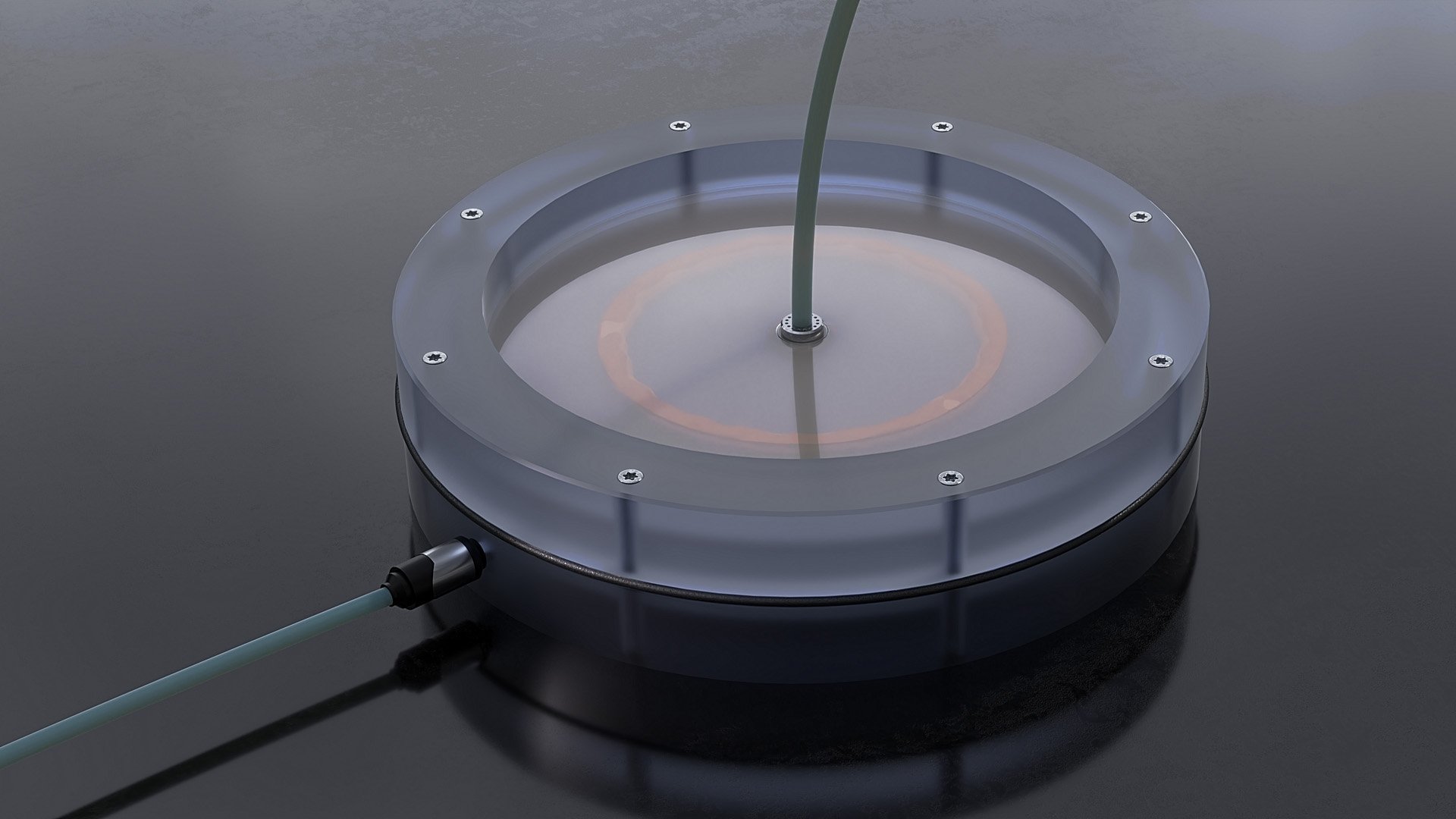
Experiments in weightlessness isolate the classic phenomenon of diffusion.
For years, researchers have developed various models to describe a critical class of mixing effects, such as those occurring in the flow within a chemical reactor. However, experimental validation has significantly lagged behind, primarily due to the interference of gravity effects.
A European research team involving the Helmholtz-Zentrum Dresden-Rossendorf (HZDR) and partners at the University of Szeged (Hungary) and Université libre de Bruxelles (ULB, Belgium) has now closed this gap with experiments conducted under weightlessness. The researchers recently published their results in the Nature journal npj Microgravity.
So-called reaction-diffusion fronts occur when two chemicals react with one another and at the same time spread out. Scientists can use this effect to model and better understand problems in chemistry and physics as well as in completely different areas like the financial world or linguistics as the underlying mathematical equations have the same characteristics. It gets more complicated when researchers combine these reactions with flows.
Processes of this kind are important for technological applications relating to combustion processes, geology, the production of specific materials and storing carbon dioxide. Despite the plethora of applications, essential parts of these systems are not yet fully understood.
“Up to now, experiments to verify models of such processes have been distorted by buoyancy effects caused by density differences between the reaction solutions. In order to isolate this problem, we conducted experiments using weightlessness on board a sounding rocket. Our partners did parallel numerical simulations to show the importance of the two-dimensional effects that can’t be taken into account in simple one-dimensional models,” says Dr. Karin Schwarzenberger of HZDR’s Institute of Fluid Dynamics, outlining the work of her team.
Rocket take-off at the Arctic Circle
The experiment took place on 1 October 2022 – on board the sounding rocket TEXUS-57 which was launched from the Esrange Space Center, 40 kilometers east of Kiruna in Sweden. The collaborative project involving Airbus Defense & Space, the European Space Agency ESA, and the German Aerospace Center (DLR) transported, among other things, the Schwarzenberger team’s experimental model to the outskirts of space. The module had three reactors of different sizes consisting of glass plates stacked on top of each other at differing proximity. The rocket reached a height of 240 kilometers, achieving a state of almost complete weightlessness for nearly six minutes.
During this period, the researchers were able to run their experiments automatically – experiments that resulted from several years of meticulous planning. The reaction was triggered when the weightlessness set in. Three high-resolution cameras filmed the reaction fronts that spread between two flowing liquids. It was these images that were the focus of all the team’s efforts: with their help, the researchers can now separate a very specific mixing effect from other flow phenomena.
Flow physics in weightlessness
Flows in liquid channels exhibit uneven velocity distribution due to friction with the walls, which subsequently influences the transport of dissolved substances and diffusing reactants in the liquid. This diffusion effect is known as Taylor-Aris dispersion, named for the two researchers who laid the foundations for understanding it back in the 1950s. In the past, theoretical studies proposed models of varying complexity to describe the interplay of Taylor-Aris dispersion and chemical reactions.
With regard to applications, however, it is important to assess the preconditions under which the various models can be used. This meant conducting experiments to isolate Taylor-Aris dispersion from other flow phenomena. On Earth, Taylor-Aris dispersion is essentially superimposed by buoyancy effects caused by gravity. Up to now, researchers have tried minimizing the buoyancy effects by using shallow reactors – but it never worked completely because a certain range of reactor heights and flow velocities still needed to be covered in order to take in many application fields. But the larger the flow system, the stronger the gravity. The researchers have now been able to overcome these limitations in zero gravity.
A comparison with the reference experiments on the ground revealed that significantly less reaction product was generated at greater reactor heights under weightlessness. Even more important were the image data of the reaction fronts that were not distorted by the buoyancy effects. The Brussels partners were thus able to replicate the development of the front in various theoretical models. Joint evaluation showed that in very shallow reactors with slow flow, simple one-dimensional models can be used. However, in the case of larger reactors or faster flow, two-dimensional models using Taylor-Aris dispersion are required.
Within these validity ranges the corresponding correlations can now be employed to predict product formation. This can be used to design innovative reactors, for the targeted synthesis of particles and fluid transport in geological layers, but also to supply space stations, where gravitational conditions differ from those on Earth.
Reference: “Unraveling dispersion and buoyancy dynamics around radial A + B → C reaction fronts: microgravity experiments and numerical simulations” by Yorgos Stergiou, Darío M. Escala, Paszkál Papp, Dezső Horváth, Marcus J. B. Hauser, Fabian Brau, Anne De Wit, Ágota Tóth, Kerstin Eckert and Karin Schwarzenberger, 9 May 2024, npj Microgravity.
DOI: 10.1038/s41526-024-00390-8
Never miss a breakthrough: Join the SciTechDaily newsletter.
Follow us on Google and Google News.