

Scientists have discovered how brain circuits affected by stress can predict resilience in mice.
By stimulating certain neurons, they could transform less resilient mice into ones that actively sought pleasure, suggesting a potential new treatment pathway for depression.
Resilience and Depression: Brain Circuit Insights
Some people recover from trauma and regain their happiness, while others remain trapped in depressive cycles that drain the joy from their lives.
Researchers at the University of California, San Francisco are investigating why these differences occur, focusing on how the brain shapes these contrasting responses. Their goal is to develop treatments for individuals struggling with persistent stress-related symptoms.
Exploring Brain Responses to Stress
In their study, scientists discovered that stress alters activity in specific brain circuits in mice. These changes differentiate mice that recover from stress from those that do not.
By stimulating certain neurons in the less resilient mice to increase their activity, the researchers observed a remarkable shift: the mice stopped dwelling on negative experiences and began seeking pleasure, such as drinking sugar-sweetened water.
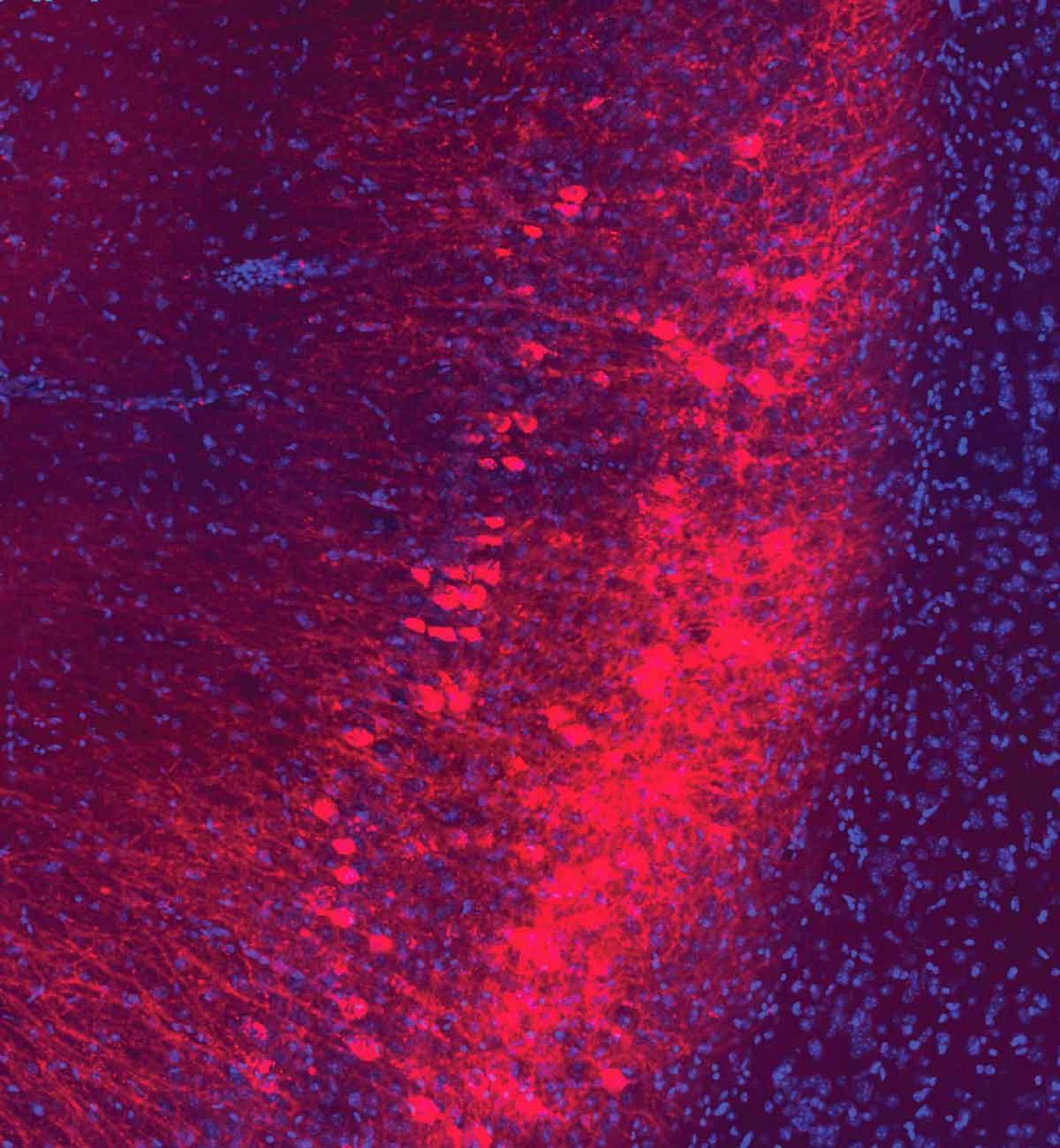
“Seeing that we can set these brain signals back on course in mice suggests that doing the same in humans could act as an antidepressant,” said Mazen Kheirbek, PhD, an associate professor of psychiatry and senior author of the study, which was published on December 4 in Nature.
“There’s considerable interest in finding out how we can we translate these discoveries to an approach that will work in people. If we can do that, we’ll have a new, non-invasive way of treating depression.”
Mazen Kheirbek, PhD
The Stress of Indecision
Kheirbek, a member of the UCSF Weill Institute for Neurosciences, set out to find the signature with a team that included Frances Xia, PhD, an associate specialist in psychiatry at UCSF, and two scientists from Columbia University, Valeria Fascianelli, PhD, and Stefano Fusi, PhD.
The researchers looked at a brain region called the amygdala, which helps to evaluate how risky it may be to seek a reward.
First, they observed brain activity while the mice were resting. Stress had changed the activity in the amygdala of the less resilient mice much more than it had in the resilient ones.
When the researchers gave the mice a choice between plain and sugar-sweetened water, the resilient mice easily chose the sugar water. But the less resilient mice became obsessed and often opted for the plain water.
Xia looked at brain recordings of the mice who chose the sweet water. Their amygdala was communicating with a nearby brain region called the hippocampus that remembers and predicts.
She saw a different pattern in the mice that could not decide whether to drink the plain or sweetened water. In those mice, the conversation between the two brain areas sputtered.
“The process actually wiped out the whole state of indecision and turned these guys into resilient mice.”
Frances Xia, PhD
Behavioral Changes Through Brain Stimulation
Xia thought she could stop the mice from ruminating and improve their decision-making if she could get the neurons that connect these two regions to fire more often.
She used a technique called chemogenetics, which employs artificial molecules that interact inside the body. The team attached one of the molecules, a receptor, to the surface of neurons in the hippocampus to make them fire.
Then, Xia injected the less resilient mice with a second molecule that bound to the receptor and made the neurons fire.
When the team once again gave the rumination-prone mice a choice of waters, they took the sweet treat. The mice’s brain activity also looked resilient.
“The whole thing seemed like such a wild idea that I almost couldn’t believe it worked,” Xia said. “The process actually wiped out the whole state of indecision and turned these guys into resilient mice.”
The team plans to look at human brain data to see if they can find similar signatures.
Kheirbek is working with researchers at the Dolby Family Center for Mood Disorders to explore different ways of changing these brain patterns.
“There’s considerable interest in finding out how we can we translate these discoveries to an approach that will work in people,” he said. “If we can do that, we’ll have a new, non-invasive way of treating depression.”
Reference: “Understanding the neural code of stress to control anhedonia” by Frances Xia, Valeria Fascianelli, Nina Vishwakarma, Frances Grace Ghinger, Andrew Kwon, Mark M. Gergues, Lahin K. Lalani, Stefano Fusi and Mazen A. Kheirbek, 4 December 2024, Nature.
DOI: 10.1038/s41586-024-08241-y
Other authors include Nina Vishwakarma, Frances Grace Ghinger, Andrew Kwon, Mark M. Gergues, and Lahin K. Lalani of UCSF.
The study was supported by the National Institutes of Health (F31 MH130127, DSPAN F99/K00 NS130927, R01 MH108623, R01 MH111754, R01 MH117961, R01 MH125515 and R01 DC019813), Neuronex (NSF1707398), the Canadian Institutes of Health Research Postdoctoral Scholarship, the Brain and Behavior Research Foundation Young Investigator Award, the Ray and Dagmar Dolby Family Fund, the Simons Foundation, the Gatsby Charitable Foundation (GAT3708), the Kavli Foundation the Swartz Foundation, the One Mind Rising Star Award and the Human Frontier Science Program (RGY0072/2019), the Esther A. and Joseph Klingenstein Fund, the Pew Charitable Trusts and the McKnight Memory and Cognitive Disorders Award.
Never miss a breakthrough: Join the SciTechDaily newsletter.
Follow us on Google and Google News.
16 Comments
Definitely not understanding this
Depression is a symptom of bad living conditions. Treating symptoms never works long-term. You don’t get to engineer the brain and expect people to be happy, if you don’t improve the quality of life for them as well.
As a 60-year-old male who has been dealing with my depression for 40+ years, through widely-varying economic and living situations, and I assure you my depression gave zero F’s about those things.
If you had said depression can SOMETIMES be a symptom of bad living conditions… I’d still probably disagree.
Bear in mind that there are several major kinds of depression. I may have been more accurate in formulation but that’s beside the point.
Disagree if you must, but you just might be depriving yourself from healthy options in life if you refuse to even give a look into them.
The point I was making is that expecting the technology to solve the problems caused by technology to begin with, is just gonna set people up for more disappointment. And consequently more depression.
On another note, you did say “my depression didn’t give a…”. To me that says that you yourself are acknowledging that your depression isn’t “you”. That sounds like a start of the journey towards solving your problems.
We know that expecting medical “technology” to solve problems is a useful expectation.
If you are not a doctor you should preferably abstain from uninformed comments and opinions on medical issues and advice on personal problems – in both cases misinformation/disinformation can harm.
Well, I am a doctor. So what are you gonna do now, Karen?
I’m trying to help the guy with a well meaning advice from practice, and you come on like an idiot screaming “misinformation”. Be proud, you’ve been brainwashed well.
I wasn’t specific about the branch of technology – I meant all technology. But since you brought up medical technology, and misinformation, let me be the first to inform you that all the big pharmaceutical companies pay billions in fines, on a yearly basis, for false advertising and attempts to hide the knowledge of harmful sideffects their products cause to patients.
So, good luck with your expectations, dumbass.
Indecision is a feature, not a bug. We need it often. Wiping it out may create the ‘sometimes wrong, never in doubt’ personality.
The Germans have a saying; materialists and madmen never have doubts. Examples will come to mind.
Seems more like ‘turns them into vacant consumers’ than ‘makes them feel better’.
So far just mice ready to take over the world!
I don’t think “vacant” would be an effect of treating stress induced depression, and of course it helped the mice to resume being happy consumers. Why would we expect differently!?
Several experiences have led me to conclude that depression can be a result of a deviated septum and the consequential exhaustion of oxygen to specific parts of the brain. Check how many of your depressed patients can actually pronounced “N” or “M”. Encourage them to correct it.
There might be something there.
Pass it on. [email protected]. I have given away several good ideas to people who can get some recognition. People have a way of ignoring me. I don’t mind.
Sugar water seems less healthy than regular water…
My septum theory might also explain why exercise is such a helpful remedy to depression. Also, getting a “nose job” is such a lift, as it usually involves a deviated septum.