
Close Menu
    Facebook X (Twitter) Instagram
    SciTechDaily
    • Biology
    • Chemistry
    • Earth
    • Health
    • Physics
    • Science
    • Space
    • Technology
    Facebook X (Twitter) Pinterest YouTube RSS
    SciTechDaily
    Home»Chemistry»Detection of Sugars in Laboratory Simulation of Interstellar Organic Matter
    Chemistry

    Detection of Sugars in Laboratory Simulation of Interstellar Organic Matter

    By Institut d’Astrophysique SpatialeJanuary 13, 2015No Comments3 Mins Read
    Facebook Twitter Pinterest Telegram LinkedIn WhatsApp Email Reddit
    Share
    Facebook Twitter LinkedIn Pinterest Telegram Email Reddit
    Detection of Sugars in Laboratory Simulation of Interstellar and Pre-Cometary Organic Matter
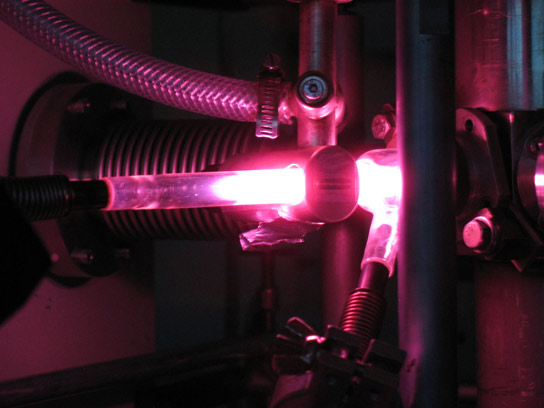
    UV source for astrochemistry experiments at IAS. Credit: P. de Marcellus 

    Using multidimensional gas chromatography coupled to time-of-flight mass spectrometry, researchers have detected 10 aldehydes laboratory samples which were created to simulate material found in interstellar molecular clouds.

    Ten aldehydes, including two sugars potentially important for prebiotic chemistry, have for the first time been identified in organic residues issued from photochemistry of interstellar ice analogs, produced in the laboratory by the IAS MICMOC/SUGARS experiment.

    The MICMOC experiment (Matière Interstellaire et Cométaire: Molécules Organiques Complexes) has a variant (Chiral-MICMOC on the SOLEIL synchrotron) which investigates the spatial conformation (left, L, or right D) of the amino acids produced under the photochemical action of ultraviolet circularly polarized light. The aim of this experiment is to propose an astrophysical scenario for the origin of homochirality observed in biological molecules on Earth. The MICMOC/SUGARS experiment is another variant of the initial setup. This fully interdisciplinary approach assembles astrophysicists, molecular physicists, and chemists. It mixes an experimental approach including a strong astrophysical background with the simulation of the evolution of interstellar ice analogs in the laboratory and sophisticated analytical chemistry methods for the detection of molecules of prebiotic interest.

    The detection of numerous amino acids in the organic residues produced by the photo/thermo-chemistry of ices has been reported, in part thanks to our collaboration between IAS (Orsay) and INC (Nice). The overall quality of the samples produced by the IAS team « Astrochimie et Origines » has been attested by the use of 13C atoms markers in the original ice samples to avoid any confusion with possible contamination of the samples during manipulation.

    Recently, a change in the analytical procedure has allowed the detection of a new family of molecules: the aldehydes. Among them are the two sugars glycolaldehyde and glyceraldehyde, potentially important for prebiotic chemistry. According to a recent study, these molecules may be considered as possible precursors of ribonucleotides (constituents of RNA), in the same manner that amino acids (which are detected within the same experimental protocol) are key molecules for the early formation of proteins. The detection of these molecules in our samples strengthens the scenario of an exogenous delivery of organic molecules essential for starting prebiotic chemistry at the surface of the early Earth.

    Finally, if glycolaldehyde is indeed detected in the interstellar medium, that is not the case yet for glyceraldehyde, which can be seen now as a potential target for large modern radio astronomy instruments such as ALMA. Glyceraldehyde could also be proposed for detection in primitive carbonaceous meteorites.

    Reference: “Aldehydes and sugars from evolved precometary ice analogs: Importance of ices in astrochemical and prebiotic evolution” by Pierre de Marcellus, Cornelia Meinert, Iuliia Myrgorodska, Laurent Nahon, Thomas Buhse, Louis Le Sergeant d’Hendecourt and Uwe J. Meierhenrich, 12 January 2015, PNAS.
    DOI: 10.1073/pnas.1418602112


    Never miss a breakthrough: Join the SciTechDaily newsletter.
    Follow us on Google and Google News.

    Astrobiology Astrochemistry Astronomy Biochemistry
    Share. Facebook Twitter Pinterest LinkedIn Email Reddit

    Related Articles

    New Chemical Recipes for Life’s Origins: Guiding Us to Distant Planets Inhabited by Extraterrestrials

    Gamma Rays and Meteorites: The Unlikely Duo That May Have Sparked Life on Earth

    Alien Life May Not Be Like Earth Life: Scientists Find Molecular Patterns That May Help Identify Extraterrestrial Life

    Life on Venus? Scientists Shed More Light on Molecules Linked to Life on Other Planets

    How Did Organic Matter Reach Earth? Cosmic Detectives Trace Origin of Complex Organic Molecules

    Stardust and Radiation Could Lead to Complex Biomolecule Forms

    Astrochemists Discover How to Use Methanol to Measure Magnetic Fields in Space

    New Technique to Search Space Dust for Molecules Critical for Life

    Goddard Lab Researchers Study the Chemistry of Cosmic Ice

    Leave A Reply Cancel Reply

    • Facebook
    • Twitter
    • Pinterest
    • YouTube

    Don't Miss a Discovery

    Subscribe for the Latest in Science & Tech!

    Trending News

    Popular Sugar-Free Sweetener Linked to Liver Disease, Study Warns

    What Is Hantavirus? The Deadly Disease Raising Alarm Worldwide

    Scientists Just Discovered How the Universe Builds Monster Black Holes

    Scientists Unveil New Treatment Strategy That Could Outsmart Cancer

    A Simple Vitamin May Hold the Key to Treating Rare Genetic Diseases

    Scientists Think the Real Fountain of Youth May Be Hiding in Your Gut

    Ravens Don’t Follow Wolves, They Predict Them

    This Common Knee Surgery May Be Doing More Harm Than Good

    Follow SciTechDaily
    • Facebook
    • Twitter
    • YouTube
    • Pinterest
    • Newsletter
    • RSS
    SciTech News
    • Biology News
    • Chemistry News
    • Earth News
    • Health News
    • Physics News
    • Science News
    • Space News
    • Technology News
    Recent Posts
    • Why Are So Many New Fathers Dying? Scientists Say the U.S. Has a Dangerous Blind Spot
    • Scientists Identify Simple Supplement That Greatly Reduces Alzheimer’s Damage
    • You May Have a Dangerous Type of Cholesterol Even if Your Tests Look Normal
    • Study Reveals Dangerous Flaw in AI Symptom Checkers
    • New MRI Breakthrough Captures Stunningly Clear Images of the Eye and Brain
    Copyright © 1998 - 2026 SciTechDaily. All Rights Reserved.
    • Science News
    • About
    • Contact
    • Editorial Board
    • Privacy Policy
    • Terms of Use

    Type above and press Enter to search. Press Esc to cancel.