

Genetic studies point to female-centered living arrangements in Neolithic Çatalhöyük. Yet, power may not have rested solely with women.
What was daily life like 8,000 to 9,000 years ago for the inhabitants of the East Mound at Çatalhöyük, a major Neolithic settlement in central Anatolia? And what roles did women play within this ancient community? A team of researchers from Turkey, Denmark, Sweden, and the United States analyzed the genetic material of 131 individuals buried at the site.
One of the most notable findings was a pattern favoring maternal lineages. The results of the study have been published in the journal Science, with Dr. Eva Rosenstock from the Bonn Center for ArchaeoSciences contributing to the research.
Located near Konya in modern-day Turkey, Çatalhöyük is one of the oldest known sites of continuous human habitation. Its residents lived in closely packed mudbrick homes and sustained themselves through agriculture and animal husbandry.
“Çatalhöyük is the leading site for finds dating from the Pottery Neolithic in Anatolia,“ explains Dr. Eva Rosenstock from the Bonn Center for ArchaeoSciences at the University. “People were already making clay vessels there in the 7th and 6th millennia BCE. The settlement lay on the route along which Neolithic technologies spread to Europe from their home in western Asia.”
University of Bonn researchers’ excavations
From 2006 to 2013, Eva Rosenstock and her team carried out excavations on the West Mound of Çatalhöyük (dated to approximately 6100–5500 BCE), which partially overlapped with the later phase of the East Mound settlement. During their work, the archaeologists uncovered two skeletons of newborn infants. “These are the only prehistoric human remains found on the West Mound to date and were incorporated into the study,” Rosenstock explains.
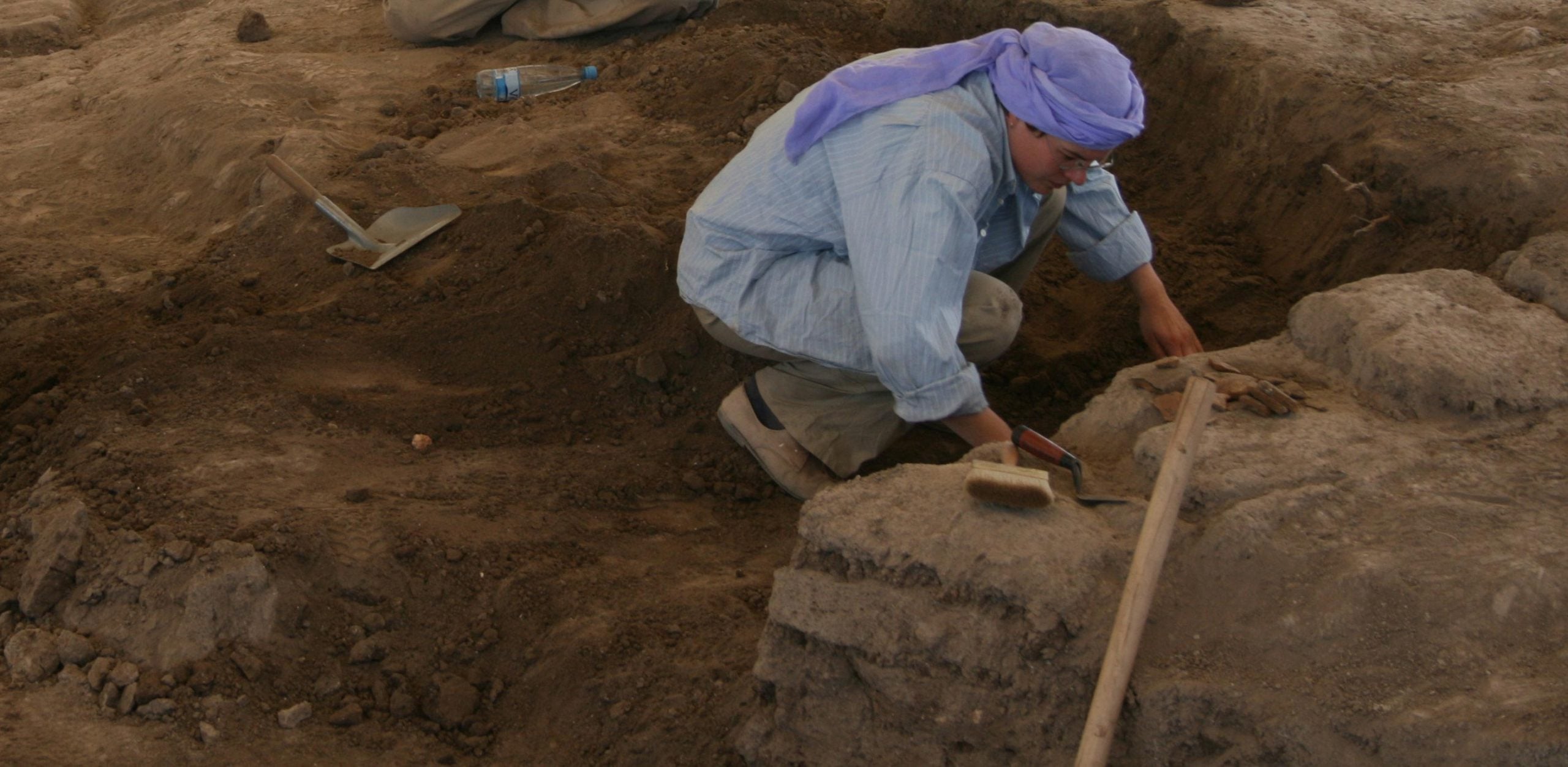
Using standard archaeological protocols, the team carefully excavated the remains and documented the skeletal features to provide the necessary contextual information. Specialists in archaeogenetics then conducted genetic analyses on the samples.
“The methods have been around for some time, but the material that makes up the samples is new,” Rosenstock notes. “Until a few years ago, teeth were thought to be the best biological source for ancient DNA, but we now know that the petrous bone—the densest bone in the human body—preserves genetic material far better.” This technique made it possible to perform genetic testing despite the challenging preservation conditions caused by the region’s dry continental climate.
Corpses under the floor
At Çatalhöyük, the dead were often buried beneath the floors of the homes they once inhabited. Earlier analyses of skeletal traits suggested a surprising pattern: individuals buried within the same house were generally not biologically related, while those who shared close genetic similarities were dispersed across the broader settlement.
This finding indicates that household membership may have been based on cultural, social, or economic criteria rather than family ties. Rosenstock explains, “Ever since it’s been possible to study DNA that’s this old, therefore, we’ve been using archaeogenetics to try and see how the occupants of a particular house were related.”
The two infant skeletons uncovered by Rosenstock’s team were also found within the same structure, yet genetic analysis confirmed they were not closely related. Furthermore, their DNA matched the genetic profile of individuals previously discovered on the East Mound. “This is yet another sign of the continuity between the East and West Mounds, which we’ve been able to show with our excavations,” Rosenstock says. This genetic consistency challenges earlier theories that suggested a break in settlement and a significant cultural shift between the two periods.
Atop the remains of one’s ancestors
For centuries, the houses in Çatalhöyük were always built on what was left of their predecessors’ walls. This meant that, not only did the mounds grow rapidly upwards, they also provide material “maps” of a Neolithic culture of remembrance in which people lived on top of generations of remains left by their ancestors, including the skeletons of former occupants. We do not yet know why, around 6000 BCE, this tradition was broken briefly, and the West Mound was begun.
The “Science” study now largely confirms the finding that being biologically related was just one factor among many when it came to forming households in Çatalhöyük. “However, female lineages were more important than male ones here in the 7th millennium BCE,” reveals Eva Rosenstock, who is also a member of the Present Pasts Transdisciplinary Research Area at the University of Bonn.
People buried in the same building were more closely related along the female line than the male line. “This suggests that women were more important as far as forming households went,” Rosenstock says, drawing her conclusion based on the analyses. “You might be able to call that matrilocality at the household level, but it’s not quite a matriarchate in the sense of women wielding power.” Nevertheless, she concedes, locality can be used to draw conclusions about power relations in many cultures.
Did the people of Çatalhöyük live in a society dominated by women? Notions of a prehistoric matriarchate date back to ancient times and have been revisited repeatedly ever since. “Even the very first person to dig here, James Mellaart, suspected that women were very important in Çatalhöyük—primarily based on the female figurines and other objects that were found,” the University of Bonn archaeologist says. Women were buried alongside a richer assortment of grave goods, which might indicate a higher status. Rosenstock adds: “And now, several decades later, material from the new excavations and state-of-the-art scientific methods have been used to uncover yet more facts.”
This raises some further questions: when and why did the role played by men and kinship become more important in Europe as the Neolithic advanced? And what were the next developments in western Asia?
Reference: “Female lineages and changing kinship patterns in Neolithic Çatalhöyük” by Eren Yüncü, Ayça Küçükakdağ Doğu, Damla Kaptan, Muhammed Sıddık Kılıç, Camilla Mazzucato, Merve N. Güler, Elifnaz Eker, Büşra Katırcıoğlu, Maciej Chyleński, Kıvılcım Başak Vural, Ekin Sağlıcan, Gözde Atağ, Defne Bozkurt, Jessica Pearson, Arda Sevkar, N. Ezgi Altınışık, Marco Milella, Cansu Karamurat, Şevval Aktürk, Emre Deniz Yurttaş, Nisan Yıldız, Dilek Koptekin, Sevgi Yorulmaz, Duygu Deniz Kazancı, Ayça Aydoğan, Kanat Gürün, Eline M.J. Schotsmans, Jana Anvari, Eva Rosenstock, Jennifer Byrnes, Peter F. Biehl, David Orton, Vendela Kempe Lagerholm, Hasan Can Gemici, Milena Vasic, Arkadiusz Marciniak, Çiğdem Atakuman, Yılmaz Selim Erdal, Emrah Kırdök, Marin Pilloud, Clark Spencer Larsen, Scott D. Haddow, Anders Götherström, Christopher J. Knüsel, Füsun Özer, Ian Hodder and Mehmet Somel, 26 June 2025, Science.
DOI: 10.1126/science.adr2915
Never miss a breakthrough: Join the SciTechDaily newsletter.
Follow us on Google and Google News.
2 Comments
If true, it must have been hell on Earth.
““This suggests that women were more important as far as forming households went,”
Perhaps the women were happy to have a variety of male mates. Nothing new about that!