
Close Menu
    Facebook X (Twitter) Instagram
    SciTechDaily
    • Biology
    • Chemistry
    • Earth
    • Health
    • Physics
    • Science
    • Space
    • Technology
    Facebook X (Twitter) Pinterest YouTube RSS
    SciTechDaily
    Home»Space»Early Quasars Got a “Super Boost” from Star Clusters
    Space

    Early Quasars Got a “Super Boost” from Star Clusters

    By Jim Shelton, Yale UniversityAugust 12, 2014No Comments3 Mins Read
    Facebook Twitter Pinterest Telegram LinkedIn WhatsApp Email Reddit
    Share
    Facebook Twitter LinkedIn Pinterest Telegram Email Reddit
    Analysis Shows That Early Quasars Got a Super Boost from Large Reservoirs of Gas
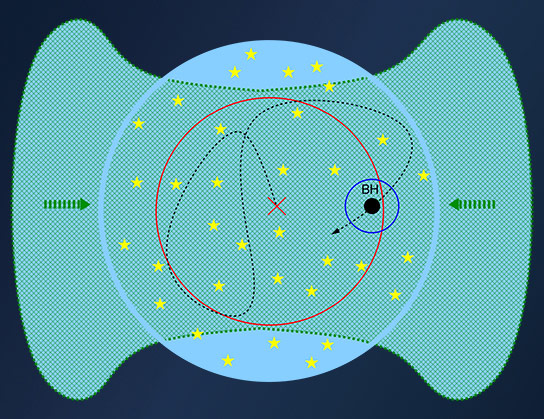
    This graphic shows the center of a newly formed star cluster (stars are in yellow), within which the seed black hole gets its super boost of gas (shown in blue). Credit: Yale News

    New research from Yale University and the Weizmann Institute shows that early quasars took in a “super boost,” feasting from large reservoirs of gas that were part of early star clusters.

    The universe’s oldest, brightest beacons may have gorged themselves in the dense, cold, gas flows of the early cosmos — creating a kind of energy drink for infant black holes in the young universe — according to new research by scientists at Yale University and the Weizmann Institute in Israel.

    For years, scientists have tried to explain the intense luminosity of quasars in the early universe. Quasars’ light is powered by swirling gas that is pulled in from the gravity of black holes. Located in the deepest precincts of space, the energy emitted by this infalling gas reveals the presence of black holes.

    Yet the earliest quasars — those dating from when the universe was barely a billion years old (today the universe is 13.8 billion years old) — have proved baffling. Their brightness suggests they harbor black holes with a million times more mass than the Sun; scientists have been at a loss to understand how these behemoths assembled so rapidly, by cosmic standards.

    “The first black holes are believed to be remnants left behind after the first stars burned out completely,” said Priyamvada Natarajan, a Yale University professor of astronomy and physics. “The puzzle has been how these ‘seed’ black holes grew into the monsters that we now see within the time available, a few billion years at best.”

    Natarajan and fellow researcher Tal Alexander of the Weizmann Institute have come up with a possible answer. Their analysis shows that early quasars took in a “super boost,” feasting from large reservoirs of gas that were part of early star clusters.

    The research appears in the journal Science.

    Natarajan and Alexander found that the robust, volatile nature of the early universe made such conditions quite likely. New black holes, they explain, were swept up into a celestial smorgasbord of gas in the star clusters that harbor them. This motion, in turn, circumvented normal restrictions that would prevent black holes from gorging on gas at a much-accelerated rate.

    “There is a new way to super boost the growth of early black holes and make them very massive within a very short time in the early universe,” Natarajan said.

    The scientists discovered the mechanism for this feeding frenzy by combining their areas of expertise. Alexander works in stellar dynamics, and Natarajan has long studied the growth history of black holes.

    “We realized that the setting where this kind of unbridled growth of initial seeds can occur was found to be commonplace in numerical simulations of the early universe,” Natarajan said.

    The research was supported in part by the National Science Foundation, with a grant from the Theoretical and Computational Astrophysics Network.

    Reference: “Rapid growth of seed black holes in the early universe by supra-exponential accretion” by Tal Alexander and Priyamvada Natarajan, 7 August 2014, Science.
    DOI: 10.1126/science.1251053
    arXiv: 1408.1718


    Never miss a breakthrough: Join the SciTechDaily newsletter.
    Follow us on Google and Google News.

    Astronomy Astrophysics Cosmology Weizmann Institute of Science Yale University
    Share. Facebook Twitter Pinterest LinkedIn Email Reddit

    Related Articles

    New Class of ‘Cold Quasars’ Was Unknown Until Now

    Astronomers Confirm The Existence of Galaxies With No Dark Matter

    Milky Way’s Supermassive Black Hole May Have ‘Wandering’ Siblings

    Milky Way Might Not Be as “Typical” as Previously Thought

    A New Approach to Detecting Earth-Like Worlds

    Astronomers Measure the Farthest Galaxy Ever Seen in the Universe

    ALMA Views the Episodic Outflow of Protostar CARMA-7

    Evidence of Galaxy Star Birth Regulated by Black Holes

    The Impact of Cosmic Wind on Galaxy Evolution

    Leave A Reply Cancel Reply

    • Facebook
    • Twitter
    • Pinterest
    • YouTube

    Don't Miss a Discovery

    Subscribe for the Latest in Science & Tech!

    Trending News

    New “Nanozyme Hypothesis” Could Rewrite the Story of Life’s Origins

    Anatomy Isn’t Finished: The Human Body Still Holds Secrets

    “Pretty Close to Home”: The Hidden Earthquake Threat Beneath Seattle

    The Surprising Reason You Might Want To Sleep Without a Pillow

    Scientists Say This Natural Hormone Reverses Obesity by Targeting the Brain

    35-Million-Year-Old Mystery: Strange Arachnid Discovered Preserved in Amber

    Is AI Really Just a Tool? It Could Be Altering How You See Reality

    JWST Reveals a “Forbidden” Planet With a Baffling Composition

    Follow SciTechDaily
    • Facebook
    • Twitter
    • YouTube
    • Pinterest
    • Newsletter
    • RSS
    SciTech News
    • Biology News
    • Chemistry News
    • Earth News
    • Health News
    • Physics News
    • Science News
    • Space News
    • Technology News
    Recent Posts
    • Scientists Finally Crack the 100-Million-Year Evolutionary Mystery of Squid and Cuttlefish
    • This Algae Could One Day Pull Microplastics out of Your Drinking Water
    • Scientists Can Now Read Your Body Clock From a Single Hair
    • Beyond “Safe Levels”: Study Challenges What We Know About Pesticides and Cancer
    • Researchers Have Found a Dietary Compound That Increases Longevity
    Copyright © 1998 - 2026 SciTechDaily. All Rights Reserved.
    • Science News
    • About
    • Contact
    • Editorial Board
    • Privacy Policy
    • Terms of Use

    Type above and press Enter to search. Press Esc to cancel.