
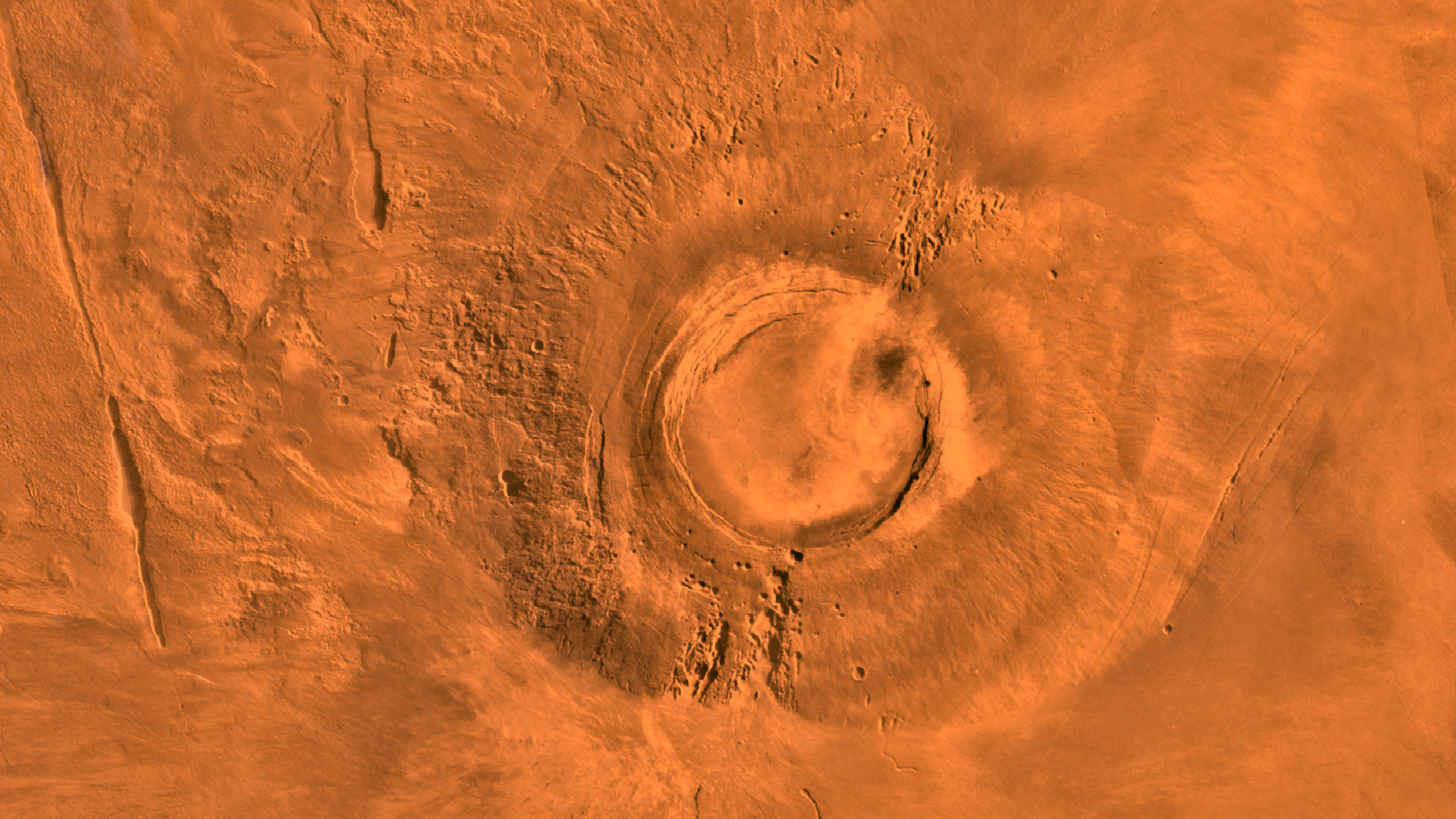
A new study from NASA reveals that the giant Martian shield volcano Arsia Mons produced one new lava flow at its summit every 1 to 3 million years during the final peak of activity. The last volcanic activity there ceased about 50 million years ago — around the time of Earth’s Cretaceous–Paleogene extinction.
Located just south of Mars’ equator, Arsia Mons is the southernmost member of a trio of broad, gently sloping shield volcanoes collectively known as Tharsis Montes. Arsia Mons was built up over billions of years, though the details of its lifecycle are still being worked out. The most recent volcanic activity is thought to have taken place in the caldera—the bowl-shaped depression at the top—where 29 volcanic vents have been identified. Until now, it’s been difficult to make a precise estimate of when this volcanic field was active.
“We estimate that the peak activity for the volcanic field at the summit of Arsia Mons probably occurred approximately 150 million years ago—the late Jurassic period on Earth—and then died out around the same time as Earth’s dinosaurs,” said Jacob Richardson, a postdoctoral researcher at NASA’s Goddard Space Flight Center in Greenbelt, Maryland. “It’s possible, though, that the last volcanic vent or two might have been active in the past 50 million years, which is very recent in geological terms.”
Richardson is presenting the findings on March 20, 2017, at the Lunar and Planetary Science Conference in The Woodlands, Texas. The study also is published in Earth and Planetary Science Letters.
Measuring about 68 miles (110 kilometers) across, the caldera is deep enough to hold the entire volume of water in Lake Huron, and then some. Examining the volcanic features within the caldera required high-resolution imaging, which the researchers obtained from the Context Camera on NASA’s Mars Reconnaissance Orbiter.
The team mapped the boundaries of the lava flows from each of the 29 volcanic vents and determined the stratigraphy, or layering, of the flows. The researchers also performed a technique called crater counting—tallying up the number of craters at least 330 feet (100 meters) in diameter—to estimate the ages of the flows.
Using a new computer model developed by Richardson and his colleagues at the University of South Florida, the two types of information were combined to determine the volcanic equivalent of a batting lineup for Arsia Mons’ 29 vents. The oldest flows date back about 200 million years. The youngest flows probably occurred 10 to 90 million years ago—most likely around 50 million years ago.
The modeling also yielded estimates of the volume flux for each lava flow. At their peak about 150 million years ago, the vents in the Arsia Mons’ caldera probably collectively produced about 1 to 8 cubic kilometers of magma every million years, slowly adding to the volcano’s size.
“Think of it like a slow, leaky faucet of magma,” said Richardson. “Arsia Mons was creating about one volcanic vent every 1 to 3 million years at the peak, compared to one every 10,000 years or so in similar regions on Earth.”
A better understanding of when volcanic activity on Mars took place is important because it helps researchers understand the Red Planet’s history and interior structure.
“A major goal of the Mars volcanology community is to understand the anatomy and lifecycle of the planet’s volcanoes. Mars’ volcanoes show evidence for activity over a larger time span than those on Earth, but their histories of magma production might be quite different,” said Jacob Bleacher, a planetary geologist at Goddard and a co-author on the study. “This study gives us another clue about how activity at Arsia Mons tailed off and the huge volcano became quiet.”
Reference: “Recurrence rate and magma effusion rate for the latest volcanism on Arsia Mons, Mars” by Jacob A. Richardson, James A. Wilson, Charles B. Connor, Jacob E. Bleacher and Koji Kiyosugi, 9 December 2016, Earth and Planetary Science Letters.
DOI: 10.1016/j.epsl.2016.10.040
Never miss a breakthrough: Join the SciTechDaily newsletter.
Follow us on Google and Google News.