
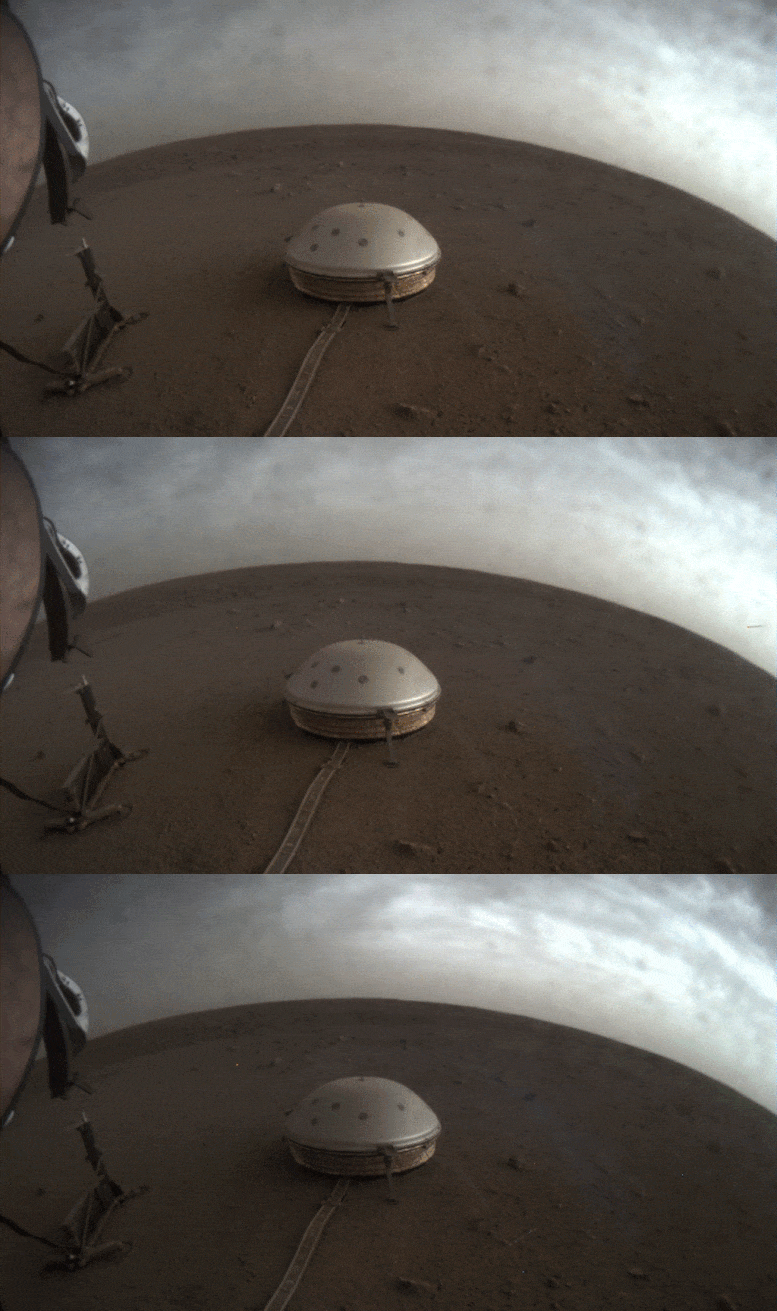
Put an ear to the ground on Mars and you’ll be rewarded with a symphony of sounds. Granted, you’ll need superhuman hearing, but NASA’s InSight lander comes equipped with a very special “ear.”
The spacecraft’s exquisitely sensitive seismometer, called the Seismic Experiment for Interior Structure (SEIS), can pick up vibrations as subtle as a breeze. The instrument was provided by the French space agency, Centre National d’Études Spatiales (CNES), and its partners.
SEIS was designed to listen for marsquakes. Scientists want to study how the seismic waves of these quakes move through the planet’s interior, revealing the deep inner structure of Mars for the first time.
But after the seismometer was set down by InSight’s robotic arm, Mars seemed shy. It didn’t produce its first rumbling until this past April, and this first quake turned out to be an odd duck. It had a surprisingly high-frequency seismic signal compared to what the science team has heard since then. Out of more than 100 events detected to date, about 21 are strongly considered to be quakes. The remainder could be quakes as well, but the science team hasn’t ruled out other causes.
Quakes
Put on headphones to listen to two of the more representative quakes SEIS has detected. These occurred on May 22, 2019 (the 173rd Martian day, or sol, of the mission) and July 25, 2019 (Sol 235). Far below the human range of hearing, these sonifications from SEIS had to be speeded up and slightly processed to be audible through headphones. Both were recorded by the “very broad-band sensors” on SEIS, which are more sensitive at lower frequencies than its short-period sensors.
The Sol 173 quake is about a magnitude of 3.7; the Sol 235 quake is about a magnitude of 3.3.
Each quake is a subtle rumble. The Sol 235 quake becomes particularly bass-heavy toward the end of the event. Both suggest that the Martian crust is like a mix of the Earth’s crust and the Moon’s. Cracks in Earth’s crust seal over time as water fills them with new minerals. This enables sound waves to continue uninterrupted as they pass through old fractures. Drier crusts like the Moon’s remain fractured after impacts, scattering sound waves for tens of minutes rather than allowing them to travel in a straight line. Mars, with its cratered surface, is slightly more Moon-like, with seismic waves ringing for a minute or so, whereas quakes on Earth can come and go in seconds.
Mechanical Sounds and Wind Gusts
SEIS has no trouble identifying quiet quakes, but its sensitive ear means scientists have lots of other noises to filter out. Over time, the team has learned to recognize the different sounds. And while some are trickier than others to spot, they all have made InSight’s presence on Mars feel more real to those working with the spacecraft.
“It’s been exciting, especially in the beginning, hearing the first vibrations from the lander,” said Constantinos Charalambous, an InSight science team member at Imperial College London who works with the SP sensors. “You’re imagining what’s really happening on Mars as InSight sits on the open landscape.”
Charalambous and Nobuaki Fuji of Institut de Physique du Globe de Paris provided the audio samples for this story, including the one below, which is also best heard with headphones and captures the array of sounds they’re hearing.
On March 6, 2019, a camera on InSight’s robotic arm was scanning the surface in front of the lander. Each movement of the arm produces what to SEIS is a piercing noise.
Wind gusts can also create noise. The team is always on the hunt for quakes, but they’ve found the twilight hours are one of the best times to do so. During the day, sunlight warms the air and creates more wind interference than at night.
Evening is also when peculiar sounds that the InSight team has nicknamed “dinks and donks” become more prevalent. The team knows they’re coming from delicate parts within the seismometer expanding and contracting against one another and thinks heat loss may be the factor, similar to how a car engine “ticks” after it’s turned off and begins cooling.
You can hear a number of these dinks and donks in this next set of sounds, recorded just after sundown on July 16, 2019 (Sol 226). Listen carefully and you can also pick out an eerie whistling that the team thinks may be caused by interference in the seismometer’s electronics.
What does it sound like to you? A hall full of grandfather clocks? A Martian jazz ensemble?
###
JPL manages InSight for NASA’s Science Mission Directorate. InSight is part of NASA’s Discovery Program, managed by the agency’s Marshall Space Flight Center in Huntsville, Alabama. Lockheed Martin Space in Denver built the InSight spacecraft, including its cruise stage and lander, and supports spacecraft operations for the mission.
A number of European partners, including France’s Centre National d’Études Spatiales (CNES) and the German Aerospace Center (DLR), are supporting the InSight mission. CNES provided the Seismic Experiment for Interior Structure (SEIS) instrument to NASA, with the principal investigator at IPGP (Institut de Physique du Globe de Paris). Significant contributions for SEIS came from IPGP; the Max Planck Institute for Solar System Research (MPS) in Germany; the Swiss Federal Institute of Technology (ETH Zurich) in Switzerland; Imperial College London and Oxford University in the United Kingdom; and JPL. DLR provided the Heat Flow and Physical Properties Package (HP3) instrument, with significant contributions from the Space Research Center (CBK) of the Polish Academy of Sciences and Astronika in Poland. Spain’s Centro de Astrobiología (CAB) supplied the temperature and wind sensors.
Never miss a breakthrough: Join the SciTechDaily newsletter.
Follow us on Google and Google News.
2 Comments
Seems to me that an instrument designed to “listen” for earthquakes with friction thermal expansion and contraction noises has a MAJOR design flaw
These should have been designed out during the thermal testing the device went through
Hello Nasa
What do you think the wind is made of? And is that sound from the capsule?could it be Morse code? Mean,who is beating the bongo?