
How are chemical elements produced in our Universe? Where do heavy elements like gold and uranium come from? Using computer simulations, a research team from the GSI Helmholtzzentrum für Schwerionenforschung in Darmstadt, together with colleagues from Belgium and Japan, shows that the synthesis of heavy elements is typical for certain black holes with orbiting matter accumulations, so-called accretion disks. The predicted abundance of the formed elements provides insight into which heavy elements need to be studied in future laboratories — such as the Facility for Antiproton and Ion Research (FAIR), which is currently under construction — to unravel the origin of heavy elements. The results are published in the journal Monthly Notices of the Royal Astronomical Society.
All heavy elements on Earth today were formed under extreme conditions in astrophysical environments: inside stars, in stellar explosions, and during the collision of neutron stars. Researchers are intrigued with the question in which of these astrophysical events the appropriate conditions for the formation of the heaviest elements, such as gold or uranium, exist. The spectacular first observation of gravitational waves and electromagnetic radiation originating from a neutron star merger in 2017 suggested that many heavy elements can be produced and released in these cosmic collisions. However, the question remains open as to when and why the material is ejected and whether there may be other scenarios in which heavy elements can be produced.
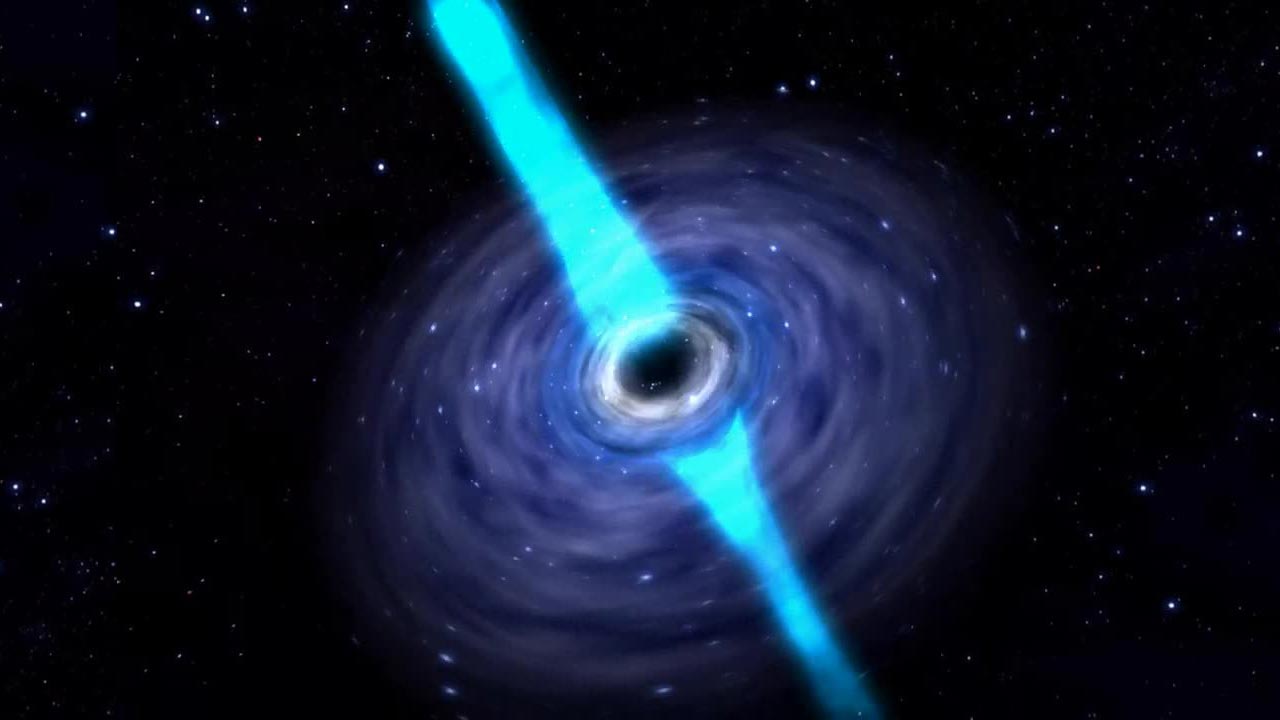
Promising candidates for heavy element production are black holes orbited by an accretion disk of dense and hot matter. Such a system is formed both after the merger of two massive neutron stars and during a so-called collapsar, the collapse and subsequent explosion of a rotating star. The internal composition of such accretion disks has so far not been well understood, particularly with respect to the conditions under which an excess of neutrons forms. A high number of neutrons is a basic requirement for the synthesis of heavy elements, as it enables the rapid neutron-capture process or r-process. Nearly massless neutrinos play a key role in this process, as they enable conversion between protons and neutrons.
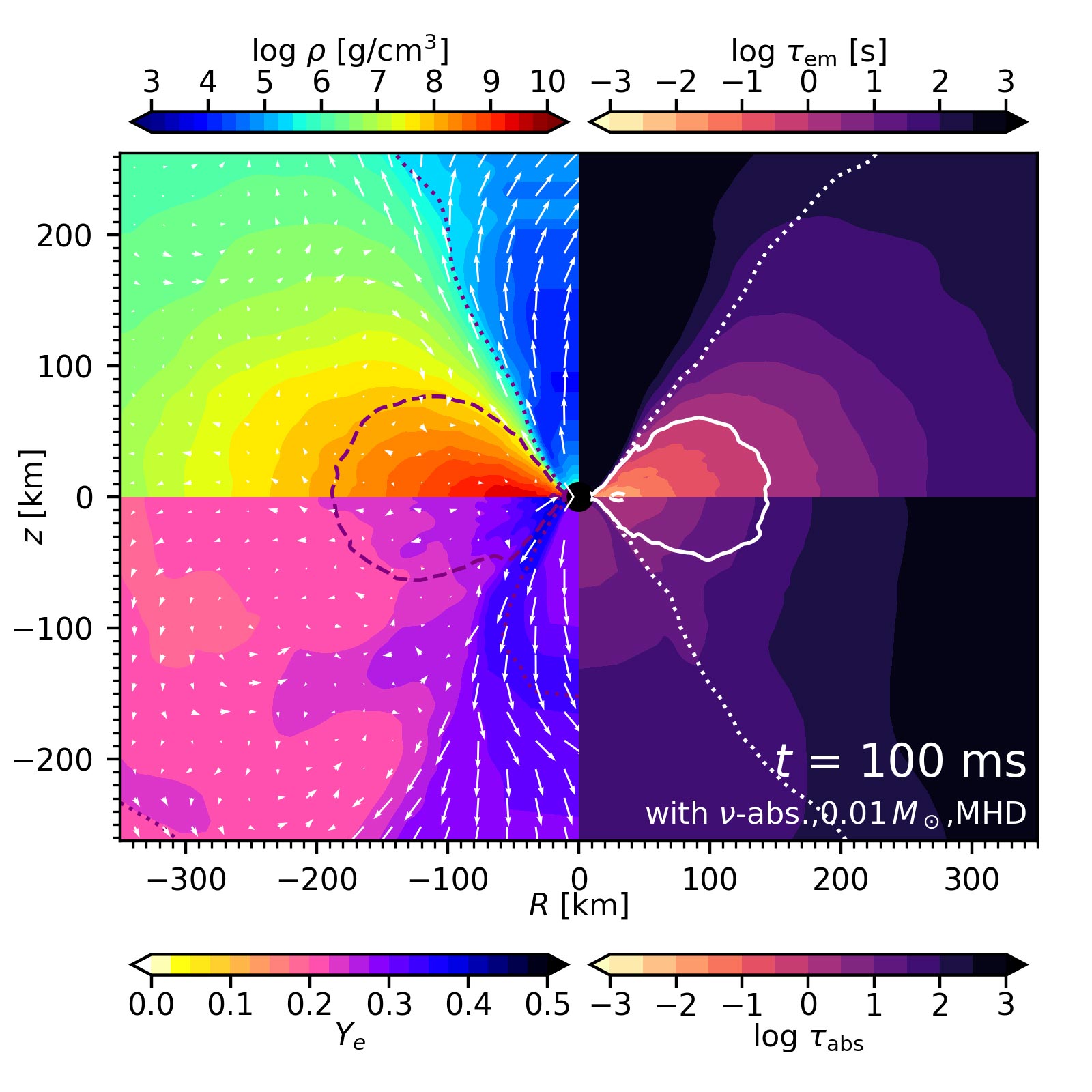
The black hole at the center is surrounded by torus-shaped matter several hundred kilometers in extent. The rotation axis of the disk is given by the z-axis, which runs at R=0 through the black hole along the vertical direction. The arrows illustrate the velocity distribution of the matter. The color shading shows the density (upper left), the proton fraction Ye (lower left), and the characteristic time scales of neutrino emission (upper right) and neutrino absorption (lower right). Values of Ye less than 0.5 indicate a high fraction of neutrons available for the r-process. Credit: GSI Helmholtz Centre for Heavy Ion Research
“In our study, we systematically investigated for the first time the conversion rates of neutrons and protons for a large number of disk configurations by means of elaborate computer simulations, and we found that the disks are very rich in neutrons as long as certain conditions are met,” explains Dr. Oliver Just from the Relativistic Astrophysics group of GSI’s research division Theory. “The decisive factor is the total mass of the disk. The more massive the disk, the more often neutrons are formed from protons through capture of electrons under emission of neutrinos, and are available for the synthesis of heavy elements by means of the r-process. However, if the mass of the disk is too high, the inverse reaction plays an increased role so that more neutrinos are recaptured by neutrons before they leave the disk. These neutrons are then converted back to protons, which hinders the r-process.” As the study shows, the optimal disk mass for prolific production of heavy elements is about 0.01 to 0.1 solar masses. The result provides strong evidence that neutron star mergers producing accretion disks with these exact masses could be the point of origin for a large fraction of the heavy elements. However, whether and how frequently such accretion disks occur in collapsar systems is currently unclear.
In addition to the possible processes of mass ejection, the research group led by Dr. Andreas Bauswein is also investigating the light signals generated by the ejected matter, which will be used to infer the mass and composition of the ejected matter in future observations of colliding neutron stars. An important building block for correctly reading these light signals is accurate knowledge of the masses and other properties of the newly formed elements. “These data are currently insufficient. But with the next generation of accelerators, such as FAIR, it will be possible to measure them with unprecedented accuracy in the future. The well-coordinated interplay of theoretical models, experiments, and astronomical observations will enable us researchers in the coming years to test neutron star mergers as the origin of the r-process elements,” predicts Bauswein.
Reference: “Neutrino absorption and other physics dependencies in neutrino-cooled black hole accretion discs” by O Just, S Goriely, H-Th Janka, S Nagataki and A Bauswein, 8 October 2021, Monthly Notices of the Royal Astronomical Society.
DOI: 10.1093/mnras/stab2861
Never miss a breakthrough: Join the SciTechDaily newsletter.
Follow us on Google and Google News.
9 Comments
As the study shows, the optimal disk mass for prolific production of heavy elements is about 0.01 to 0.1 solar masses
————————————————–
1% – 10% of the mass of the sun or other stars is enough for the synthesis of heavy elements, and the mass of only 100% of the sun or stars is not enough.
Not logical at all.
I’m not sure about “logic” here, it is physics of disparate systems, but it is a good question in the general sense – it is the one that the scientists aimed to answer.
The way I would try to answer it is that we look at an r-process element synthesis balance for accretion disk condition hydrogen (mostly), not a fusion energy balance (and element synthesis production) for stars:
““The decisive factor is the total mass of the disk. The more massive the disk, the more often neutrons are formed from protons through capture of electrons under emission of neutrinos, and are available for the synthesis of heavy elements by means of the r-process. However, if the mass of the disk is too high, the inverse reaction plays an increased role so that more neutrinos are recaptured by neutrons before they leave the disk. These neutrons are then converted back to protons, which hinders the r-process.” As the study shows, the optimal disk mass for prolific production of heavy elements is about 0.01 to 0.1 solar masses.”
As for beta capture (electrons or positrons captured by protons or neutrons), it happens mostly in the extreme conditions when stars becomes neutron stars (or, perhaps, in accretion disks). In other stars, it is not a rapid r-process but a slow s-process:
“Neutron capture nucleosynthesis describes two nucleosynthesis pathways: the r-process and the s-process, for rapid and slow neutron captures, respectively. R-process describes neutron capture in a region of high neutron flux, such as during supernova nucleosynthesis after core-collapse, and yields neutron-rich nuclides. S-process describes neutron capture that is slow relative to the rate of beta decay, as for stellar nucleosynthesis in some stars, and yields nuclei with stable nuclear shells.” [ https://en.wikipedia.org/wiki/Neutron_capture_nucleosynthesis ]
I should add that in accretion disks the gold production may involve massier starting material than hydrogen but it is the main element involved in the neutrino production-capture balance, and that the s-process likely end with iron (stable, not very neutron-rich) since heavier elements are typically not produced in stars.
Ok, let’s back this train up a bit. First of all, the accretion disc theory is the stupidest theory ever devised. Yes, you see a whirlpool in water or a vacuum cleaner with particles swirling around, but, they are drawing in a medium (air, water). In space…. where is the medium? Do you see Saturn’s rings compressing into a single sphere? Why hasn’t all the planets that encircle our sun, been swallowed up? Use some f#cking logic you bunch of dullards. Cheers Steve.
So the experts are dullards, and you have the answer by trying to use everyday occurrences instead of astrophysics?
No, we have *observed* accretion disks around many objects, including the now famous M87* supermassive black hole image [ https://en.wikipedia.org/wiki/Event_Horizon_Telescope ]. Accretion disk physics is not a complete mystery, c.f. Wikipedia:
“An accretion disk is a structure (often a circumstellar disk) formed by diffuse material in orbital motion around a massive central body. The central body is typically a star. Friction, uneven irradiance, magnetohydrodynamic effects, and other forces induce instabilities causing orbiting material in the disk to spiral inward towards the central body. Gravitational and frictional forces compress and raise the temperature of the material, causing the emission of electromagnetic radiation. The frequency range of that radiation depends on the central object’s mass. Accretion disks of young stars and protostars radiate in the infrared; those around neutron stars and black holes in the X-ray part of the spectrum. The study of oscillation modes in accretion disks is referred to as diskoseismology.”
@Steve
I believe the medium in space is called Dark Matter.
? Dark matter would feel gravity, but as you can see from my quotes it is the electromagnetic interaction of ordinary matter – resulting in friction and radiation (irradiance) for example – that makes accretion disks possible.
Wikipedia: “The large luminosity of quasars is believed to be a result of gas being accreted by supermassive black holes.”
Where the gas comes from is an open question, but here is a recent candidate that looks promising:
“While other simulations have modeled black hole growth, this is the first single computer simulation powerful enough to comprehensively account for the numerous forces and factors that play into the evolution of supermassive black holes.”
““Our simulations show that galaxy structures, such as spiral arms, use gravitational forces to ‘put the brakes on’ gas that would otherwise orbit galaxy centers forever. This breaking mechanism enables the gas to instead fall into black holes and the gravitational brakes, or torques, are strong enough to explain the quasars that we observe.””
[ https://news.northwestern.edu/stories/2021/08/new-simulation-shows-how-galaxies-feed-their-supermassive-black-holes/ ]
[ https://news.northwestern.edu/stories/2021/08/new-simulation-shows-how-galaxies-feed-their-supermassive-black-holes/ ]
? Dark matter would feel gravity, but as you can see from my quotes it is the electromagnetic interaction of ordinary matter – resulting in friction and radiation (irradiance) for example – that makes accretion disks possible.
Wikipedia: “The large luminosity of quasars is believed to be a result of gas being accreted by supermassive black holes.”
Where the gas comes from is an open question, but here is a recent candidate that looks promising:
“While other simulations have modeled black hole growth, this is the first single computer simulation powerful enough to comprehensively account for the numerous forces and factors that play into the evolution of supermassive black holes.”
““Our simulations show that galaxy structures, such as spiral arms, use gravitational forces to ‘put the brakes on’ gas that would otherwise orbit galaxy centers forever. This breaking mechanism enables the gas to instead fall into black holes and the gravitational brakes, or torques, are strong enough to explain the quasars that we observe.””
[ https://news.northwestern.edu/stories/2021/08/new-simulation-shows-how-galaxies-feed-their-supermassive-black-holes/ ]
I had a question for this topic / thread if interested people are still visiting this topic. I am an admitted skeptic regarding the claim that Nucleosynthesis activity in Supernova stars in the distant past of our Universe is the sole source and birth place of all Gold not only on our earth, but in the entire universe.
Am I correctly understanding that this is a claim of proponents of Nucleosynthesis? The reason I pose this question – recently I became interested in the precious metal (Gold and Silver) mining history in the United States State of Nevada, which is home to some of the largest Gold and Silver deposits not only in the USA, but also in the world. The State of Nevada is proud of its mineral rich history and past and present mining operations, and the University of Reno in Nevada publishes articles about the history of gold and silver deposits and the history of geology that is present in Nevada. These articles claim that the vast deposits of silver and gold found in the State of Nevada can be explained by local geological volcanic activity and earthquakes, igneous activities, and hot magma activities associated with volcanic igneous activities. In other words, subject matter experts in Nevada appear to be very comfortable attributing the creation of local gold and silver deposits in Nevada to explainable earth-bound local geological activities that occurred at fairly recent times in earth’s glacial past. In this discussion by University of Reno mining experts, there is zero reference to local gold or silver deposits being the result of Nucleosynthesis activities in far away supernova stars in the far distant past of universe before the earth was formed.
Here is a link to the University of Reno article that discussed their interpretation of the origins of Nevada’s vast gold and silver deposits:
http://www.nbmg.unr.edu/GeneralGeology/NevadaGeology.html
Do any Nucleosynthesis proponents want to disagree with the above statements?
Thanks.