
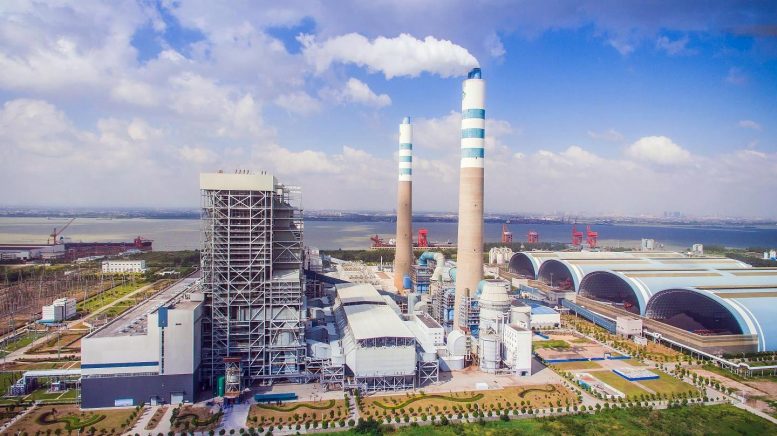
Polluting emissions from Chinese thermal power plants declined significantly between 2014 and 2017, according to research involving the University College London.
The reductions are important in helping to control China’s national emissions which could lead to an improvement in air quality and considerable health benefits.
A team of experts from the UK and China analyzed emissions from coal, oil, natural gas, and biomass power plants, with a focus on coal-fired power plants as the major contributors to ambient air pollution.
The study, published today in Nature Energy, analyzed data from 2014, when China introduced the ambitious Ultra-Low Emissions (ULE) Standards Policy for renovating coal-fired power stations to limit air pollutant emissions, to 2017.
The team found that between 2014 and 2017, China’s annual power plant emissions of sulfur dioxide, nitrogen oxide, and particulate matter dropped by 65%, 60%, and 72% each year respectively from 2.21, 3.11, and 0.52 million tonnes in 2014 to 0.77, 1.26, and 0.14 million tonnes in 2017, which is in compliance with ULE standards.
This means that China looks to be on track to further reduce its emissions if all thermal power plants meet the ULE standards by 2020. These standards aim to limit sulfur dioxide, nitrogen oxide, and particulate matter emissions to 35, 50, and 10 milligrams per cubic meter respectively.
UCL co-author Dr. Zhifu Mi (UCL Bartlett School of Construction and Project Management) said: “This is encouraging news for China, as well as other countries wishing to reduce their power emissions. Thermal power plants combusting coal, oil, natural gas, and biomass are one of the major contributors to global air pollution.
“These significant emission reductions demonstrate the technical and economic feasibility of controlling emissions from power plants to reach ultra-low levels, which is an important step towards reducing the number of deaths attributable to air pollution.”
The study shows that previous methods of estimating Chinese power emissions overestimated numbers by at least 18%, and in some cases up to 92%. This is because previous research was carried out using ex-ante studies — estimations made ahead of the introduction of ULE standards — which looked at how the standards might affect emissions based on assumptions of changes in emission concentrations.
The research is the first to use data on emission concentrations collected by China’s Continuous Emission Monitoring Systems network (CEMS) which covers 96-98% of Chinese thermal power capacity.
The team constructed a nationwide emissions dataset — the China Emissions Accounts for Power Plants (CEAP) — based on data collected from the CEMS network between 2014 and 2017.
CEAP is now publicly available and continues to present, organize and analyze data from the network. This gives accurate results for each power plant as well as real-time results on an hourly frequency.
“With coal being the most widely-used fuel in China, cutting the number of thermal power plants within a short timeframe would be challenging. The results of this research are encouraging in demonstrating that coal can be used in a much cleaner way to generate electricity,” concluded Dr. Mi.
###
The research was in collaboration with Beijing University of Chemical Technology, Beihang University, the Ministry of Environmental Protection (Beijing), HeBei University of Science and Technology, the University of Science and Technology (Beijing), Xi’an Jiaotong University, the University of Cambridge and the Chinese Academy of Sciences (Beijing). It was funded by grants from the National Science Foundation for Outstanding Young Scholars, the National Programme for Support of Top Notch Young Professionals and the National Research Programme for Key Issues in Air Pollution Control.
Image: Ling Tang, Beijing University of Chemical Technology and Beihang University; Jiabao Qu, Ministry of Environmental Protection and HeBei University of Science and Technology; Zhifu Mi, UCL; Xin Bo, Ministry of Environmental Protection and the University of Science and Technology; Xiangyu Chang, Xi’an Jiaotong University; Laura Diaz Anadon, University of Cambridge; Shouyang Wang, Chinese Academy of Sciences; Xiaoda Xue, Beihang University; Shibei Li, Ministry of Environmental Protection; Xin Wang, Ministry of Environmental Protection, Xiaohong Zhao; Ministry of Environmental Protection.
Reference: “Substantial emission reductions from Chinese power plants after the introduction of ultra-low emissions standards” by Ling Tang, Jiabao Qu, Zhifu Mi, Xin Bo, Xiangyu Chang, Laura Diaz Anadon, Shouyang Wang, Xiaoda Xue, Shibei Li, Xin Wang and Xiaohong Zhao, 7 October 2019, Nature Energy.
DOI: 10.1038/s41560-019-0468-1
Never miss a breakthrough: Join the SciTechDaily newsletter.
Follow us on Google and Google News.