
Close Menu
    Facebook X (Twitter) Instagram
    SciTechDaily
    • Biology
    • Chemistry
    • Earth
    • Health
    • Physics
    • Science
    • Space
    • Technology
    Facebook X (Twitter) Pinterest YouTube RSS
    SciTechDaily
    Home»Technology»ESA AMPER: Mesh Reflector for Shaped Radio Beams
    Technology

    ESA AMPER: Mesh Reflector for Shaped Radio Beams

    By European Space AgencySeptember 17, 2020No Comments3 Mins Read
    Facebook Twitter Pinterest Telegram LinkedIn WhatsApp Email Reddit
    Share
    Facebook Twitter LinkedIn Pinterest Telegram Email Reddit
    ESA AMPER Mesh Reflector
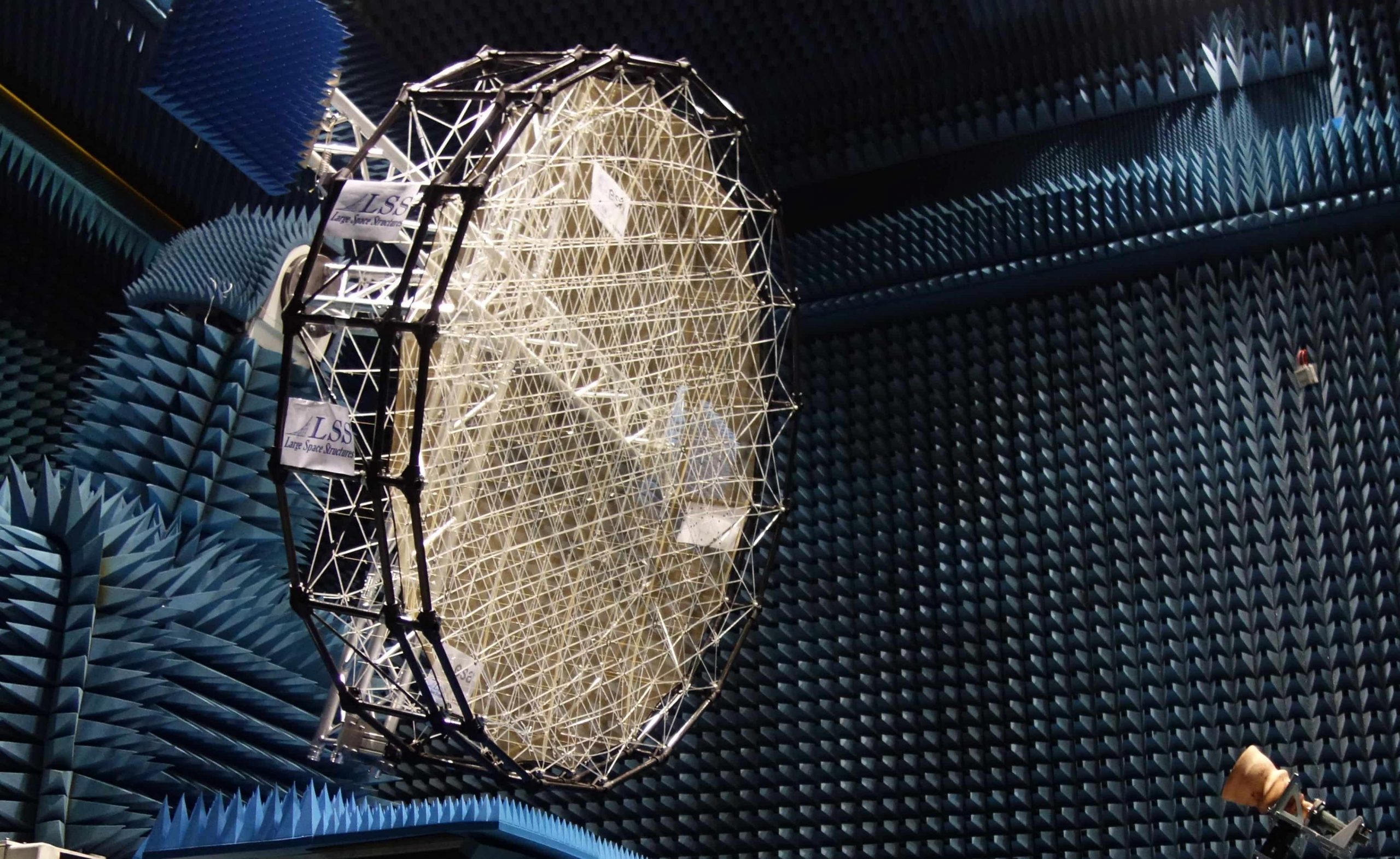
    ESA’s AMPER (Advanced techniques for mesh reflector with improved radiation pattern performance) project’s prototype 2.6-m diameter metal-mesh antenna reflector represents a big step forward for the European space sector. Credit: Leri Datashvili/Large Space Structures GmbH

    This prototype 2.6-m diameter metal-mesh antenna reflector represents a big step forward for the European space sector: versions can be manufactured to reproduce any surface pattern that antenna designers wish, something that was previously possible only with traditional solid antennas.

    “This is really a first for Europe,” says ESA antenna engineer Jean-Christophe Angevain. “China and the US have also been working hard on similar shaped mesh reflector technology. It is needed so that sufficiently large antennas can be deployed in orbit, which would otherwise be too bulky to fit inside a launcher fairing, while also meeting required performance levels.”

    ESA’s AMPER (Advanced techniques for mesh reflector with improved radiation pattern performance) project performed with Large Space Structures GmbH in Germany as prime and TICRA in Denmark as subcontractor.

    Antenna reflectors for satellites are often surprisingly ‘lumpy’ looking. Their basic paraboloid convex shape is distorted with additional peaks and valleys. These serve to contour the resulting radio frequency beam, typically to boost signal gain over target countries and minimize it beyond their borders.

    “This tailored surface shaping is traditionally done with traditional metal or carbon fiber reinforced plastic composite reflectors,” adds Jean-Christophe. “The challenge was how to reproduce such shaping using a mesh reflector design. The obvious solution would have been a conventional tension truss double layer solution, with the mesh held together tautly on an alternating ‘push and ‘pull’ basis. A smart alternative solution has been proposed and followed by the team.”

    Leri Datashvili, CEO and Chief Designer of Large Space Structures explains:  “The design of our shaped mesh reflector is based on tension members supported by a peripheral truss structure which enables decoupling of the shaped surface and the structure. Therefore, the design can be implemented for any size of reflector, for any frequencies ranging from P-band to Ka-band. Furthermore, either deployable or fixed reflector technology can be realized.”

    “This 2.6-m ‘breadboard’ prototype proves the concept at C-band frequency, and the RF measurements have shown good correlation with radio-frequency and mechanical predictions” adds Jean-Christophe.

    The AMPER project was supported through ESA’s Technology Development Element, with prototype testing carried out in ESA’s Hertz chamber at its ESTEC technical center in the Netherlands. As a next step the AMPER team plan to produce a deployable version, aimed at Earth observation as well as telecommunications uses.

    Meanwhile, this prototype reflector will be on show during next month’s virtual ESA Open Day at ESTEC.

    Never miss a breakthrough: Join the SciTechDaily newsletter.
    Follow us on Google and Google News.

    European Space Agency Telecommunications
    Share. Facebook Twitter Pinterest LinkedIn Email Reddit

    Related Articles

    OneWeb Satellite Constellation to Boost Wi-Fi on Planes – Speeds Up to 195Mbps

    UC Engineers Break Distance Barriers for Fiber Optic Signals

    Consortium to Focus on Developing a New Architecture for the Internet

    Graphene Photonics Breakthrough Has Potential for Ultrafast Telecommunications

    Researchers Develop Spaser Made of Graphene and Carbon Nanotubes

    New Fiber Optic Technology Could Boost Internet Bandwidth

    New Algorithm Enables Wi-Fi Connected Vehicles to Share Data

    Coding Scheme Guarantees Fastest Possible Delivery of Data

    Researchers at ESA Develop Augmented Reality Headset for Medical Diagnosis

    Leave A Reply Cancel Reply

    • Facebook
    • Twitter
    • Pinterest
    • YouTube

    Don't Miss a Discovery

    Subscribe for the Latest in Science & Tech!

    Trending News

    Scientists Finally Uncover How a “Forever Chemical” Causes Birth Defects

    Scientists Uncover the Earliest Brain Changes That May Predict Alzheimer’s Decades Before Symptoms

    Surprising New Study Challenges a Century-Old Theory of Habit Formation

    Scientists Turn Seawater Into Drinking Water Without Toxic Brine

    Vitamin D Drug Shows Surprising Promise Against One of the Deadliest Cancers

    NASA’s X-59 Sonic Boom Killer Is Ready for Its Biggest Test Yet

    The Best Exercise Combination for Longevity, According to a 30-Year Study

    Popular Weight-Loss Drug Found To Slow Biological Aging in Landmark Human Trial

    Follow SciTechDaily
    • Facebook
    • Twitter
    • YouTube
    • Pinterest
    • Newsletter
    • RSS
    SciTech News
    • Biology News
    • Chemistry News
    • Earth News
    • Health News
    • Physics News
    • Science News
    • Space News
    • Technology News
    Recent Posts
    • The Probiotic Breakthrough for Natural Anxiety Relief and Better Mental Health
    • Animal vs. Plant Protein: Scientists Found a Surprising Nutritional Difference
    • Tiny Genetic Change Turns Female Mice Into Males, Scientists Discover
    • Scientists Discover Strange New Spider Species That Disguises Itself as a Fungus
    • This Simple Drink Could Help Calm the Inflammation Behind Many Diseases
    Copyright © 1998 - 2026 SciTechDaily. All Rights Reserved.
    • Science News
    • About
    • Contact
    • Editorial Board
    • Privacy Policy
    • Terms of Use

    Type above and press Enter to search. Press Esc to cancel.