
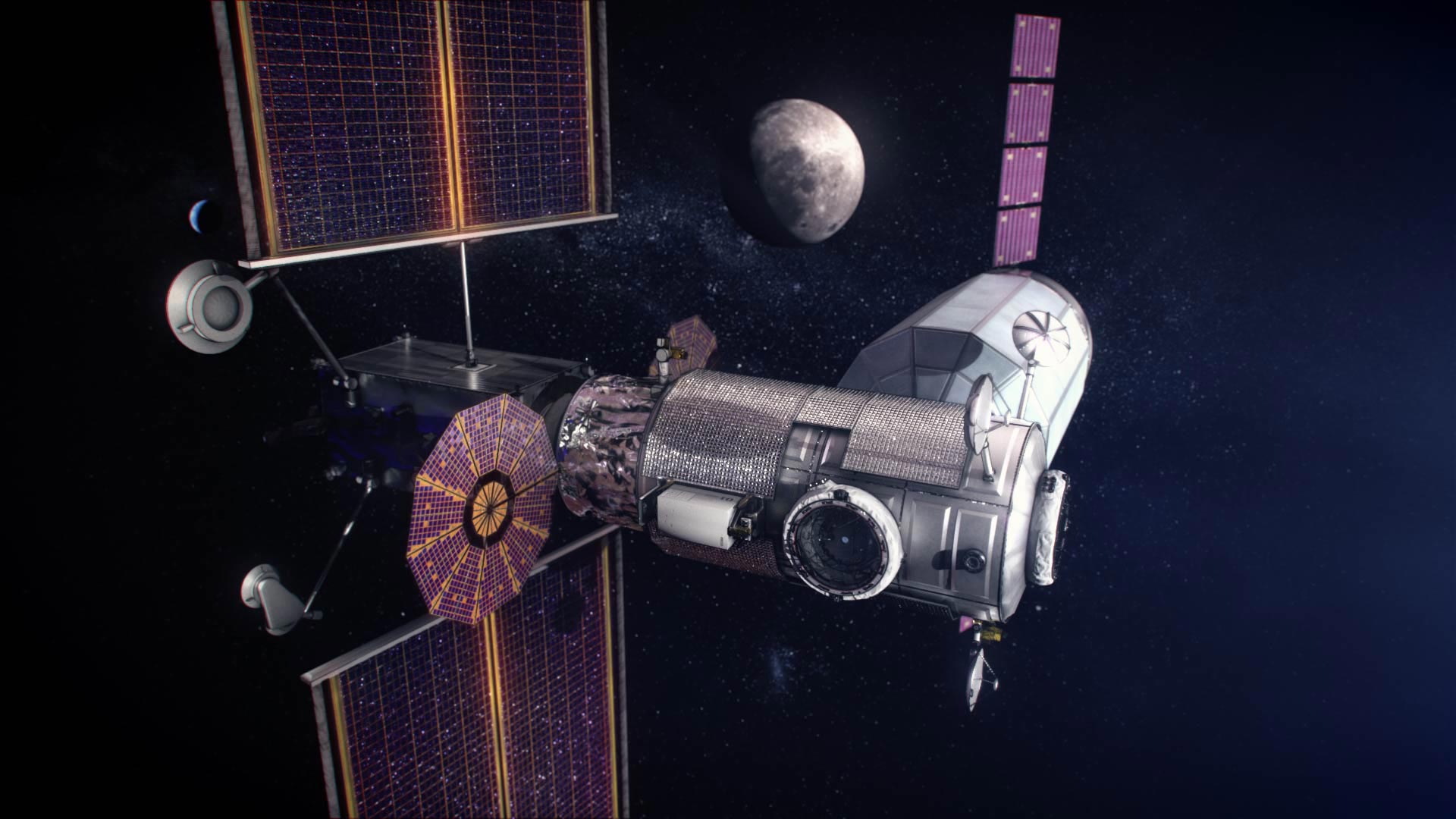
NASA has selected the first two scientific investigations to fly aboard the Gateway, an orbital outpost that will support Artemis lunar operations while demonstrating the technologies necessary to conduct a historic human mission to Mars. The instruments selected for Gateway will observe space weather and monitor the Sun’s radiation environment.
“Building the Gateway with our commercial and international partners is a critical component of sustainable lunar exploration and the Artemis program,” said NASA Administrator Jim Bridenstine. “Using the Gateway as a platform for robotic and human exploration around the Moon will help inform what we do on the lunar surface as well as prepare us for our next giant leap – human exploration of Mars.”
The radiation instrument package, built by ESA (European Space Agency), will help provide an understanding of how to keep astronauts safe by monitoring the radiation exposure in Gateway’s unique orbit.
The space weather instrument suite, built by NASA, will observe solar particles and solar wind created by the Sun. As we move deeper into space, human and robotic explorers face greater challenges from the sometimes violent and unpredictable outbursts of the Sun. The space weather instrument suite will gather data and enhance our ability to forecast events originating from the Sun that could affect our astronauts on and around the Moon as well as on future missions to Mars.
“Our Sun and the environment around it is very dynamic. This instrument suite will help us observe the particles and energy that our star emits — and mitigate the risks to astronauts at the Moon and eventually Mars,” said Thomas Zurbuchen, NASA’s associate administrator for science at the agency’s headquarters in Washington. “Not only will we learn more about our space environment, but we’ll also learn how to improve forecasting space weather wherever the Artemis Generation journeys away from Earth.”
Additional scientific payloads will be selected to fly aboard the Gateway in the future. These investigations will take advantage of the unique environment in lunar orbit, one that cannot be duplicated on Earth or on the International Space Station.
The Gateway will orbit near the Moon and will be occupied periodically by astronauts as part of NASA’s sustainable lunar exploration plans. NASA awarded Maxar Technologies a contract in May 2019 to develop the power and propulsion element which will provide solar arrays and maneuvering capabilities. NASA is continuing negotiations with Northrop Grumman to build the habitation and logistics outpost or HALO, the first pressurized module for crew visiting the Gateway.
ESA, the Japan Aerospace Exploration Agency, and the Canadian Space Agency are all actively engaged in discussions with NASA to support the construction and operation of the Gateway which, again, will support lunar surface missions and pave the way for the human exploration of Mars.
“This is an incredible moment in human spaceflight as NASA is closer than any other time in history since the Apollo program to returning to the lunar surface,” said Bridenstine. “America is leading a return to the Moon, and this time, we’re taking all of humanity with us to explore long-term and get ready for Mars.”
Never miss a breakthrough: Join the SciTechDaily newsletter.
Follow us on Google and Google News.
1 Comment
Very exciting news, do not delay scientific research it is always been humans greatest ability to think and explore!