

Enceladus’ ice plumes may hold the building blocks of life.
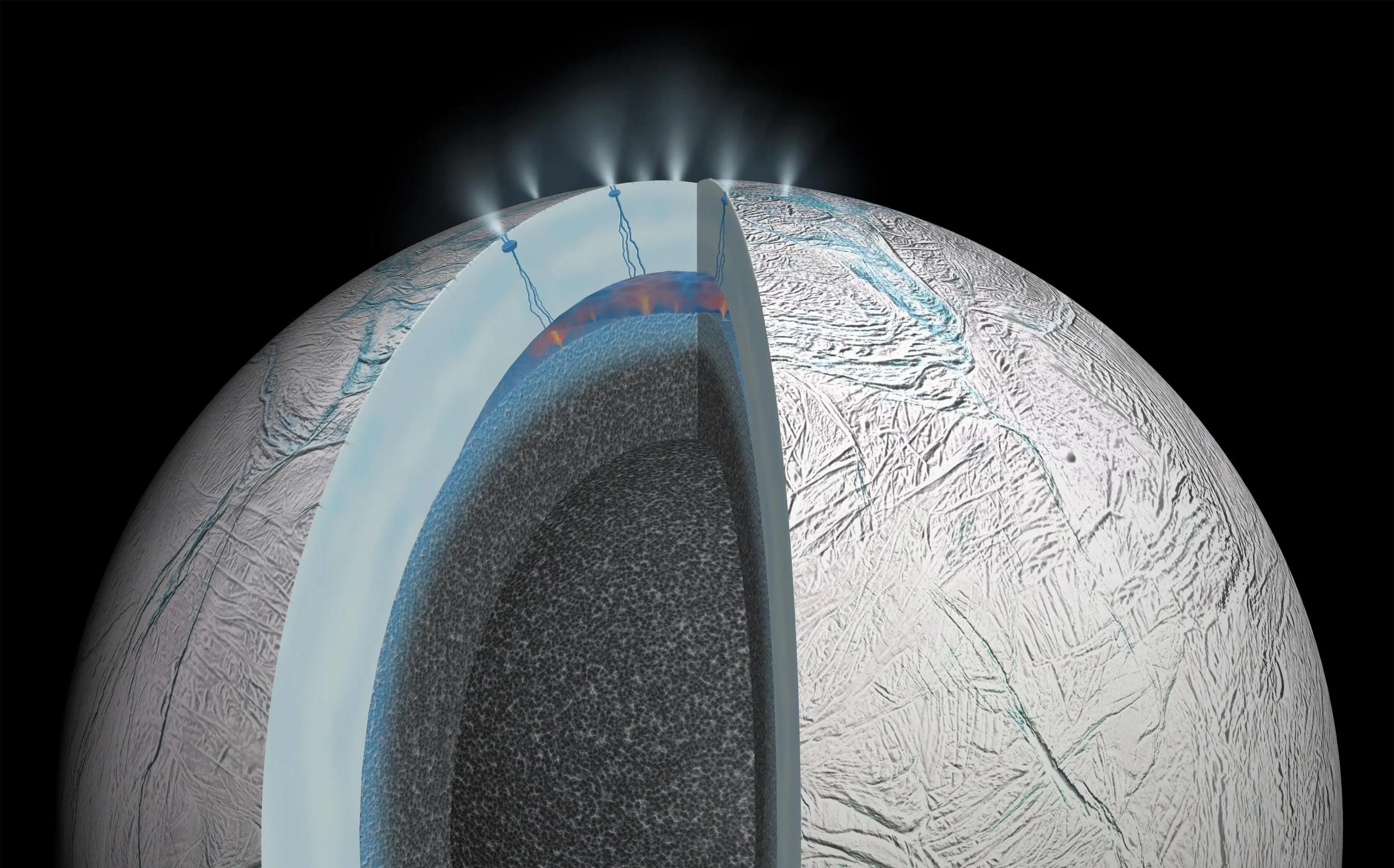
As astrophysics technology and research continue to advance, one question persists: is there life elsewhere in the universe? The Milky Way galaxy alone has hundreds of billions of celestial bodies, but scientists often look for three crucial elements in their ongoing search: water, energy, and organic material. Evidence indicates that Saturn’s icy moon Enceladus is an ‘ocean world’ that contains all three, making it a prime target in the search for life.
Cassini’s Discoveries on Enceladus
During its 20-year mission, NASA’s Cassini spacecraft discovered that ice plumes spew from Enceladus’ surface at approximately 800 miles per hour (400 m/s). These plumes provide an excellent opportunity to collect samples and study the composition of Enceladus’ oceans and potential habitability. However, until now it was not known if the speed of the plumes would fragment any organic compounds contained within the ice grains, thus degrading the samples.
Breakthrough in Laboratory Research
Now researchers from the University of California San Diego have shown unambiguous laboratory evidence that amino acids transported in these ice plumes can survive impact speeds of up to 4.2 km/s, supporting their detection during sampling by spacecraft. Their findings were published in The Proceedings of the National Academy of Sciences (PNAS).
Unique Aerosol Impact Spectrometer
Beginning in 2012, UC San Diego Distinguished Professor of Chemistry and Biochemistry Robert Continetti and his co-workers custom-built a unique aerosol impact spectrometer, designed to study collision dynamics of single aerosols and particles at high velocities. Although not built specifically to study ice grain impacts, it turned out to be exactly the right machine to do so.
“This apparatus is the only one of its kind in the world that can select single particles and accelerate or decelerate them to chosen final velocities,” stated Continetti. “From several micron diameters down to hundreds of nanometers, in a variety of materials, we’re able to examine particle behavior, such as how they scatter or how their structures change upon impact.”
A custom-built aerosol impact spectrometer from UC San Diego Professor of Chemistry Robert Continetti’s lab. Ice grains impact the microchannel plate detector (far right) at hypervelocity speeds, which can then be characterized in-situ. Credit: Robert Continetti lab / UC San Diego
The Europa Clipper Mission
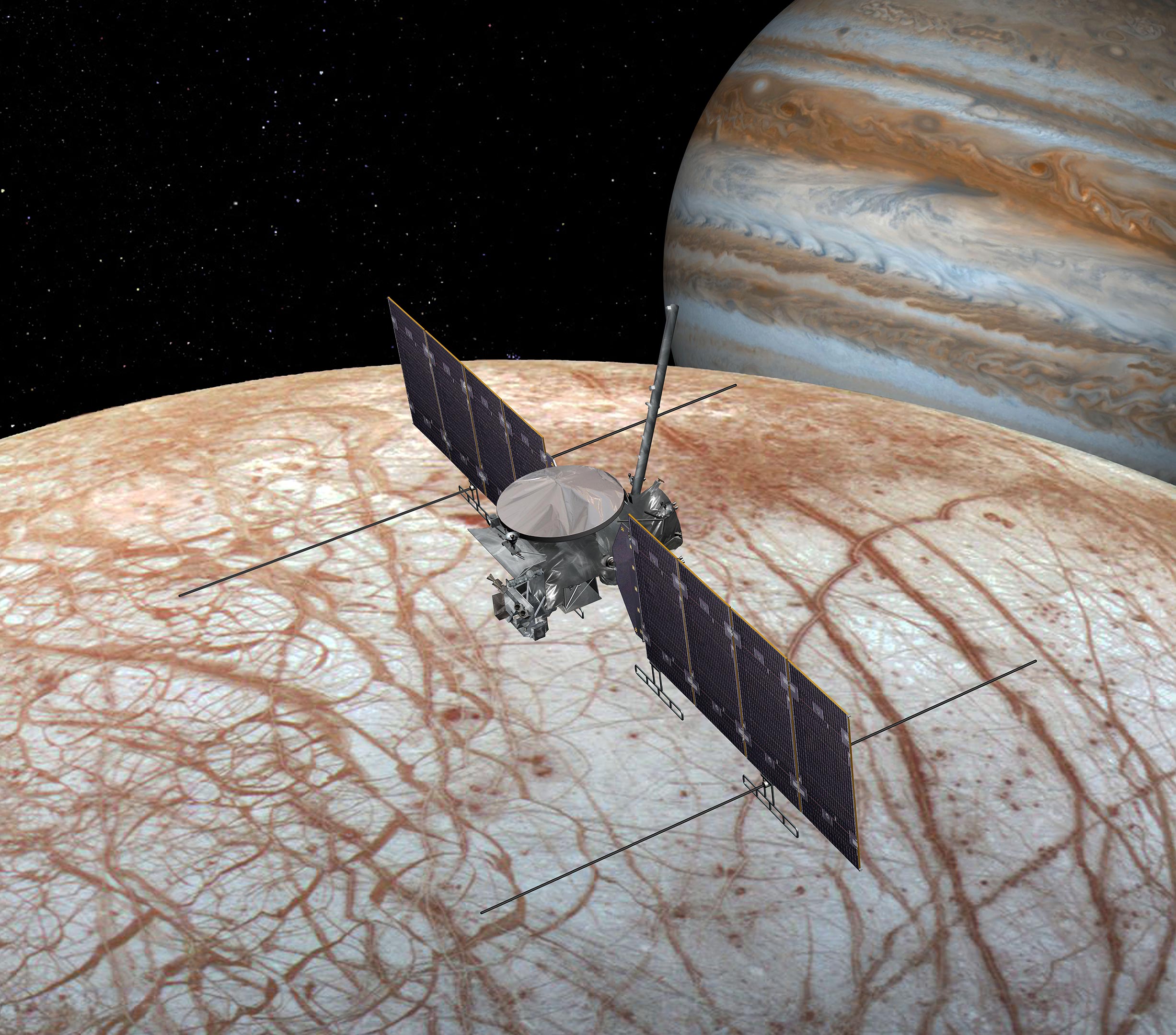
In 2024 NASA will launch the Europa Clipper, which will travel to Jupiter. Europa, one of Jupiter’s largest moons, is another ocean world, and has a similar icy composition to Enceladus. There is hope that the Clipper or any future probes to Saturn will be able to identify a specific series of molecules in the ice grains that could point to whether life exists in the subsurface oceans of these moons, but the molecules need to survive their speedy ejection from the moon and collection by the probe.
Innovative Experimentation Techniques
Although there has been research into the structure of certain molecules in ice particles, Continetti’s team is the first to measure what happens when a single ice grain impacts a surface.
To run the experiment, ice grains were created using electrospray ionization, where water is pushed through a needle held at a high voltage, inducing a charge that breaks the water into increasingly smaller droplets. The droplets were then injected into a vacuum where they freeze. The team measured their mass and charge, then used image charge detectors to observe the grains as they flew through the spectrometer. A key element to the experiment was installing a microchannel plate ion detector to accurately time the moment of impact down to the nanosecond.
Significant Findings in Astrobiology
The results showed that amino acids — often called the building blocks of life — can be detected with limited fragmentation up to impact velocities of 4.2 km/s.
“To get an idea of what kind of life may be possible in the solar system, you want to know there hasn’t been a lot of molecular fragmentation in the sampled ice grains, so you can get that fingerprint of whatever it is that makes it a self-contained life form,” said Continetti. “Our work shows that this is possible with the ice plumes of Enceladus.”
Broader Implications in Chemistry
Continetti’s research also raises interesting questions for chemistry itself, including how salt affects the detectability of certain amino acids. It is believed that Enceladus contains vast salty oceans — more than is present on Earth. Because salt changes the properties of water as a solvent as well as the solubility of different molecules, this could mean that some molecules cluster on the surface of the ice grains, making them more likely to be detected.
“The implications this has for detecting life elsewhere in the solar system without missions to the surface of these ocean-world moons is very exciting, but our work goes beyond biosignatures in ice grains,” stated Continetti. “It has implications for fundamental chemistry as well. We are excited by the prospect of following in the footsteps of Harold Urey and Stanley Miller, founding faculty at UC San Diego in looking at the formation of the building blocks of life from chemical reactions activated by ice grain impact.”
Reference: “Detection of intact amino acids with a hypervelocity ice grain impact mass spectrometer” by Sally E. Burke, Zachary A. Auvil, Karl A. Hanold and Robert E. Continetti, 4 December 2023, Proceedings of the National Academy of Sciences.
DOI: 10.1073/pnas.2313447120
This work was supported by the Air Force Office of Science Research (MURI-22, grant FA9550-22-0199) and the Jet Propulsion Laboratory, California Institute of Technology, under a contract with the National Aeronautics and Space Administration (grant 80NM0018D0004).
Never miss a breakthrough: Join the SciTechDaily newsletter.
Follow us on Google and Google News.