
Close Menu
    Facebook X (Twitter) Instagram
    SciTechDaily
    • Biology
    • Chemistry
    • Earth
    • Health
    • Physics
    • Science
    • Space
    • Technology
    Facebook X (Twitter) Pinterest YouTube RSS
    SciTechDaily
    Home»Biology»Functional Magnetic Resonance Imaging Shows How the Brain Repurposes Unused Regions
    Biology

    Functional Magnetic Resonance Imaging Shows How the Brain Repurposes Unused Regions

    By Society for NeuroscienceSeptember 29, 2019No Comments2 Mins Read
    Facebook Twitter Pinterest Telegram LinkedIn WhatsApp Email Reddit
    Share
    Facebook Twitter LinkedIn Pinterest Telegram Email Reddit
    Visual Cortex Activation
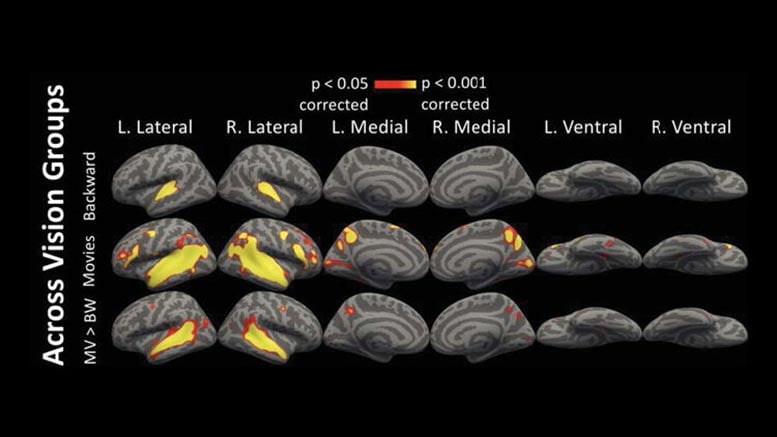
    Naturalistic auditory stories synchronize “visual” cortices across congenitally blind but not sighted individuals. Credit: Loiotile et al., JNeurosci (2019)

    Listening triggers synchronized activity in the ‘visual’ cortex in blind adults.

    In adults that are born blind, the “visual” cortex is activated in a similar way during a listening task, according to new research in JNeurosci. The results answer questions about how development can override anatomy to influence brain function.

    Previous research observed that the “visual” cortex in blind people is recruited for other functions, but it was not known if the new purpose was consistent or varied from person to person.

    Loiotile et al. used functional magnetic resonance imaging to compare how the auditory and visual cortices of the brain were activated in blind and blindfolded, sighted participants while listening to audio clips from movies. Sixty-five percent of the regions in the visual cortex had similar activation among the blind participants when they listened to the movie clips. The similarity diminished when the sentences were played in a random order or the track was played backward, indicating that the region is used for higher-order processing. These results suggest that there is an underlying organization that dictates how the visual cortex is repurposed in blind people, and that it is not random.

    ###

    The Society for Neuroscience is the world’s largest organization of scientists and physicians devoted to understanding the brain and nervous system. The nonprofit organization, founded in 1969, now has nearly 37,000 members in more than 90 countries and over 130 chapters worldwide.

    Reference: “Naturalistic auditory stories synchronize ‘visual’ cortices across congenitally blind but not sighted individuals” by Rita Loiotile, Rhodri Cusack and Marina Bedny, 23 September 2019, Journal of Neuroscience.
    DOI: 10.1523/JNEUROSCI.0298-19.2019

    Never miss a breakthrough: Join the SciTechDaily newsletter.
    Follow us on Google and Google News.

    Brain Neuroscience Society for Neuroscience
    Share. Facebook Twitter Pinterest LinkedIn Email Reddit

    Related Articles

    Drug (Cocaine, Methamphetamine, or Nicotine) Withdrawal Morphs Brain Communication Networks in Mice

    The Brain Networks Underlying Imagination – Separate Subnetworks Construct and Evaluate Imagined Scenarios

    Deep Inside the Brain: Neuroscientists Discover the Missing Piece of the Brain’s Multitasking Network

    Scientists Uncover Brain Mechanism That May Explain Why Sleep Helps You Learn

    Adult-Born Neurons Grow More Than Their Counterparts From Infancy – May Even Have Unique Functions

    Feeling Disconnected? Loneliness Alters Your Brain’s Social Network

    A Child’s Unique Brain Activity Reveals Their Memory Ability

    Unlocking the Neuroscience of How Experiencing Traumatic Stress Leads to Aggression

    Researchers Discover How Stress Restructures the Brain

    Leave A Reply Cancel Reply

    • Facebook
    • Twitter
    • Pinterest
    • YouTube

    Don't Miss a Discovery

    Subscribe for the Latest in Science & Tech!

    Trending News

    Could Low Vitamin D Be Making Your Pain Worse?

    Scientists Discover Once-Weekly Workout That Melts Belly Fat Surprisingly Effectively

    Scientists Just Tested a Thruster Powerful Enough for Human Missions to Mars

    Doctors Say Your Ice Pack Might Be Making Injuries Worse

    Scientists Discover 43-Foot Sea Reptile Twice the Size of a Great White Shark

    Bees and Birds Are Drinking Alcohol From Flowers

    Scientists Discover How Obesity May Trigger Alzheimer’s Disease

    Scientists Confirm Alcohol Causes Widespread Health Damage

    Follow SciTechDaily
    • Facebook
    • Twitter
    • YouTube
    • Pinterest
    • Newsletter
    • RSS
    SciTech News
    • Biology News
    • Chemistry News
    • Earth News
    • Health News
    • Physics News
    • Science News
    • Space News
    • Technology News
    Recent Posts
    • Why More People in Their 30s Are Suddenly Getting Colon Cancer
    • Scientists Discover Sperm Seem To Bypass a Fundamental Law of Physics
    • The Secret Behind Indigenous Andeans’ “Digestive Superpower” May Be Potatoes
    • Archaeologists Discover Mysterious Artificial Island Older Than Stonehenge in Scotland
    • Magnon Breakthrough Could Shrink Quantum Computers to the Size of a Penny
    Copyright © 1998 - 2026 SciTechDaily. All Rights Reserved.
    • Science News
    • About
    • Contact
    • Editorial Board
    • Privacy Policy
    • Terms of Use

    Type above and press Enter to search. Press Esc to cancel.