
The center of our galaxy is a frenzy of activity. A behemoth black hole — 4 million times as massive as the sun — blasts out energy as it chows down on interstellar detritus while neighboring stars burst to life and subsequently explode.
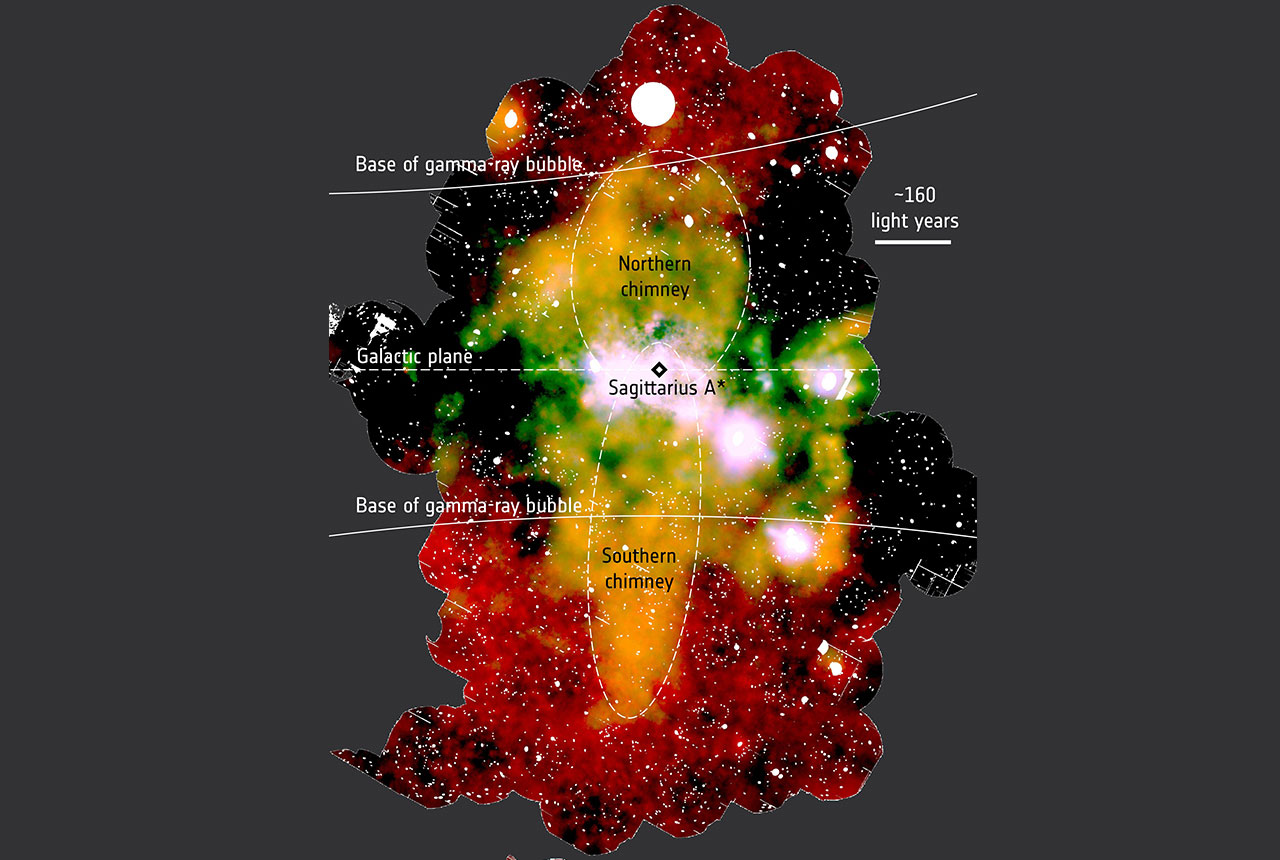
Now, an international team of astronomers has discovered two exhaust channels — dubbed “galactic center chimneys” — that appear to funnel matter and energy away from the cosmic fireworks in the Milky Way’s center, about 28,000 light-years from Earth.
Mark Morris, a University of California, Los Angeles (UCLA) professor of astronomy and astrophysics, contributed to the research, which will be published on March 21 in the journal Nature.
“We hypothesize that these chimneys are exhaust vents for all the energy released at the center of the galaxy,” Morris said.
All galaxies are giant star-forming factories, but their productivity can vary widely — from one galaxy to the next and even over the course of each galaxy’s lifetime. One mechanism for throttling the rate of star production is the fountain of matter and energy whipped up by the heavyweight black hole that lurks at a galaxy’s center.
“Star formation determines the character of a galaxy,” Morris said. “And that’s something we care about because stars produce the heavy elements out of which planets — and life — are made.”
To better understand what becomes of that outflow of energy, Morris and his colleagues pointed the European Space Agency’s XMM-Newton satellite, which detects cosmic X-rays, toward the center of the Milky Way. Because X-rays are emitted by extremely hot gas, they are especially useful for mapping energetic environments in space.
In images they collected from 2016 to 2018 and in 2012, the researchers found two plumes of X-rays — the galactic center chimneys — stretching in opposite directions from the central hub of the galaxy. Each plume originates within about 160 light-years of the supermassive black hole and spans over 500 light-years.
The chimneys hook up to two gargantuan structures known as the Fermi bubbles, cavities carved out of the gas that envelops the galaxy. The bubbles, which are filled with high-speed particles, straddle the center of the galaxy and stretch for 25,000 light-years in either direction. Some astronomers suspect that the Fermi bubbles are relics of massive eruptions from the supermassive black hole, while others think the bubbles are blown out by hordes of newly born stars. Either way, the chimneys could be the conduits through which high-speed particles get there.
Understanding how energy makes its way from a galaxy’s center to its outer limits could provide insights into why some galaxies are bursting with star formation whereas others are dormant.
“In extreme cases, that fountain of energy can either trigger or shut off star formation in the galaxy,” Morris said.
Our galaxy isn’t quite that extreme — other galaxies have fountains powered by central black holes weighing a thousand times more than ours — but the Milky Way’s center provides an up-close look at what might be happening in galaxies that are more energetic.
“We know that outflows and winds of material and energy emanating from a galaxy are crucial in sculpting and altering that galaxy’s shape over time — they’re key players in how galaxies, and other structures, form and evolve throughout the cosmos,” said lead author Gabriele Ponti of the Max Planck Institute for Extraterrestrial Physics in Garching, Germany. “Luckily, our galaxy gives us a nearby laboratory to explore this in detail, and probe how material flows out into the space around us.”
Morris said the centers of the nearest galaxies are hundreds to thousands of times farther away than our own. “The amount of energy coming out of the center of our galaxy is limited, but it’s a really good example of a galactic center that we can observe and try to understand,” he said.
Nine authors from five countries contributed to the study. The research was funded by NASA, the French National Center for Space Studies, the French National Agency for Research, the German Federal Ministry of Economics and Technology, the German Aerospace Center and the Max Planck Society.
Never miss a breakthrough: Join the SciTechDaily newsletter.
Follow us on Google and Google News.