

Scientists state that this discovery offers a rare chance to examine the physics influencing thousands of other planets.
WASP-69b experiences unending extreme temperatures. This massive gas giant, comparable in size to Jupiter and located about 160 light-years from Earth, is in such close proximity to its intensely hot star that its atmosphere is continuously evaporating at a rate of 200,000 tons per second.
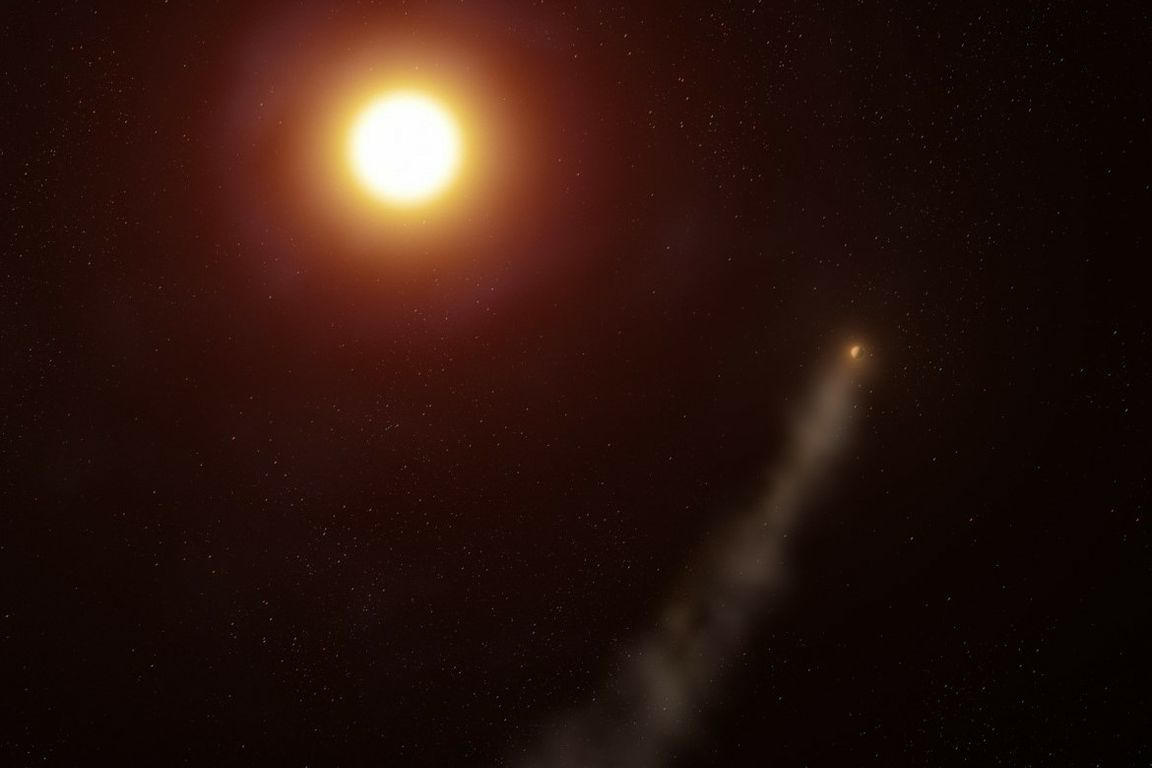
In new research published in The Astrophysical Journal, a team led by UCLA astrophysicists discovered that as the planet’s atmosphere escapes into space, its host star’s stellar winds sculpt it into a comet-like tail that trails the planet for at least 350,000 miles — far longer than observed before.
“Work by previous groups showed that this planet was losing some of its atmosphere and suggested a subtle tail or perhaps none at all,” said Dakotah Tyler, a UCLA doctoral student and first author of the research. “However, we have now definitively detected this tail and shown it to be at least seven times longer than the planet itself.”
Characteristics and Orbit of WASP-69b
Discovered a decade ago, WASP-69b is known as a “hot Jupiter” — a gas giant planet that orbits precariously close to its star. In fact, the exoplanet is so close that it completes a full orbit in less than four Earth days; by comparison, Mercury, the closest planet to our sun, has an 88-day orbit.
The discovery that WASP-69b’s star is not only stripping away the planet’s atmosphere with high-energy radiation but also physically shepherding that escaped gas into a long, thin tail helps to reveal how stellar winds affect planets that orbit their stars so closely. Studying this type of atmospheric mass-loss directly is pivotal for understanding exactly how planets across the galaxy evolve over time with their stars, the researchers said.
Impact of Stellar Winds on Planetary Atmospheres
“Over the last decade, we have learned that the majority of stars host a planet that orbits them closer than Mercury orbits our sun and that the erosion of their atmospheres plays a key role in explaining the types of planets we see today,” said co-author and UCLA professor of physics and astronomy Erik Petigura. “However, for most known exoplanets, we suspect that the period of atmospheric loss concluded long ago. The WASP-69b system is a gem because we have a rare opportunity to study atmospheric mass-loss in real-time and understand the critical physics that shape thousands of other planets.”
Earlier observations of WASP-69b, conducted with a 3.5-meter telescope at the Calar Alto Observatory in Spain and a 5-meter telescope at the Palomar Observatory in San Diego County, showed only a hint of a tail or no tail. For the current study, the researchers used a larger, 10-meter telescope at the W. M. Keck Observatory in Hawaii, along with its high-resolution spectrograph instrument, called NIRSPEC, to make observations that were more sensitive to the detailed structure of WASP-69b’s escaping atmosphere.
The observations revealed that WASP-69b’s escaping gas, primarily hydrogen and helium, is shaped and pushed in the direction of Earth by radiation and an outflow of gas from its host star known as a stellar wind for hundreds of thousands of miles. The researchers were then able to calculate the amount of mass the planet was losing.
“These comet-like tails are really valuable because they form when the escaping atmosphere of the planet rams into the stellar wind, which causes the gas to be swept back,” Petigura said. “Observing such an extended tail allows us to study these interactions in great detail.”
Longevity and Resilience of WASP-69b
Even though the hot Jupiter is dancing a dangerous tango with its star, Tyler said its atmosphere won’t completely evaporate.
“At around 90 times the mass of Earth, WASP-69b has such a large reservoir of material that even losing this enormous amount of mass won’t affect it much over the course of its life. It’s in no danger of losing its entire atmosphere within the star’s lifetime,” Tyler said.
“The resilience of this planet in such an extreme and hostile environment serves as a powerful reminder to us all,” he added. “Despite the multitude of challenges we may face, our capacity to withstand and overcome is often far greater than we realize. Our problems may seem daunting, but like WASP-69b, we have what it takes to continue on.”
Reference: “WASP-69b’s Escaping Envelope Is Confined to a Tail Extending at Least 7 Rp” by Dakotah Tyler, Erik A. Petigura, Antonija Oklopčić and Trevor J. David, 9 January 2024, The Astrophysical Journal.
DOI: 10.3847/1538-4357/ad11d0
Other authors of the paper include Antonija Oklopcic from the University of Amsterdam and Trevor David from the Flatiron Institute.
Never miss a breakthrough: Join the SciTechDaily newsletter.
Follow us on Google and Google News.