
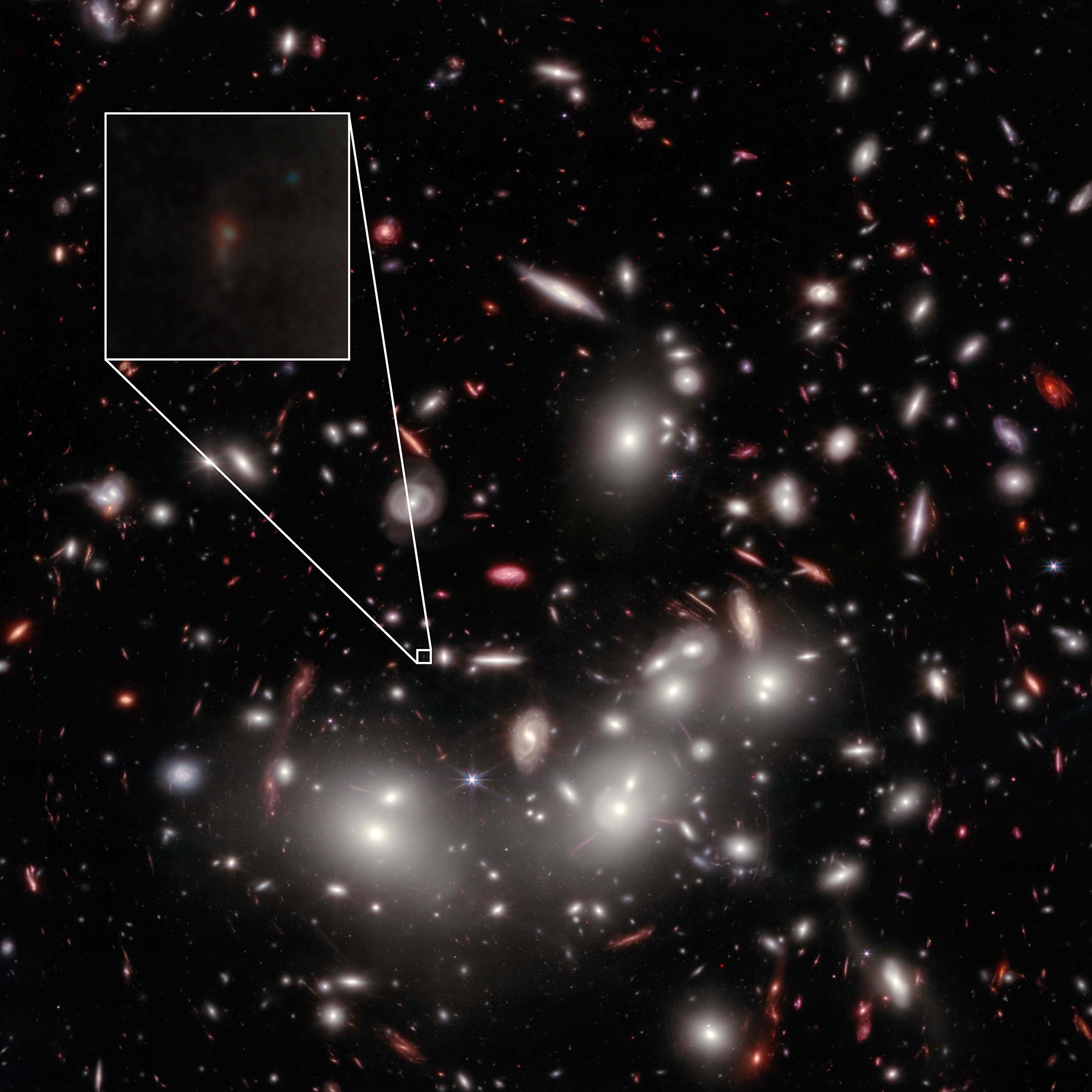
An international research team has confirmed the existence of the faintest galaxy ever observed in the early universe, JD1. This discovery was made using NASA’s James Webb Space Telescope and contributes to the understanding of the universe’s evolution. JD1, typical of galaxies that ionized the post-Big Bang hydrogen fog, was studied thanks to its position behind a galaxy cluster that magnified its light.
- After the Big Bang, the universe expanded and cooled sufficiently for hydrogen atoms to form. In the absence of light from the first stars and galaxies, the universe entered a period known as the cosmic dark ages.
- The first stars and galaxies appeared several hundred million years later and began burning away the hydrogen fog left over from the Big Bang, rendering the universe transparent, like it is today.
- Researchers led by astrophysicists from UCLA confirmed the existence of a distant, faint galaxy typical of those whose light burned through the hydrogen atoms; the finding should help them understand how the cosmic dark ages ended.
An international research team led by University of California, Los Angeles (UCLA) astrophysicists has confirmed the existence of the faintest galaxy ever seen in the early universe. The galaxy, called JD1, is one of the most distant identified to date, and it is typical of the kinds of galaxies that burned through the fog of hydrogen atoms left over from the Big Bang, letting light shine through the universe and shaping it into what exists today.
The discovery was made using NASA’s James Webb Space Telescope, and the findings are published in the journal Nature.
Unveiling the Epoch of Reionization
The first billion years of the universe’s life were a crucial period in its evolution. After the Big Bang, approximately 13.8 billion years ago, the universe expanded and cooled sufficiently for hydrogen atoms to form. Hydrogen atoms absorb ultraviolet photons from young stars; however, until the birth of the first stars and galaxies, the universe became dark and entered a period known as the cosmic dark ages. The appearance of the first stars and galaxies a few hundred million years later bathed the universe in energetic ultraviolet light which began burning, or ionizing, the hydrogen fog. That, in turn, enabled photons to travel through space, rendering the universe transparent.
Determining the types of galaxies that dominated that era — dubbed the Epoch of Reionization — is a major goal in astronomy today, but until the development of the Webb telescope, scientists lacked the sensitive infrared instruments required to study the first generation of galaxies.
“Most of the galaxies found with JWST so far are bright galaxies that are rare and not thought to be particularly representative of the young galaxies that populated the early universe,” said Guido Roberts-Borsani, a UCLA postdoctoral researcher and the study’s first author. “As such, while important, they are not thought to be the main agents that burned through all of that hydrogen fog.
“Ultra-faint galaxies such as JD1, on the other hand, are far more numerous, which is why we believe they are more representative of the galaxies that conducted the reionization process, allowing ultraviolet light to travel unimpeded through space and time.”
JD1 is so dim and so far away that it is challenging to study without a powerful telescope — and a helping hand from nature. JD1 is located behind a large cluster of nearby galaxies, called Abell 2744, whose combined gravitational strength bends and amplifies the light from JD1, making it appear larger and 13 times brighter than it otherwise would. The effect, known as gravitational lensing, is similar to how a magnifying glass distorts and amplifies light within its field of view; without gravitational lensing, JD1 would likely have been missed.
The researchers used the Webb Telescope’s near-infrared spectrograph instrument, NIRSpec, to obtain an infrared light spectrum of the galaxy, allowing them to determine its precise age and its distance from Earth, as well as the number of stars and amount of dust and heavy elements that it formed in its relatively short lifetime.
Tracing Light from 13.3 Billion Years Ago
The combination of the galaxy’s gravitational magnification and new images from another one of the Webb Telescope’s near-infrared instruments, NIRCam, also made it possible for the team to study the galaxy’s structure in unprecedented detail and resolution, revealing three main elongated clumps of dust and gas that are forming stars. The team used the new data to trace JD1’s light back to its original source and shape, revealing a compact galaxy just a fraction of the size of older galaxies like the Milky Way, which is 13.6 billion years old.
Because light takes time to travel to Earth, JD1 is seen as it was approximately 13.3 billion years ago, when the universe was only about 4% of its present age.
“Before the Webb telescope switched on, just a year ago, we could not even dream of confirming such a faint galaxy,” said Tommaso Treu, a UCLA physics and astronomy professor, and the study’s second author. “The combination of JWST and the magnifying power of gravitational lensing is a revolution. We are rewriting the book on how galaxies formed and evolved in the immediate aftermath of the Big Bang.”
Reference: “The nature of an ultra-faint galaxy in the cosmic dark ages seen with JWST” by Guido Roberts-Borsani, Tommaso Treu, Wenlei Chen, Takahiro Morishita, Eros Vanzella, Adi Zitrin, Pietro Bergamini, Marco Castellano, Adriano Fontana, Karl Glazebrook, Claudio Grillo, Patrick L. Kelly, Emiliano Merlin, Themiya Nanayakkara, Diego Paris, Piero Rosati, Lilan Yang, Ana Acebron, Andrea Bonchi, Kit Boyett, Maruša Bradač, Gabriel Brammer, Tom Broadhurst, Antonello Calabró, Jose M. Diego, Alan Dressler, Lukas J. Furtak, Alexei V. Filippenko, Alaina Henry, Anton M. Koekemoer, Nicha Leethochawalit, Matthew A. Malkan, Charlotte Mason, Amata Mercurio, Benjamin Metha, Laura Pentericci, Justin Pierel, Steven Rieck, Namrata Roy, Paola Santini, Victoria Strait, Robert Strausbaugh, Michele Trenti, Benedetta Vulcani, Lifan Wang, Xin Wang and Rogier A. Windhorst, 17 May 2023, Nature.
DOI: 10.1038/s41586-023-05994-w
Never miss a breakthrough: Join the SciTechDaily newsletter.
Follow us on Google and Google News.
2 Comments
Faintest whisper or furthest galaxy found to date? So much maybe and possibly…
Likely not the farthest galaxy since its z ~ 10 redshift was spectroscopically estimated and there are photometric candidates at z >~ 11 IIRC. But small and dim.
” JD1 was previously identified as a triply-imaged galaxy with a magnification factor of 13 provided by the foreground cluster Abell 2744 (ref. 3), and a photometric redshift of z ≈ 10. Here we report the spectroscopic confirmation of this very low luminosity (≈0.05 L*) galaxy at z = 9.79, observed 480 Myr after the Big Bang, by means of the identification of the Lyman break and redward continuum, as well as multiple ≳4σ emission lines, with the Near-InfraRed Spectrograph (NIRSpec) and Near-InfraRed Camera (NIRCam) instruments. The combination of the James Webb Space Telescope (JWST) and gravitational lensing shows that this ultra-faint galaxy (MUV = −17.35)—with a luminosity typical of the sources responsible for cosmic reionization—has a compact (≈150 pc) and complex morphology, low stellar mass (107.19 M⊙) and subsolar (≈0.6 Z⊙) gas-phase metallicity.”