

What lies within a toe bean? According to NASA’s James Webb Space Telescope, mini toe beans composed of gas, dust, and stars.
Since kicking off full science operations in July 2022, the James Webb Space Telescope has dazzled researchers and sky-watchers alike by looking deeper into space than any telescope before it. Every new infrared image adds pieces to the cosmic puzzle, exposing features of the universe we never knew existed.
For its third birthday, Webb turned its powerful gaze on the Cat’s Paw Nebula (NGC 6334), an enormous stellar nursery about 4,000 light-years away. The close-up targets a single “toe bean” and, inside it, tiny knots of gas and dust that cradle newborn stars. Together, they paint a vivid scene of creation in action, proving once again how Webb keeps pushing the frontier of discovery.
This visualization explores a subset of toe bean-reminiscent structures within a section of the Cat’s Paw Nebula, a massive, local star-forming region located approximately 4,000 light-years away in the constellation Scorpius.
NASA’s Webb Scratches Beyond Surface of Cat’s Paw for 3rd Anniversary
It’s the cat’s meow! To celebrate its third year of revealing stunning scenes of the cosmos in infrared light, NASA’s James Webb Space Telescope has “clawed” back the thick, dusty layers of a section within the Cat’s Paw Nebula (NGC 6334). Focusing Webb’s NIRCam (Near-Infrared Camera) on a single “toe bean” within this active star-forming region revealed a subset of mini toe beans, which appear to contain young stars shaping the surrounding gas and dust.
This detailed peek at one corner of the nebula hints at the wealth of discoveries Webb has delivered during its first three years of exploration.
“Three years into its mission, Webb continues to deliver on its design, revealing previously hidden aspects of the universe, from the star formation process to some of the earliest galaxies,” said Shawn Domagal-Goldman, acting director of the Astrophysics Division at NASA Headquarters in Washington. “As it repeatedly breaks its own records, Webb is also uncovering unknowns for new generations of flagship missions to tackle. Whether it’s following up on the mysteries of dark matter with NASA’s nearly complete Nancy Grace Roman Space Telescope, or narrowing our search for life to Earth-like planets with the Habitable Worlds Observatory, the questions Webb has raised are just as exciting as the answers it’s giving us.”
This zoom-in video shows the location of the Cat’s Paw Nebula on the sky. It begins with a ground-based photo by the late astrophotographer Akira Fujii, then shows views from the Digitized Sky Survey. The video then homes in on a select portion of the sky to reveal a European Southern Observatory image of the Cat’s Paw Nebula in visible light. The video continues to zoom in on a section of the Cat’s Paw, which gradually transitions to the stunning image captured by NASA’s James Webb Space Telescope in near-infrared light. Credit: NASA, ESA, CSA, STScI, Danielle Kirshenblat (STScI), Acknowledgment: VISTA, Akira Fuji
Star Formation Flex
The progression from a large molecular cloud to massive stars entails multiple steps, some of which are still not well understood by astronomers. Located approximately 4,000 light-years away in the constellation Scorpius, the Cat’s Paw Nebula offers scientists the opportunity to study the turbulent cloud-to-star process in great detail. Webb’s observation of the nebula in near-infrared light builds upon previous studies by NASA’s Hubble and retired Spitzer Space Telescope in visible- and infrared-light, respectively.
With its sharp resolution, Webb shows never-before-seen structural details and features: Massive young stars are carving away at nearby gas and dust, while their bright starlight is producing a bright nebulous glow represented in blue. It’s a temporary scene where the disruptive young stars, with their relatively short lives and luminosity, have a brief but important role in the region’s larger story. As a consequence of these massive stars’ lively behavior, the local star formation process will eventually come to a stop.
Opera House’s Intricate Structure
Start with the toe bean at top center, which is nicknamed the “Opera House” for its circular, tiered-like structure. The primary drivers for the area’s cloudy blue glow are most likely toward its bottom: either the light from the bright yellowish stars or from a nearby source still hidden behind the dense, dark brown dust.
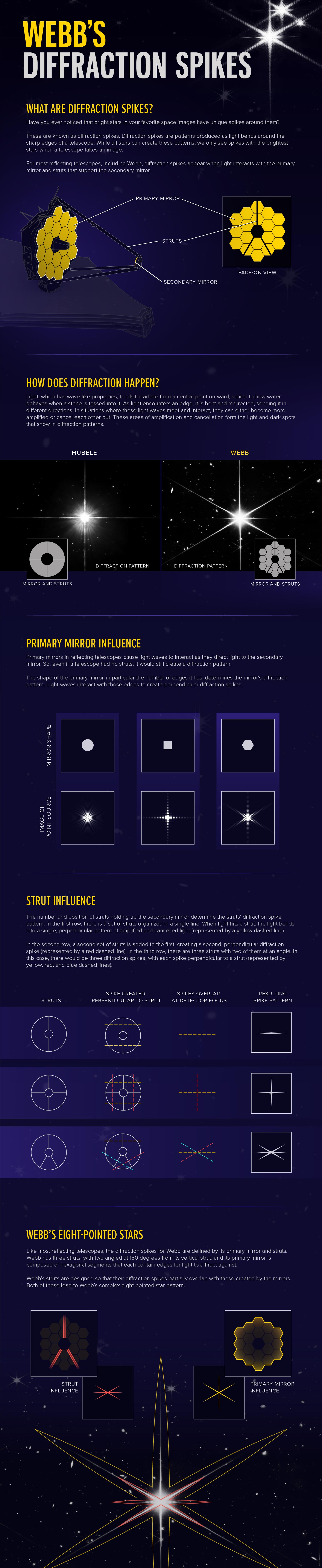
Just below the orange-brown tiers of dust is a bright yellow star with diffraction spikes. While this massive star has carved away at its immediate surroundings, it has been unable to push the gas and dust away to greater distances, creating a compact shell of surrounding material.
Look closely to notice small patches, like the tuning fork-shaped area to the Opera House’s immediate left, that contain fewer stars. These seemingly vacant zones indicate the presence of dense foreground filaments of dust that are home to still-forming stars and block the light of stars in the background.

Spotlight on Stars
Toward the image’s center are small, fiery red clumps scattered amongst the brown dust. These glowing red sources mark regions where massive star formation is underway, albeit in an obscured manner.
Some massive blue-white stars, like the one in the lower left toe bean, seem to be more sharply resolved than others. This is because any intervening material between the star and the telescope has been dissipated by stellar radiation.
Near the bottom of that toe bean are small, dense filaments of dust. These tiny clumps of dust have managed to remain despite the intense radiation, suggesting that they are dense enough to form protostars. A small section of yellow at the right notes the location of a still-enshrouded massive star that has managed to shine through intervening material.
Across this entire scene are many small yellow stars with diffraction spikes. Bright blue-white stars are in the foreground of this Webb image, but some may be a part of the more expansive Cat’s Paw Nebula area.
One eye-catching aspect of this Webb image is the bright, red-orange oval at top right. Its low count of background stars implies it is a dense area just beginning its star-formation process. A couple of visible and still-veiled stars are scattered throughout this region, which contribute to the illumination of the material in the middle. Some still-enveloped stars leave hints of their presence, like a bow shock at the bottom left, which indicates an energetic ejection of gas and dust from a bright source.
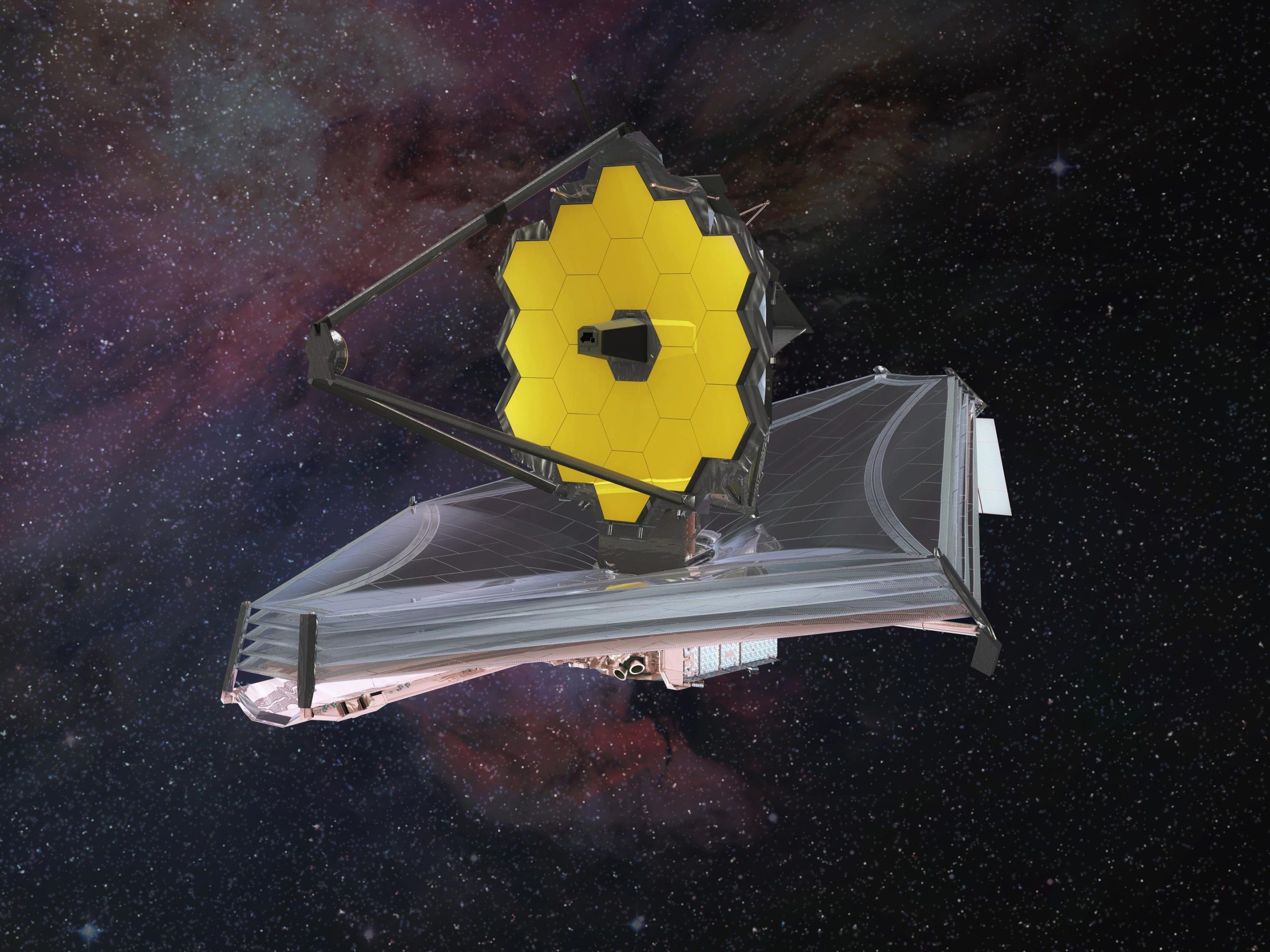
The James Webb Space Telescope (JWST) is the world’s premier space-science observatory, designed to look farther back in time and with sharper infrared eyes than any telescope before it. Launched on December 25, 2021, JWST orbits the Sun–Earth L2 point 1.5 million kilometres from Earth, where its tennis-court-sized sunshield keeps its optics chilled to just a few degrees above absolute zero. Four cutting-edge instruments—NIRCam, NIRSpec, NIRISS, and the mid-infrared imager/spectrograph MIRI—allow Webb to capture faint heat signatures from the first galaxies, dissect exoplanet atmospheres, map star-forming nurseries, and even study objects in our own solar system.
Never miss a breakthrough: Join the SciTechDaily newsletter.
Follow us on Google and Google News.
1 Comment
Never seen the term “toe bean” before. I suppose it’s more biology than astronomy.
In other news: The clickable “enlarged” section of the diffraction-spikes graphic is still illegible.