
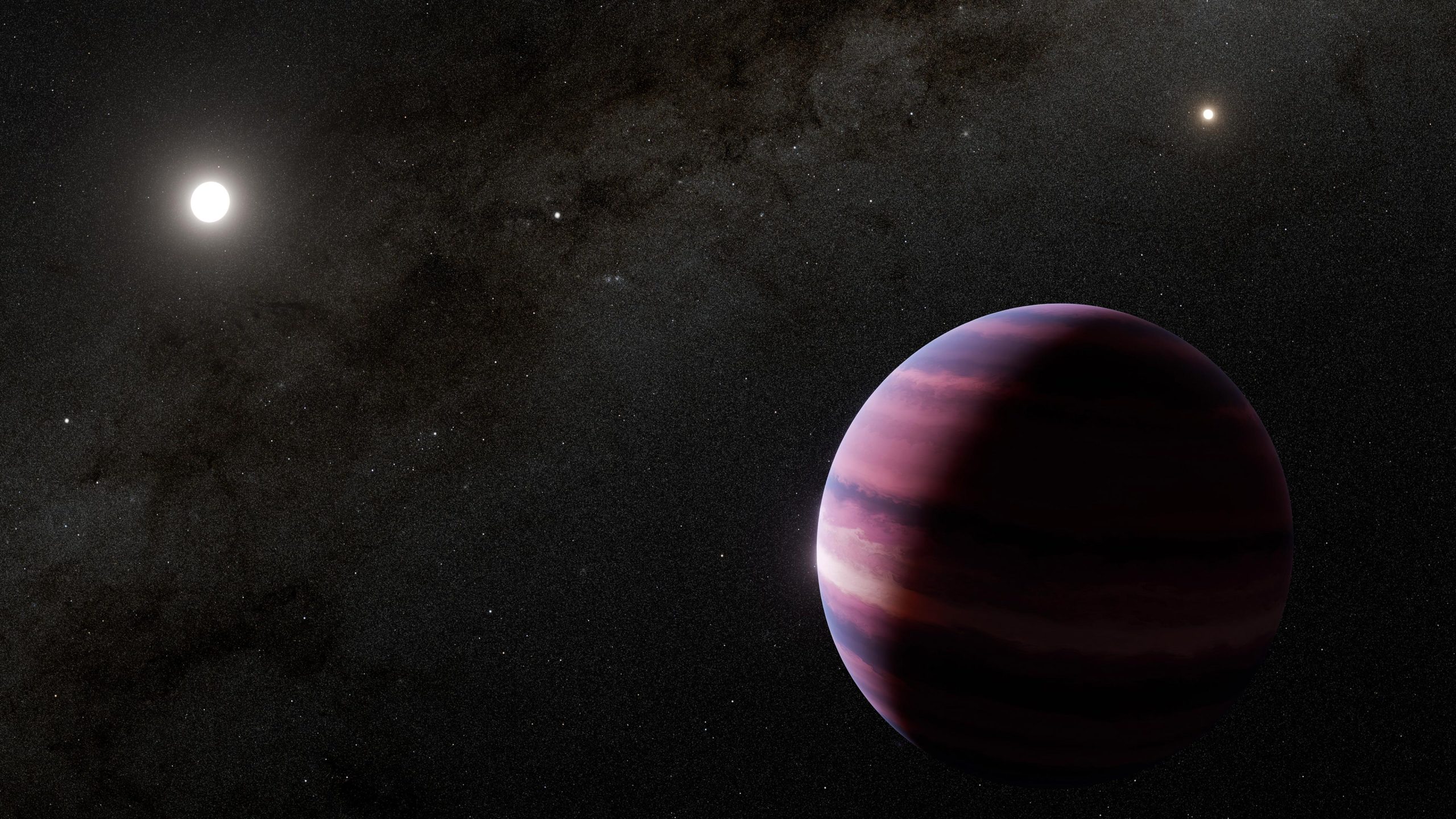
In this concept, Alpha Centauri A is depicted at the upper left of the planet, while the other Sun-like star in the system, Alpha Centauri B, is at the upper right. Our Sun is shown as a small dot of light between those two stars. Credit: NASA, ESA, CSA, STScI, Robert L. Hurt (Caltech/IPAC)
Planet could be a gas giant, orbiting 1 to 2 times the distance between Sun and Earth.
The Alpha Centauri system, our nearest stellar neighbor, has long captured the imagination of science fiction and pop culture — often depicted as a gateway to future interstellar voyages or a home for alien worlds brimming with life. The truth is no less fascinating, even if it looks a little different from Hollywood’s vision.
This dynamic system is made up of two Sun-like stars, Alpha Centauri A and Alpha Centauri B, along with a faint red dwarf, Proxima Centauri. So far, only Proxima is known to host planets — three confirmed worlds orbit it.
Now, new observations from NASA’s James Webb Space Telescope have delivered the strongest evidence yet of a giant planet orbiting Alpha Centauri A, bringing us closer than ever to finding another world in our cosmic backyard.
NASA’s Webb Finds New Evidence for Planet Around Closest Solar Twin
Astronomers using NASA’s James Webb Space Telescope have gathered compelling evidence for a giant planet orbiting a star in the nearest stellar system to our Sun. Just four light-years from Earth, the Alpha Centauri system has long been one of the most enticing places to search for planets beyond our own.
Situated in the far southern sky, Alpha Centauri consists of the bright binary pair Alpha Centauri A and Alpha Centauri B, both similar to our Sun, along with a faint red dwarf, Proxima Centauri. Alpha Centauri A ranks as the third brightest star visible at night. While astronomers have confirmed three planets orbiting Proxima Centauri, finding definitive proof of worlds around Alpha Centauri A or B has remained a major challenge.
Webb’s Breakthrough Mid-Infrared Observations
Recent observations from Webb’s Mid-Infrared Instrument (MIRI) have now produced the strongest evidence so far for a gas giant around Alpha Centauri A. The findings are detailed in two papers accepted for publication in The Astrophysical Journal Letters.
If verified, this planet would be the closest known world orbiting in the habitable zone of a Sun-like star. However, because it is a gas giant, scientists do not believe it could support life as we know it.
“With this system being so close to us, any exoplanets found would offer our best opportunity to collect data on planetary systems other than our own. Yet, these are incredibly challenging observations to make, even with the world’s most powerful space telescope, because these stars are so bright, close, and move across the sky quickly,” said Charles Beichman, NASA’s Jet Propulsion Laboratory and the NASA Exoplanet Science Institute at Caltech’s IPAC astronomy center, co-first author on the new papers. “Webb was designed and optimized to find the most distant galaxies in the universe. The operations team at the Space Telescope Science Institute had to come up with a custom observing sequence just for this target, and their extra effort paid off spectacularly.”
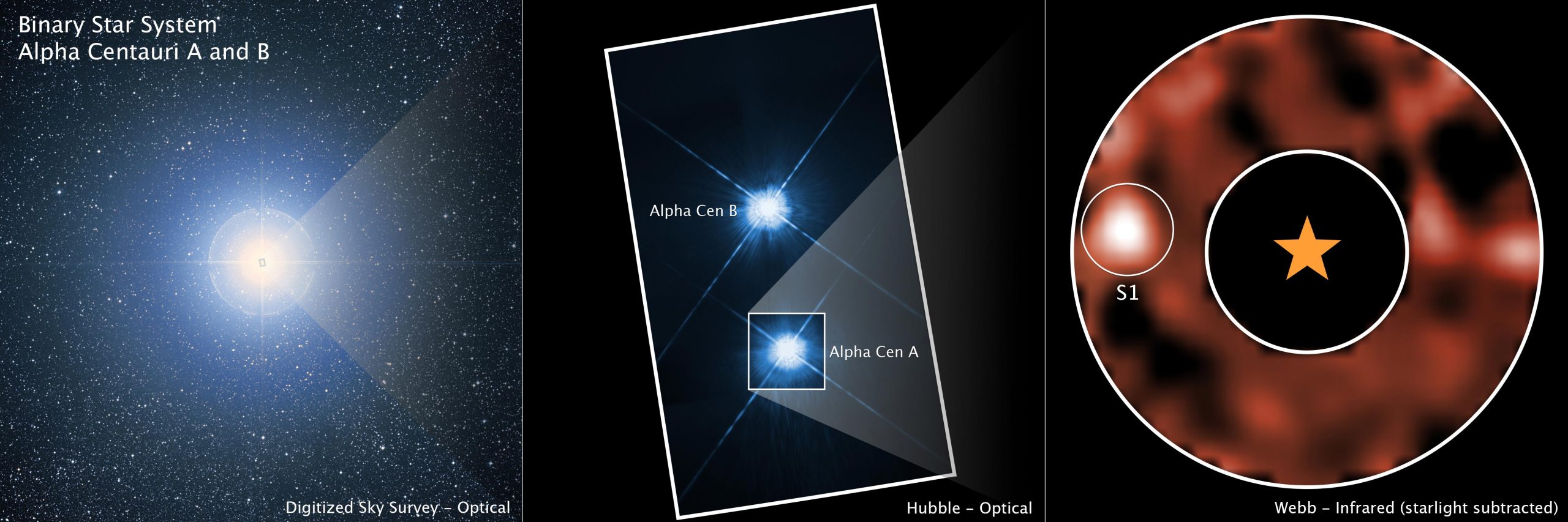
The ground-based image from DSS shows the triple system as a single source of light, while Hubble resolves the two Sun-like stars in the system, Alpha Centauri A and Alpha Centauri B.
The image from Webb’s MIRI (Mid-Infrared Instrument), which uses a coronagraphic mask to block the bright glare from Alpha Centauri A, reveals a potential planet orbiting the star. Credit: NASA, ESA, CSA, Aniket Sanghi (Caltech), Chas Beichman (NExScI, NASA/JPL-Caltech), Dimitri Mawet (Caltech), Image Processing: Joseph DePasquale (STScI)
Meticulous Observations and Image Analysis
Several rounds of meticulously planned observations by Webb, careful analysis by the research team, and extensive computer modeling helped determine that the source seen in Webb’s image is likely to be a planet, and not a background object (like a galaxy), foreground object (a passing asteroid), or other detector or image artifact.
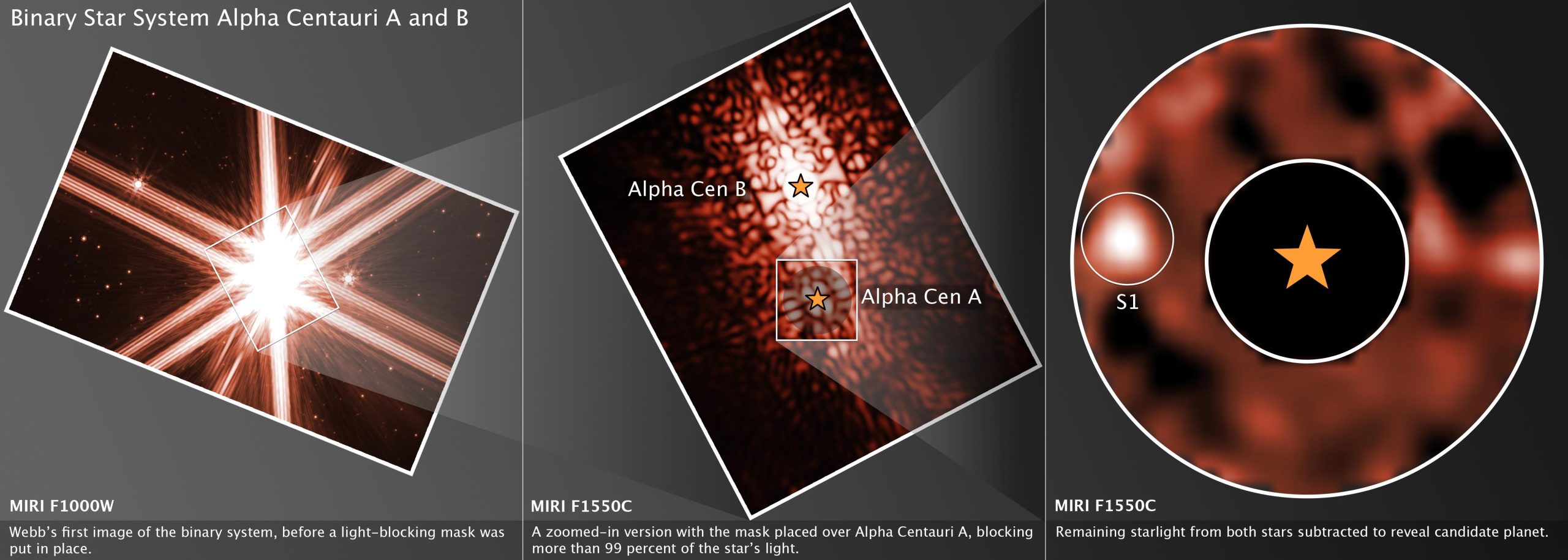
The first observations of the system took place in August 2024, using the coronagraphic mask aboard MIRI to block Alpha Centauri A’s light. While extra brightness from the nearby companion star Alpha Centauri B complicated the analysis, the team was able to subtract out the light from both stars to reveal an object over 10,000 times fainter than Alpha Centauri A, separated from the star by about two times the distance between the Sun and Earth.
The Disappearing Planet Mystery
While the initial detection was exciting, the research team needed more data to come to a firm conclusion. However, additional observations of the system in February 2025 and April 2025 (using Director’s Discretionary Time) did not reveal any objects like the one identified in August 2024.
“We are faced with the case of a disappearing planet! To investigate this mystery, we used computer models to simulate millions of potential orbits, incorporating the knowledge gained when we saw the planet, as well as when we did not,” said PhD student Aniket Sanghi of Caltech in Pasadena, California. Sanghi is a co-first author on the two papers covering the team’s research.
Simulating Millions of Possible Orbits
In these simulations, the team took into account both a 2019 sighting of the potential exoplanet candidate by the European Southern Observatory’s Very Large Telescope, the new data from Webb, and considered orbits that would be gravitationally stable in the presence of Alpha Centauri B, meaning the planet wouldn’t get flung out of the system.
Researchers say a non-detection in the second and third round of observations with Webb isn’t surprising.
“We found that in half of the possible orbits simulated, the planet moved too close to the star and wouldn’t have been visible to Webb in both February and April 2025,” said Sanghi.
A Saturn-Mass Planet on an Elliptical Orbit
Based on the brightness of the planet in the mid-infrared observations and the orbit simulations, researchers say it could be a gas giant approximately the mass of Saturn orbiting Alpha Centauri A in an elliptical path varying between 1 and 2 times the distance between the Sun and Earth.
“If confirmed, the potential planet seen in the Webb image of Alpha Centauri A would mark a new milestone for exoplanet imaging efforts,” Sanghi says. “Of all the directly imaged planets, this would be the closest to its star seen so far. It’s also the most similar in temperature and age to the giant planets in our solar system, and nearest to our home, Earth,” he says. “Its very existence in a system of two closely separated stars would challenge our understanding of how planets form, survive, and evolve in chaotic environments.”
Transforming the Future of Exoplanet Science
If confirmed by additional observations, the team’s results could transform the future of exoplanet science.
“This would become a touchstone object for exoplanet science, with multiple opportunities for detailed characterization by Webb and other observatories,” said Beichman.
For example, NASA’s Nancy Grace Roman Space Telescope, set to launch by May 2027 and potentially as early as fall 2026, is equipped with dedicated hardware that will test new technologies to observe binary systems like Alpha Centauri in search of other worlds. Roman’s visible light data would complement Webb’s infrared observations, yielding unique insights on the size and reflectivity of the planet.
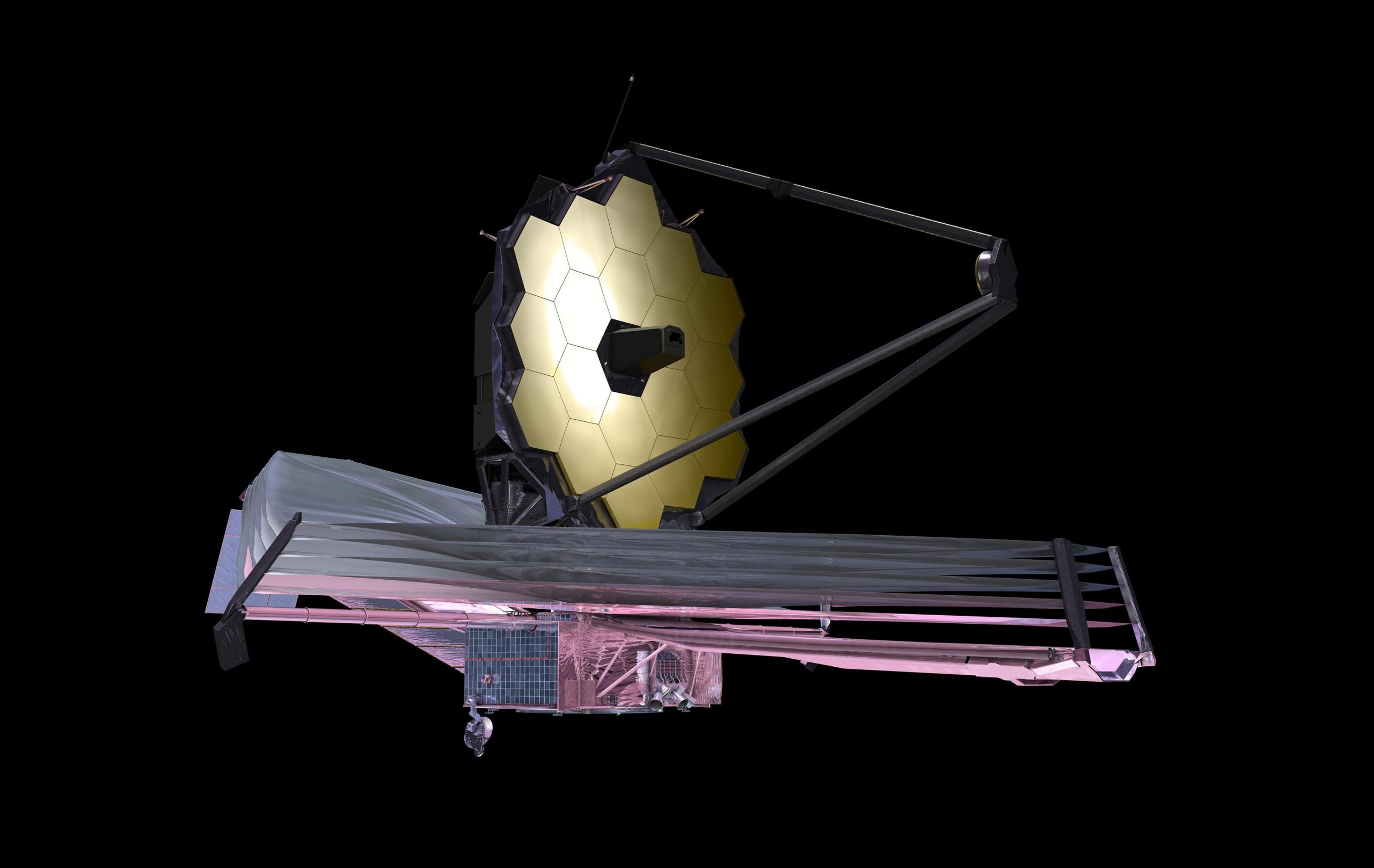
The James Webb Space Telescope is the world’s leading space science observatory, designed to unlock some of the greatest cosmic mysteries. Built through an international collaboration between NASA, the European Space Agency (ESA), and the Canadian Space Agency (CSA), Webb explores our own solar system, studies distant exoplanets, and peers deep into the universe’s earliest structures. With its advanced instruments and unparalleled infrared vision, Webb is revealing how stars and galaxies formed, uncovering the atmospheres of alien worlds, and providing unprecedented insight into the origins and evolution of the cosmos — and our place within it.
References:
“Worlds Next Door: A Candidate Giant Planet Imaged in the Habitable Zone of Cen A. I. Observations, Orbital and Physical Properties, and Exozodi Upper Limits” by Charles Beichman, Aniket Sanghi, Dimitri Mawet, Pierre Kervella, Kevin Wagner, Billy Quarles, Jack J. Lissauer, Max Sommer, Mark Wyatt, Nicolas Godoy, William O. Balmer, Laurent Pueyo, Jorge Llop-Sayson, Jonathan Aguilar, Rachel Akeson, Ruslan Belikov, Anthony Boccaletti, Elodie Choquet, Edward Fomalont, Thomas Henning, Dean Hines, Renyu Hu, Pierre-Olivier Lagage, Jarron Leisenring, James Mang, Michael Ressler, Eugene Serabyn, Pascal Tremblin, Marie Ygouf and Mantas Zilinskas, accepted, The Astrophysical Journal Letters.
arXiv:2508.03814
“Worlds Next Door: A Candidate Giant Planet Imaged in the Habitable Zone of Cen A. II. Binary Star Modeling, Planet and Exozodi Search, and Sensitivity Analysis” by Aniket Sanghi, Charles Beichman, Dimitri Mawet, William O. Balmer, Nicolas Godoy, Laurent Pueyo, Anthony Boccaletti, Max Sommer, Alexis Bidot, Elodie Choquet, Pierre Kervella, Pierre-Olivier Lagage, Jarron Leisenring, Jorge Llop-Sayson, Michael Ressler, Kevin Wagner and Mark Wyatt, accepted, The Astrophysical Journal Letters.
arXiv:2508.03812
Never miss a breakthrough: Join the SciTechDaily newsletter.
Follow us on Google and Google News.
2 Comments
Crap. Now what are we gonna do?
THAT WOULD BE GOOD OL PLANET X!!!