
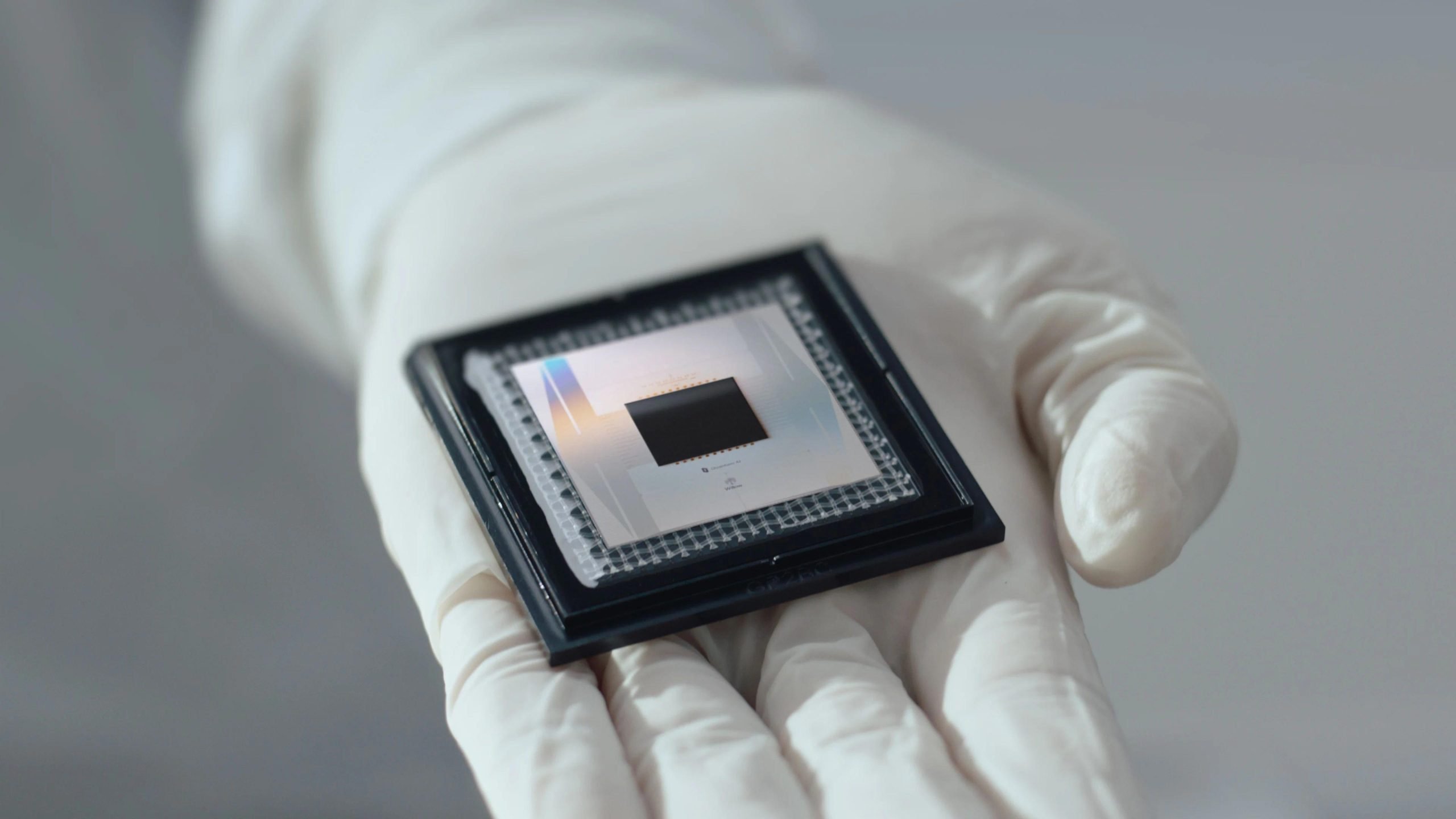
A quantum processor has revealed a previously unobserved exotic phase of matter. The discovery highlights the role of quantum computers in advancing fundamental physics.
Phases of matter describe the fundamental forms materials can take, such as water existing as liquid or ice. Traditionally, scientists have defined these phases under equilibrium, when a system remains stable over time. Yet nature also permits more unusual possibilities: phases that only appear when a system is forced out of equilibrium. In a new study published in Nature, researchers demonstrate that quantum computers provide a unique platform for investigating these exotic forms of matter.
Non-equilibrium quantum states and floquet systems
In contrast to conventional phases, non-equilibrium quantum phases are characterized by their time-dependent and dynamic behavior, features that cannot be explained by standard equilibrium thermodynamics. A particularly rich category of these phases emerges in Floquet systems, which are quantum systems subjected to periodic external driving. This rhythmic stimulation can generate entirely new patterns of order that do not exist in equilibrium, uncovering physical phenomena that lie beyond the scope of ordinary matter phases.
Working with a 58-qubit superconducting quantum processor, a collaboration between the Technical University of Munich (TUM), Princeton University, and Google Quantum AI successfully created a Floquet topologically ordered state, a phase that had long been theorized but never experimentally realized. The researchers directly visualized the directed edge motions characteristic of this state and developed a new interferometric algorithm to probe its topological features. With these tools, they observed the dynamic “transmutation” of exotic particles, a predicted hallmark of these unusual quantum phases.
Quantum computer as a laboratory
“Highly entangled non-equilibrium phases are notoriously hard to simulate with classical computers,” said the first author, Melissa Will, a PhD student at the Physics Department of the TUM School of Natural Sciences. “Our results show that quantum processors are not just computational devices – they are powerful experimental platforms for discovering and probing entirely new states of matter.”
This work opens the door to a new era of quantum simulation, where quantum computers become laboratories for studying the vast and largely unexplored landscape of out-of-equilibrium quantum matter. The insights gained from these studies could have far-reaching implications, from understanding fundamental physics to designing next-generation quantum technologies.
Reference: “Probing non-equilibrium topological order on a quantum processor” by M. Will, T. A. Cochran, E. Rosenberg, B. Jobst, N. M. Eassa, P. Roushan, M. Knap, A. Gammon-Smith and F. Pollmann, 10 September 2025, Nature.
DOI: 10.1038/s41586-025-09456-3
Never miss a breakthrough: Join the SciTechDaily newsletter.
Follow us on Google and Google News.
6 Comments
They observed the dynamic “transmutation” of exotic particles, a predicted hallmark of these unusual quantum phases.
VERY GOOD!
Please ask the researchers to think deeply:
1. How do you understand the quantum phases?
2. Does your observation alter the quantum phase?
In the history of physics, Newton’s absolute space and Einstein’s relative spacetime are often seen as two mutually exclusive models of the universe. Based on the Topological Vortex Theory (TVT), Newton’s absolute space is the physical background of the universe, characterized by non-viscosity, uniformly incompressibility, and isotropy, providing the ultimate stage for all physical phenomena. Einstein’s relative spacetime, in contrast, can be understood as a dynamic structure arising from topological excitations at critical energy points within this absolute background. The two are not in a “life-and-death” substitutive relationship but rather a symbiotic relationship of “background” and “excited state,” “stage” and “actor.” Denying the foundational status of absolute space is not only physically one-sided but also philosophically a form of historical nihilism, hindering the progress of physics towards a unified theory.
TVT’s mathematical self-consistency hinges on resolving three tensions: (1) global solvability of nonlinear PDEs, (2) symmetry-compatible regularization, and (3) quantum-classical duality. Hybrid frameworks incorporating topological quantization and RG methods show promise. The theory’s viability as a universal model of vortex dynamics depends on reconciling geometric analogies with quantum indeterminacy (such as the spin direction of topological vortices) and relativistic invariance (such as the spin velocity of topological vortices).
When we pursue the ultimate truth of all things, the space in which our bodies and all things exist may itself be the final and deepest puzzle we need to explore. This is not only the pursuit of physics, but also the most magnificent exploration of the origin of the universe by human reason.
Based on the Topological Vortex Theory (TVT), space is an uniformly incompressible physical entity. Space-time vortices are the products of topological phase transitions of the tipping points in space, are the point defects in spacetime. Point defects do not only impact the thermodynamic properties, but are also central to kinetic processes. They create all things and shape the world through spin and self-organization.
In today’s physics, some so-called peer-reviewed journals—including Physical Review Letters, Nature, Science, and others—stubbornly insist on and promote the following:
1. Even though θ and τ particles exhibit differences in experiments, physics can claim they are the same particle. This is science.
2. Even though topological vortices and antivortices have identical structures and opposite rotational directions, physics can define their structures and directions as entirely different. This is science.
3. Even though two sets of cobalt-60 rotate in opposite directions and experiments reveal asymmetry, physics can still define them as mirror images of each other. This is science.
4. Even though vortex structures are ubiquitous—from cosmic accretion disks to particle spins—physics must insist that vortex structures do not exist and require verification. Only the particles that like God, Demonic, or Angelic are the most fundamental structures of the universe. This is science.
5. Even though everything occupies space and maintains its existence in time, physics must still debate and insist on whether space exists and whether time is a figment of the human mind. This is science.
6. Even though space, with its non-stick, incompressible, and isotropic characteristics, provides a solid foundation for the development of physics, physics must still insist that the ideal fluid properties of space do not exist. This is science.
and go on.
Is this the counterintuitive science they widely promote?
What are the shames?
What are the corruption, dirtiness, and ugliness?
Under the topological vortex architecture, it is highly challenging for even two hydrogen atoms or two quarks to be perfectly symmetrical, let alone counter-rotating two sets of cobalt-60. Contemporary physics and so-called peer-reviewed publications (including Physical Review Letters, Science, Nature, etc.) stubbornly believe that two sets of counter rotating cobalt-60 are two mirror images of each other, constructing a more shocking pseudoscientific theoretical framework in the history of science than the “geocentric model”. This pseudo scientific framework and system have seriously hindered scientific progress and social development.
For nearly a century, physics has been manipulated by this pseudo scientific theoretical system and the interest groups behind it, wasting a lot of manpower, funds, and time. A large amount of pseudo scientific research has been conducted, and countless pseudo scientific papers have been published, causing serious negative impacts on scientific and social progress, as well as humanistic development.
Complexity does not necessarily mean that there is no logical and architectural framework to follow. Mathematics is the language and tool that reveals the motion of spacetime, rather than the motion itself. Although the physical form of spacetime vortices is extremely simple, their interaction patterns are highly complex, and we must develop more and richer mathematical languages to describe and understand them.
You should write an article! When a comment has me more captivated than the story it refers to, I’m more than interested to hear more.
Sounds like what Terrence Howard been talking about already for a long time. Just prove that nothing to be trusted nowadays everybody steals from everyone else we all know who the real true enjoy though you phony fake