
Close Menu
    Facebook X (Twitter) Instagram
    SciTechDaily
    • Biology
    • Chemistry
    • Earth
    • Health
    • Physics
    • Science
    • Space
    • Technology
    Facebook X (Twitter) Pinterest YouTube RSS
    SciTechDaily
    Home»Technology»Groundbreaking 3D-Printing With Unprecedented Precision and Resolution – All in Record Time
    Technology

    Groundbreaking 3D-Printing With Unprecedented Precision and Resolution – All in Record Time

    By Ecole Polytechnique Federale de LausanneMarch 1, 20201 Comment3 Mins Read
    Facebook Twitter Pinterest Telegram LinkedIn WhatsApp Email Reddit
    Share
    Facebook Twitter LinkedIn Pinterest Telegram Email Reddit
    New High-Precision 3D Printer
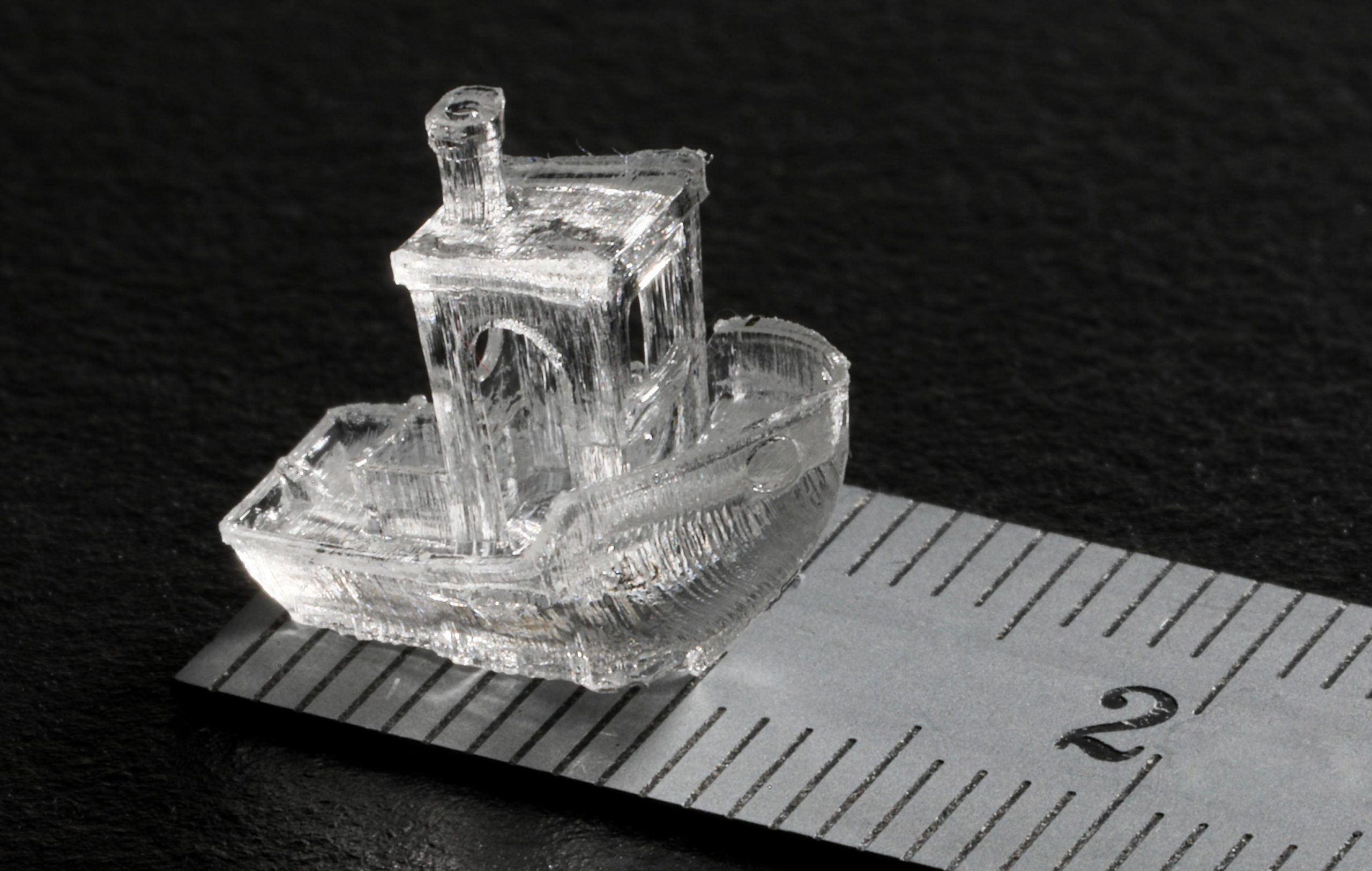
    3D-printing high-precision objects in a matter of seconds Credit: © 2020 EPFL/ Alain Herzog

    Researchers at EPFL have developed a new, high-precision method for 3D-printing small, soft objects. The process, which takes less than 30 seconds from start to finish, has potential applications in a wide range of fields, including 3D bioprinting.

    It all starts with a translucent liquid. Then, as if by magic, darker spots begin to form in the small, spinning container until, barely half a minute later, the finished product takes shape. This groundbreaking 3D-printing method, developed by researchers at EPFL’s Laboratory of Applied Photonics Devices (LAPD), can be used to make tiny objects with unprecedented precision and resolution – all in record time. The team has published its findings in the journal Nature Communications, and a spin-off, Readily3D, has been set up to develop and market the system.

    The technology could have innovative applications in a wide range of fields, but its advantages over existing methods – the ability to print solid parts of different textures – make it ideally suited for medicine and biology. The process could be used, for instance, to make soft objects such as tissue, organs, hearing aids, and mouthguards.

    “Conventional 3D printing techniques, known as additive manufacturing, build parts layer by layer,” explains Damien Loterie, the CEO of Readily3D. “The problem is that soft objects made that way quickly fall apart.” What’s more, the process can be used to make delicate cell-laden scaffolds in which cells can develop in a pressure-free 3D environment. The researchers teamed up with a surgeon to test 3D-printed arteries made using the technique. “The trial results were extremely encouraging,” says Loterie.

    Hardened by light

    The new technique draws on the principles of tomography, a method used mainly in medical imaging to build a model of an object based on surface scans.

    The printer works by sending a laser through the translucent gel – either a biological gel or liquid plastic, as required. “It’s all about the light,” explains Paul Delrot, Readily3D’s CTO. “The laser hardens the liquid through a process of polymerization. Depending on what we’re building, we use algorithms to calculate exactly where we need to aim the beams, from what angles, and at what dose.”

    The system is currently capable of making two-centimeter structures with a precision of 80 micrometers, about the same as the diameter of a strand of hair. But as the team develops new devices, they should be able to build much bigger objects, potentially up to 15 centimeters (6 inches). “The process could also be used to quickly build small silicone or acrylic parts that don’t need finishing after printing,” says Christophe Moser, who heads the LAPD. Interior design could be a potentially lucrative market for the new printer.

    Reference: “High-resolution tomographic volumetric additive manufacturing” by Damien Loterie, Paul Delrot and Christophe Moser, 12 February 2020, Nature Communications.
    DOI: 10.1038/s41467-020-14630-4

    Never miss a breakthrough: Join the SciTechDaily newsletter.
    Follow us on Google and Google News.

    EPFL Popular
    Share. Facebook Twitter Pinterest LinkedIn Email Reddit

    Related Articles

    Making Next Generation Quantum Computers Even More Powerful

    Retinal Implants Equipped With 10,500 Electrodes to Give Artificial Vision to the Blind

    AI Boosted by Parallel Convolutional Light-Based Processors

    Transistor-Integrated Microfluidic Cooling for More Powerful Electronic Chips

    Titanate Nanowire Mask Filter Can Kill Bacteria and Viruses Including SARS-CoV-2/COVID-19

    New High-Precision Technology Cuts Atom-Sized Patterns Into 2D Materials

    MegaX: The First Camera to Capture the Smallest Particles of Light

    Capturing CO2 Directly From Truck Exhaust and Reducing Emissions 90%

    Guanidinium Helps Stabilizes Perovskite Solar Cells

    1 Comment

    1. Loner98 on October 7, 2020 4:02 pm

      Impressive result of 3D printing technology. I want also to admit about anisoprint technology. Companies like https://anisoprint.com/ use this technology for industrial purposes. I think that the future of additive technologies is in anisoprinted composites.

      Reply
    Leave A Reply Cancel Reply

    • Facebook
    • Twitter
    • Pinterest
    • YouTube

    Don't Miss a Discovery

    Subscribe for the Latest in Science & Tech!

    Trending News

    The Best Exercise Combination for Longevity, According to a 30-Year Study

    Popular Weight-Loss Drug Found To Slow Biological Aging in Landmark Human Trial

    NASA’s Fermi Telescope Caught a Supernova Doing Something Never Seen Before

    This Dinosaur Had the Claws of a Raptor but Hunted Like a Heron

    Doctors May Need To Rethink Calcium and Vitamin D Recommendations After Major Review

    Scientists Discover a Hidden Cause of Cellular Aging That Can Be Reversed

    Archaeologists Have Found Something Unexpected Inside a 1,600-Year-Old Egyptian Mummy

    Scientists May Have Found a Completely New Way To Treat Depression

    Follow SciTechDaily
    • Facebook
    • Twitter
    • YouTube
    • Pinterest
    • Newsletter
    • RSS
    SciTech News
    • Biology News
    • Chemistry News
    • Earth News
    • Health News
    • Physics News
    • Science News
    • Space News
    • Technology News
    Recent Posts
    • A Normal Kidney Test Could Still Signal Serious Risk
    • Scientists Discover Gut Signal That Turns Off Sugar Cravings
    • NASA Captures Typhoon Jangmi’s Massive Eye in Stunning Nighttime Image
    • Super Typhoon Sinlaku Was So Powerful It Made the Sky Ripple With Gravity Waves
    • The World Praised This Wolverine Program. Then Everything Changed
    Copyright © 1998 - 2026 SciTechDaily. All Rights Reserved.
    • Science News
    • About
    • Contact
    • Editorial Board
    • Privacy Policy
    • Terms of Use

    Type above and press Enter to search. Press Esc to cancel.