
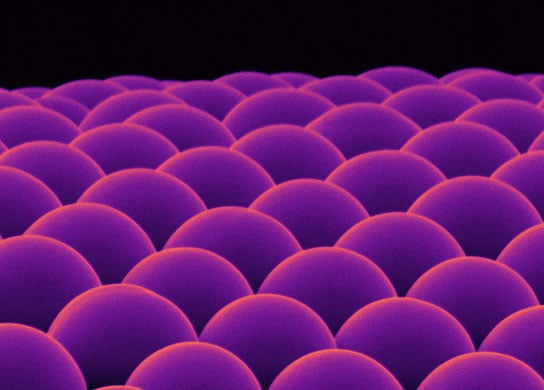
By studying the brittlestar Ophiocoma wendtii, whose body is covered with tiny crystalline lenses made of calcium carbonate, scientists were able to create high quality microlenses produced from calcium carbonate structures.
Inspired from Mother Nature: The body of the brittlestar Ophiocoma wendtii is studded with tiny crystalline lenses made of calcium carbonate. Microlenses like these are of great interest technologically, yet they have always been extremely expensive to produce. However, scientists from the Max Planck Institute of Colloids and Interfaces and colleagues from other institutes took their cue from biology and came up with a relatively simple and inexpensive method of producing calcium carbonate lenses packed together in a regular arrangement.
Many living creatures build minerals into their organism so perfectly as to produce structures with truly astonishing properties. It is a combination of calcium carbonate (CaCO3) and organic matter that makes the seashells, corallites and sea urchin spines we find in our oceans. The brittlestar Ophiocoma wendtii has developed the most perfect way of using minerals for biological purposes. Related to the starfish, the brittlestar long remained something of a mystery to zoologists because it was clearly sensitive to light without having any visible eyes. Then, a few years ago, scientists discovered that the body of the reef-dwelling creature is covered with tiny crystalline lenses made of calcium carbonate, which together form a type of compound eye.
Microlenses like these are used technologically in all sorts of applications that require optical systems and measurements in anything smaller than the millimeter scale. For instance, they are used in telecommunications to conduct light signals through bundles of glass fibers. However, up to now, it has been very tricky to produce these miniature optical lenses, requiring the use of semiconductor technology, for example. Scientists at the Max Planck Institute of Colloids and Interfaces working in conjunction with colleagues from the University of Konstanz and partners from South Korea have developed a surprisingly simple method of producing such lenses – and Mother Nature inspired them.
Microlenses without a cleanroom environment
What the team of scientists discovered is that – within a few minutes at room temperature – tiny calcium carbonate structures form on a solution that has been saturated with calcium, and that these structures grow into a thin film within one or two hours. With the addition of an organic surfactant, they then form uniform hemispheres. “Compared with the conventional method, which is a multi-step procedure requiring a cleanroom environment, this enables us to very cheaply and easily produce microlenses packed together in a regular arrangement,” says Kyubock Lee who works at the Max Planck Institute of Colloids and Interfaces in Potsdam and the KAIST in South Korea.
The researchers could observe clear multiple images of a micron-sized ‘A’ projected through the array of microlenses. “The high quality of the microlenses was a huge surprise to us,” says Wolfgang Wagermaier, a materials scientist at the Max Planck Institute in Potsdam. “This was the first time anyone had ever demonstrated such optical properties in synthetically produced calcium carbonate structures.” The lenses focus a beam of parallel rays of light, each of which is around 0.001 millimeters in size; they have a diameter of 0,006 millimeters and a focal length of 0.007 to 0.008 millimeters.
Brittlestar produces lenses with no image defect
Many living beings build calcium carbonate into their skeletons as a basic material, which shows that the mineral has no negative effect on their organism. The scientists were also able to demonstrate that the lab-made microlenses are compatible with biological substances; as a result, they could potentially be used in fields such as cell research.
This replication of the brittlestar’s optical lenses is a prime example for the up-and-coming research field of bio-inspired materials production to showcase. That is because the crystalline lenses of this sea dweller have an astonishing quality: the crystals are aligned such that the birefringence, or double refraction, that is typical of CaCO3, does not affect them, meaning that no double image is produced. Moreover, they have exactly the right shape to correct any spherical aberration, a serious image defect. Peter Fratzl, who heads the Department of Biomaterials at the Max Planck Institute of Colloids and Interfaces, says: “Deriving fundamental principles for material synthesis from the way in which natural materials are formed is usually an enormous challenge. Sometimes we also get pleasant surprises, like this discovery of a relatively easy method of producing optical elements modeled on nature.”
Reference: “Self-assembly of amorphous calcium carbonate microlens arrays” by Kyubock Lee, Wolfgang Wagermaier, Admir Masic, Krishna P. Kommareddy, Mathieu Bennet, Inderchand Manjubala, Seung-Woo Lee, Seung B. Park, Helmut Cölfen and Peter Fratzl, 6 March 2012, Nature Communications.
DOI: 10.1038/ncomms1720
Never miss a breakthrough: Join the SciTechDaily newsletter.
Follow us on Google and Google News.