
Close Menu
    Facebook X (Twitter) Instagram
    SciTechDaily
    • Biology
    • Chemistry
    • Earth
    • Health
    • Physics
    • Science
    • Space
    • Technology
    Facebook X (Twitter) Pinterest YouTube RSS
    SciTechDaily
    Home»Technology»Miniature Wide-Angle Camera – Created With Array of Metalenses – Could Fit Into Smartphones
    Technology

    Miniature Wide-Angle Camera – Created With Array of Metalenses – Could Fit Into Smartphones

    By OpticaApril 14, 20221 Comment4 Mins Read
    Facebook Twitter Pinterest Telegram LinkedIn WhatsApp Email Reddit
    Share
    Facebook Twitter LinkedIn Pinterest Telegram Email Reddit
    Wide Angle Camera Lens
    Traditional high-quality wide-angle camera lenses are large.

    New design could enable high-quality wide-angle cameras that can possibly fit into smartphones.

    Researchers have designed a new compact camera that acquires wide-angle images of high-quality using an array of metalenses — flat nanopatterned surfaces used to manipulate light. By eliminating the bulky and heavy lenses typically required for this type of imaging, the new approach could enable wide-angle cameras to be incorporated into smartphones and portable imaging devices for vehicles such as cars or drones.

    Tao Li and colleagues from Nanjing University in China report their new ultrathin camera in Optica, Optica Publishing Group’s journal for high-impact research. The new camera, which is just 0.3 centimeters thick, can produce clear images of a scene with a viewing angle of more than 120 degrees.
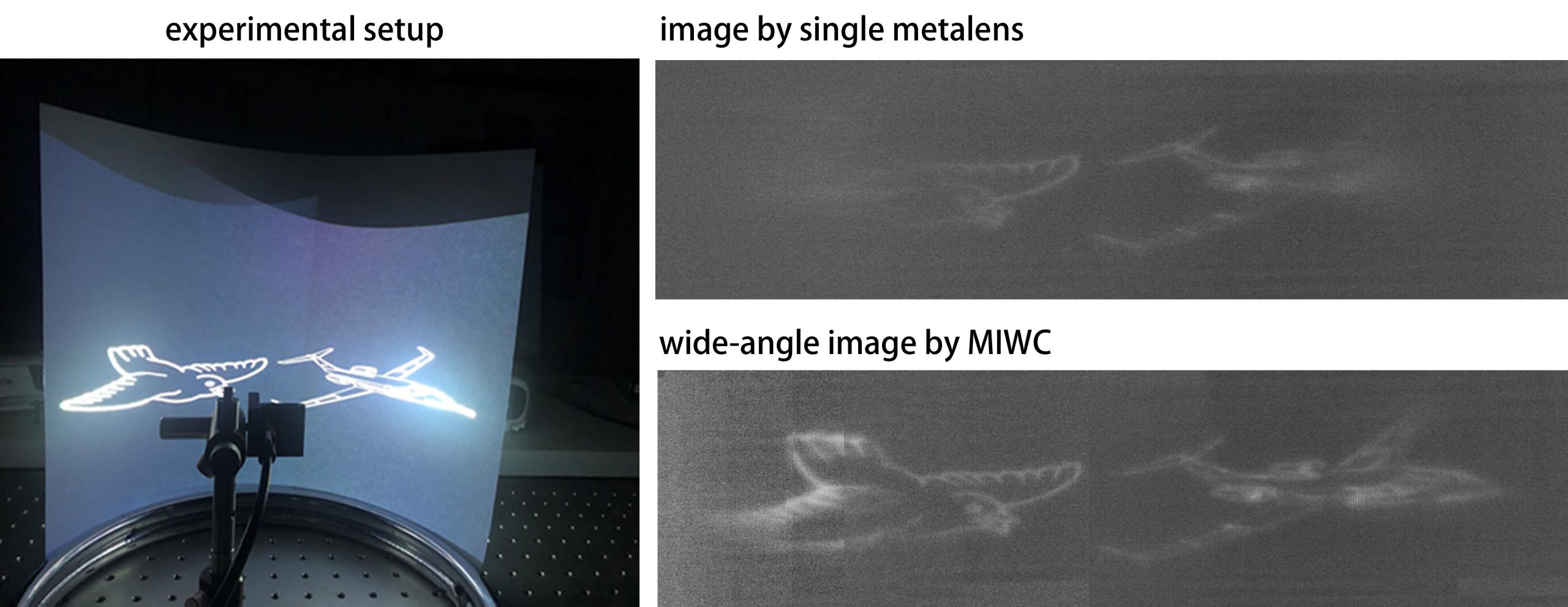
    Wide Angle Images Compact Array of Metalenses
    Researchers designed a new compact camera that acquires high-quality wide-angle images using an array of metalenses. Their new planar camera (MIWC) produced clearer images of pictures projected across a curved screen compared to a camera based on a single traditional metalens. Credit: Tao Li, Nanjing University

    Wide-angle imaging is useful for capturing large amounts of information that can create stunning, high-quality images. For machine vision applications such as autonomous driving and drone-based surveillance, wide-angle imaging can enhance performance and safety, for example by revealing an obstacle you couldn’t otherwise see while backing up in a vehicle.

    “To create an extremely compact wide-angle camera, we used an array of metalenses that each capture certain parts of the wide-angle scene,” said Li. “The images are then stitched together to create a wide-angle image without any degradation in image quality.”

    Miniaturizing the Wide-Angle Lens

    Wide-angle imaging is usually accomplished with a fish-eye compound lens or other type of multilayer lens. Although researchers have previously tried to use metalenses to create wide-angle cameras, they tend to suffer from poor image quality or other drawbacks.

    In the new work, the researchers used an array of metalenses that are each carefully designed to focus a different range of illumination angles. This allows each lens to clearly image part of a wide-angle object or scene. The clearest parts of each image can then be computationally stitched together to create the final image.

    Planar Camera
    The researchers fabricated a metalens array (enlarged on the right) and mounted it directly to a CMOS sensor. This created a planar camera that measured about 1 cm × 1 cm × 0.3 cm. Credit: Tao Li, Nanjing University

    “Thanks to the flexible design of the metasurfaces, the focusing and imaging performance of each lens can be optimized independently,” said Li. “This gives rise to a high quality final wide-angle image after a stitching process. What’s more, the array can be manufactured using just one layer of material, which helps keep cost down.”

    Seeing More With Flat Lenses

    To demonstrate the new approach, the researchers used nanofabrication to create a metalens array and mounted it directly to a CMOS sensor, creating a planar camera that measured about 1 cm × 1 cm × 0.3 cm. They then used this camera to image a wide-angle scene created by using two projectors to illuminate a curved screen surrounding the camera at a distance of 15 cm.

    They compared their new planar camera with one based on a single traditional metalens while imaging the words “Nanjing University” projected across the curved screen. The planar camera produced an image that showed every letter clearly and had a viewing angle larger than 120°, more than three times larger than that of the camera based on a traditional metalens.

    The researchers note that the planar camera demonstrated in this research used individual metalenses just 0.3 millimeters in diameter. They plan to enlarge these to about 1 to 5 millimeters to increase the camera’s imaging quality. After optimization, the array could be mass produced to reduce the cost of each device.

    Reference: “Planar wide-angle-imaging camera enabled by metalens array” by Ji Chen, Xin Ye, Shenglun Gao, Yuxin Chen, Yunwei Zhao, Chunyu Huang, Kai Qiu, Shining Zhu and Tao Li, 14 April 2022, Optica.
    DOI: 10.1364/OPTICA.446063

    Never miss a breakthrough: Join the SciTechDaily newsletter.
    Follow us on Google and Google News.

    Camera Lenses Nanotechnology Optica Smartphone
    Share. Facebook Twitter Pinterest LinkedIn Email Reddit

    Related Articles

    Superconducting Nanowire Photon Detector Could Enable High-Speed Quantum Communication

    New Atomically Thin Material That Improves the Efficiency of Light-Based Tech: Solar Panels, Cameras, Biosensors

    Groundbreaking X-Ray Lens Provides Incredible Glimpse Into the Nanoworld

    Researchers Use Flat Lenses for Realistic-Looking 3D Displays Without Glasses

    Eliminating Lenses: Ghost Imaging Speeds Up X-Ray Fluorescence Chemical Mapping

    Color-Sorting Metalenses Boost Imaging Sensitivity for Smartphones and Autonomous Vehicles

    Ultrathin Flat Lens Focuses Light Without Optical Distortions

    Nanotextures Make Anti-Fogging, Self-Cleaning and Glare-Free Glass

    Scientists Develop Pocket-Size Microscope Accessory Accurate to one Hundredth of a Millimeter

    1 Comment

    1. nefojon964 on April 14, 2022 7:36 am

      ko

      Reply
    Leave A Reply Cancel Reply

    • Facebook
    • Twitter
    • Pinterest
    • YouTube

    Don't Miss a Discovery

    Subscribe for the Latest in Science & Tech!

    Trending News

    Researchers Have Found a Dietary Compound That Increases Longevity

    Scientists Baffled by Bizarre “Living Fossil” From 275 Million Years Ago

    Your IQ at 23 Could Predict Your Wealth at 27, Study Finds

    320 Light-Years Away, a Planet Confirms a Fundamental Cosmic Assumption

    The Crown Jewel of Dentistry? Breakthrough Tech Could Transform Tooth Repair

    Python Blood Could Hold the Secret to Weight Loss Without Side Effects

    Naturally Occurring Bacteria Completely Eradicate Tumors in Mice With a Single Dose

    New “Nanozyme Hypothesis” Could Rewrite the Story of Life’s Origins

    Follow SciTechDaily
    • Facebook
    • Twitter
    • YouTube
    • Pinterest
    • Newsletter
    • RSS
    SciTech News
    • Biology News
    • Chemistry News
    • Earth News
    • Health News
    • Physics News
    • Science News
    • Space News
    • Technology News
    Recent Posts
    • 34-Million-Year-Old Snake Found in Wyoming Rewrites Our Understanding of Evolution
    • Prehistoric “Vomit Fossil” Reveals Never-Before-Seen Flying Reptile
    • Scientists Discover Bizarre Crocodile Relative That Walked on Two Legs
    • How Quantum Mechanics Went From Baffling Theory to Revolutionizing Modern Technology
    • Scientists May Have Found the Key to Jupiter and Saturn’s Moon Mystery
    Copyright © 1998 - 2026 SciTechDaily. All Rights Reserved.
    • Science News
    • About
    • Contact
    • Editorial Board
    • Privacy Policy
    • Terms of Use

    Type above and press Enter to search. Press Esc to cancel.