
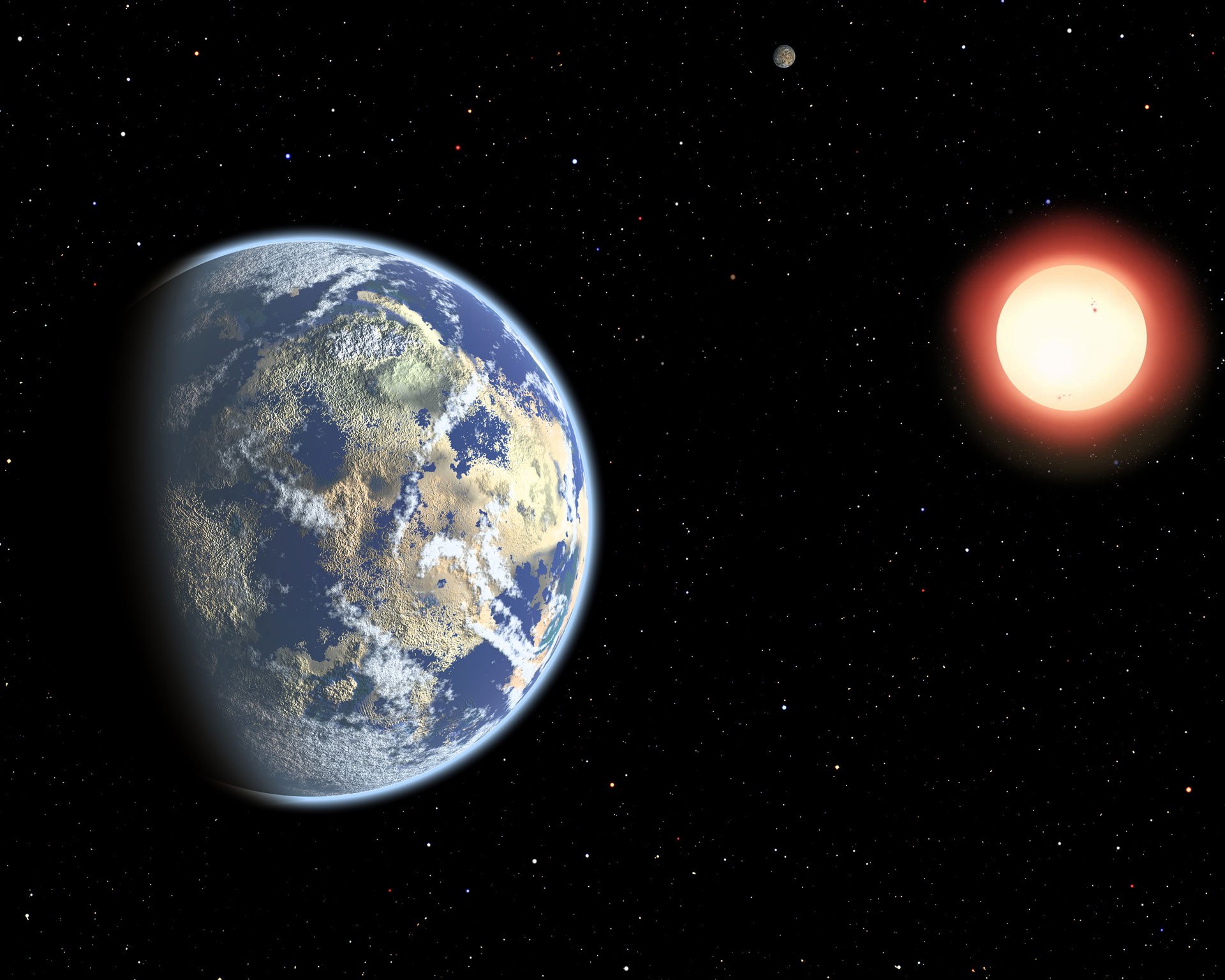
Research from the University of Sheffield has found that the chance of finding Earth-like planets in their early stages of formation is much higher than previously thought.
The team studied groups of young stars in the Milky Way to see if these groups were typical compared to theories and previous observations in other star-forming regions in space, and to study if the populations of stars in these groups affected the likelihood of finding forming Earth-like planets.
The research, published in The Astrophysical Journal, found that there are more stars like the Sun than expected in these groups, which would increase the chances of finding Earth-like planets in their early stages of formation.
In their early stages of formation these Earth-like planets, called magma ocean planets, are still being made from collisions with rocks and smaller planets, which causes them to heat up so much that their surfaces become molten rock.
The team, led by Dr. Richard Parker, included undergraduate students from the University of Sheffield giving them the opportunity to apply the skills learned on their course to leading published research in their field.
Dr. Richard Parker, from the University of Sheffield’s Department of Physics and Astronomy, said: “These magma ocean planets are easier to detect near stars like the Sun, which are twice as heavy as the average mass star. These planets emit so much heat that we will be able to observe the glow from them using the next generation of infrared telescopes.
“The locations where we would find these planets are so-called ‘young moving groups’ which are groups of young stars that are less than 100 million years old – which is young for a star. However, they typically only contain a few tens of stars each and previously it was difficult to determine whether we had found all of the stars in each group because they blend into the background of the Milky Way galaxy.
“Observations from the Gaia telescope have helped us to find many more stars in these groups, which enabled us to carry out this study.”
The findings from the research will help further understanding of whether star formation is universal and will be an important resource for studying how rocky, habitable planets like Earth form. The team now hopes to use computer simulations to explain the origin of these young moving groups of stars.
The research team included undergraduate students Amy Bottrill, Molly Haigh, Madeleine Hole, and Sarah Theakston from the University of Sheffield’s Department of Physics and Astronomy.
Molly Haigh said: “Being involved in this project was one of the highlights of our university experience and it was a great opportunity to work on an area of astronomy outside the typical course structure.
“It was rewarding to see a physical application of the computer coding we learned in our degree by sampling the initial mass distribution of stars and how this can relate to the future of exoplanet detection.”
Reference: “Exoplanet Detection and Its Dependence on Stochastic Sampling of the Stellar Initial Mass Function” by Amy L. Bottrill, Molly E. Haigh, Madeleine R. A. Hole, Sarah C. M. Theakston, Rosa B. Allen, Liam P. Grimmett and Richard J. Parker, 5 June 2020, The Astrophysical Journal.
DOI: 10.3847/1538-4357/ab8e39
The Department of Physics and Astronomy at the University of Sheffield explores the fundamental laws of the universe and develops pioneering technologies with real-world applications. Researchers are looking beyond our planet to map out distant galaxies, tackling global challenges including energy security, and exploring the opportunities presented by quantum computing and 2D materials.
Never miss a breakthrough: Join the SciTechDaily newsletter.
Follow us on Google and Google News.
1 Comment
Progress in Planet hunting is moving at an incredible pace.
Surely we are on the brink of finding life outside our solar system.
Of course, we might not find life, but the implications if we do are huge.