
Close Menu
    Facebook X (Twitter) Instagram
    SciTechDaily
    • Biology
    • Chemistry
    • Earth
    • Health
    • Physics
    • Science
    • Space
    • Technology
    Facebook X (Twitter) Pinterest YouTube RSS
    SciTechDaily
    Home»Biology»Hired Blade: Anchoring Complex in Plant Cells Recruits Its Own Katana Sword To Cut New Microtubules
    Biology

    Hired Blade: Anchoring Complex in Plant Cells Recruits Its Own Katana Sword To Cut New Microtubules

    By Nara Institute of Science and TechnologyJune 17, 2021No Comments3 Mins Read
    Facebook Twitter Pinterest Telegram LinkedIn WhatsApp Email Reddit
    Share
    Facebook Twitter LinkedIn Pinterest Telegram Email Reddit
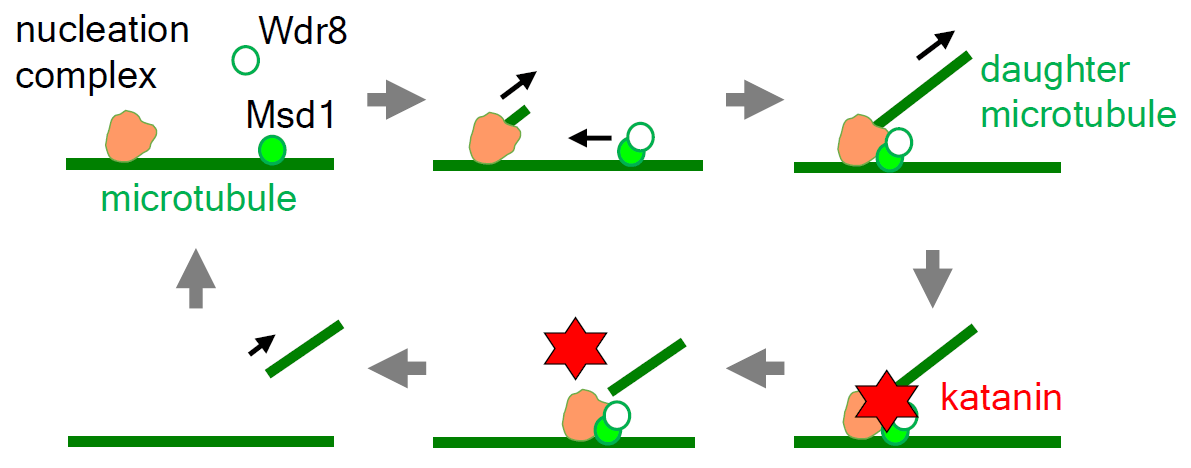
    Lattice-Bound Msd1 Recruits Cytoplasmic Wdr8
    In wild-type plant cells, lattice-bound Msd1 (filled green circle) recruits cytoplasmic Wdr8 (open green circle) to form a heteromeric complex, which is translocated to and associated with a microtubule nucleation complex (orange) on a preexisting microtubule (green line). After nucleation of a daughter microtubule, Msd1-Wdr8 stabilizes the base of the Y-shaped nucleation structure and then recruit katanin (red) to sever the basal end of the daughter microtubule. Credit: Takashi Hashimoto

    Researchers from Nara Institute of Science and Technology find that an anchoring complex stabilizes microtubule creation sites within plant cells, then recruits katanin — named after the katana sword — to cut new microtubules.

    The katana, a Japanese sword, may be thought of solely as a weapon used by the samurai. But researchers from Japan have discovered that not only do plants wield their own katanas within their cells, they recruit them to specific locations within those cells to do their work.

    In a study published in Nature Communications, researchers from Nara Institute of Science and Technology have revealed that the enzyme katanin, which is named after the katana, is used by an anchoring complex to cut microtubules at specific locations of the framework within individual plant cells.

    Katanin severs microtubules in cells, which is an important step in cell division and central to the development of many organisms, including plants and animals. Microtubules form part of the cytoskeleton, a complex network of protein filaments found in all cells. The severing performed by katanin enables mobility, which is important during development, and treadmilling — a phenomenon where one end of a filament lengthens as the other shrinks, which results in a section of filament that seems to ‘move’ like a treadmill.

    “Katanin severs microtubules at specific locations in plant and animal cells, and this leads to active reorganization of the microtubule cytoskeleton,” says senior author of the study Takashi Hashimoto. “But the mechanisms for targeting this extraordinary enzyme at specific sites within the cell are not well understood — these are what we wanted to investigate.”

    Role of the Msd1-Wdr8 Anchoring Complex

    The team’s genetic and cell biology research results showed that the microtubule anchoring complex Msd1-Wdr8 is used to stabilize microtubule nucleation sites (where microtubules are formed) in plant cells to prevent early release of the new microtubules (called ‘daughter microtubules’). But in a seemingly counterintuitive twist, Msd1-Wdr8 then turns around and recruits katanin to the same location to enable the efficient release of daughter microtubules.

    “These ‘glue-and-cut’ functions performed by Msd1-Wdr8 and their effects on microtubule stability may seem confusing at first, but they probably enable strict control of microtubule release by the katanin activity,” explains Hashimoto.

    This study will inform future research on whether the Msd1-Wdr8 complex in animal cells also recruits katanin, and whether other sites use similar mechanisms for the stabilization and release of daughter microtubules. The results of this study will be of interest to cell biologists, especially those working on cytoskeletons, in plants and other organisms.

    Reference: “An anchoring complex recruits katanin for microtubule severing at the plant cortical nucleation sites” by Noriyoshi Yagi, Takehide Kato, Sachihiro Matsunaga, David W. Ehrhardt, Masayoshi Nakamura and Takashi Hashimoto, 17 June 2021, Nature Communications.
    DOI: 10.1038/s41467-021-24067-y

    Never miss a breakthrough: Join the SciTechDaily newsletter.
    Follow us on Google and Google News.

    Cell Biology Genetics Nara Institute of Science and Technology Plant Science
    Share. Facebook Twitter Pinterest LinkedIn Email Reddit

    Related Articles

    The Flower Clock: How a Small Protein Helps Flowers Develop Properly

    How Information Beyond the Genetic Sequence Is Encoded in Plant Sperm and Passed Down the Generations

    New CRISPR/Cas9 Plant Genetics Technology to Improve Agricultural Yield and Resist the Effects of Climate Change

    Solving a Long-Standing Biological Mystery: How Cells Measure Themselves

    Genetic Scalpel Invented for Microalgae to Efficiently Turn CO2 Into Biofuel

    Development of Next-Generation Crops: Research Catches Up to World’s Fastest-Growing Plant

    Special Genes Behind the Pressure Sensor of the Venus Flytrap

    How the Architecture of the Cell Nucleus Can Change Gene Activity in Plants

    Biologists Unravel Tangled Mystery of Plant Cell Growth – Insight Could Lead to Bigger Crops and Better Yields

    Leave A Reply Cancel Reply

    • Facebook
    • Twitter
    • Pinterest
    • YouTube

    Don't Miss a Discovery

    Subscribe for the Latest in Science & Tech!

    Trending News

    Your Blood Pressure Reading Could Be Wrong Because of One Simple Mistake

    Astronomers Stunned by Ancient Galaxy With No Spin

    Physicists May Be on the Verge of Discovering “New Physics” at CERN

    Scientists Solve 320-Million-Year Mystery of Reptile Skin Armor

    Scientists Say This Daily Walking Habit May Be the Secret to Keeping Weight Off After Dieting

    New Therapy Rewires the Brain To Restore Joy in Depression Patients

    Giant Squid Detected off Western Australia in Stunning Deep-Sea Discovery

    Popular Sugar-Free Sweetener Linked to Liver Disease, Study Warns

    Follow SciTechDaily
    • Facebook
    • Twitter
    • YouTube
    • Pinterest
    • Newsletter
    • RSS
    SciTech News
    • Biology News
    • Chemistry News
    • Earth News
    • Health News
    • Physics News
    • Science News
    • Space News
    • Technology News
    Recent Posts
    • New Stroke Study Challenges Decades-Old Medical Beliefs
    • These Simple Plant Foods Are Linked to Lower Blood Pressure
    • Common Blood Pressure Drug Supercharges Cancer Treatment in Surprising New Study
    • Key Magic Mushroom Ingredient Increases Laziness and Reduces Aggression
    • Researchers Solve 15-Year Mystery Behind Cancer-Causing Gut Toxin
    Copyright © 1998 - 2026 SciTechDaily. All Rights Reserved.
    • Science News
    • About
    • Contact
    • Editorial Board
    • Privacy Policy
    • Terms of Use

    Type above and press Enter to search. Press Esc to cancel.