
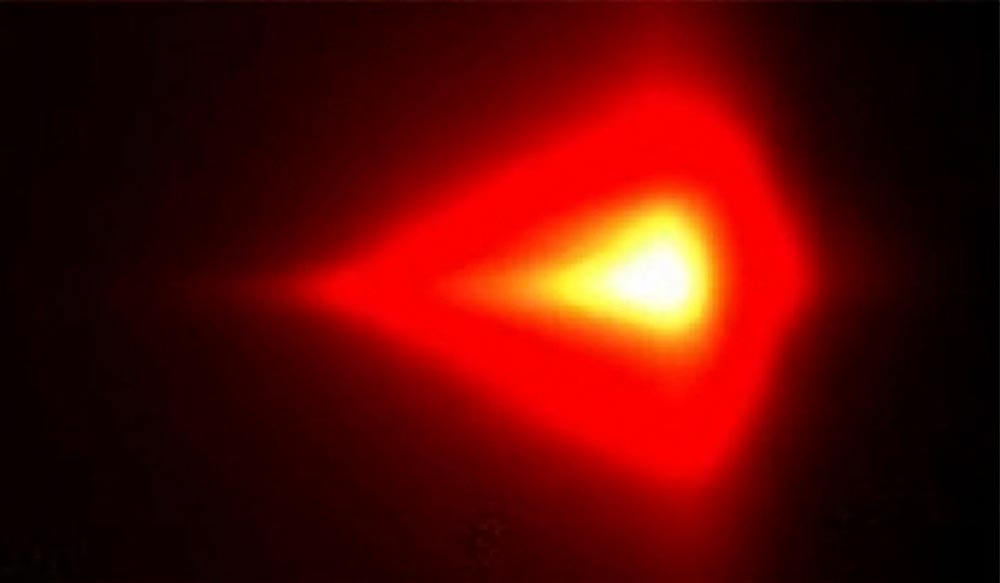
Physicists from Yale University have engineered a “random laser” which they believe will improve both processing time and the clarity of the images from devices that use laser illumination. The published study describes their findings in detail and explains how random lasers enable faster image generation while generating speckle-free images.
Using “random lasers” as a source of illumination in medical imaging equipment could improve both processing time and the clarity of the final images, according to new research by Yale University scientists.
Imaging systems currently rely on a variety of light sources — specialty light bulbs, light-emitting diodes (LEDs), and traditional lasers. But systems using traditional lasers, the brightest of these light sources, often yield undesirable visual byproducts that mar the final picture. One common byproduct, speckle, looks something like a snowfall pattern.
The Yale researchers have engineered a special type of laser called a random laser — which generates and emits light differently from traditional lasers — to serve the same function without giving off speckle or other visual blight. They report their results online on April 29 in the journal Nature Photonics.
“Our work is innovative and significant because we show that random lasers are much brighter than LEDs and light bulbs and also generate speckle-free images,” said Michael A. Choma, an assistant professor of diagnostic radiology, pediatrics, and biomedical engineering at Yale. He is one of the study’s principal investigators.
Hui Cao, a professor of applied physics and physics at Yale, is the other principal investigator. Brandon Redding, a postdoctoral associate in applied physics, is the lead author.
A traditional laser emits a single intense beam of light, known as a spatial mode. Photons from that single beam can be scattered by a sample under observation, resulting in random grainy background noise — speckle — on top of the desired image.
One way of mitigating the noise is to use many different spatial modes, such as the light emitted by a LED or light bulb. Unfortunately, these light sources are dim compared with lasers.
But random lasers offer the best of both worlds, according to the Yale researchers. They are bright, like lasers, while also having many modes, like a light bulb, so they generate speckle-free images. That is, random lasers are something akin to a light bulb with the intensity of a laser.
“Our random lasers combine the advantages of lasers and the white light sources, and may be used for a wide range of imaging and projection applications,” said Cao.
The light emitted by random lasers could also enable faster image generation. This would help researchers and clinicians better capture fast-moving physiological phenomena — the movements of embryo hearts, perhaps, or blood flow patterns in the eye — as well as broad swaths of tissue in less time than required by current technologies.
“Your light source really defines the boundaries of what you can do — how fast you can image,” said Choma. “And you always want to go faster.”
Random lasers could have applications in consumer electronics also, according to the researchers — in digital light projection systems, for example.
Within medical imaging, the introduction of random lasers could lead to improved microscopy and endoscopy, they said.
The scientists have produced a prototype random laser for use in imaging applications and are refining it.
The National Science Foundation and the Yale Child Health Research Center supported the work.
Reference: “Speckle-free laser imaging using random laser illumination” by Brandon Redding, Michael A. Choma and Hui Cao, 29 April 2012, Nature Photonics.
DOI: 10.1038/nphoton.2012.90
Never miss a breakthrough: Join the SciTechDaily newsletter.
Follow us on Google and Google News.
1 Comment
“Random Lasers” Reduce Noise and Improve Medical Imaging
Thanks For Sharing with Us!