
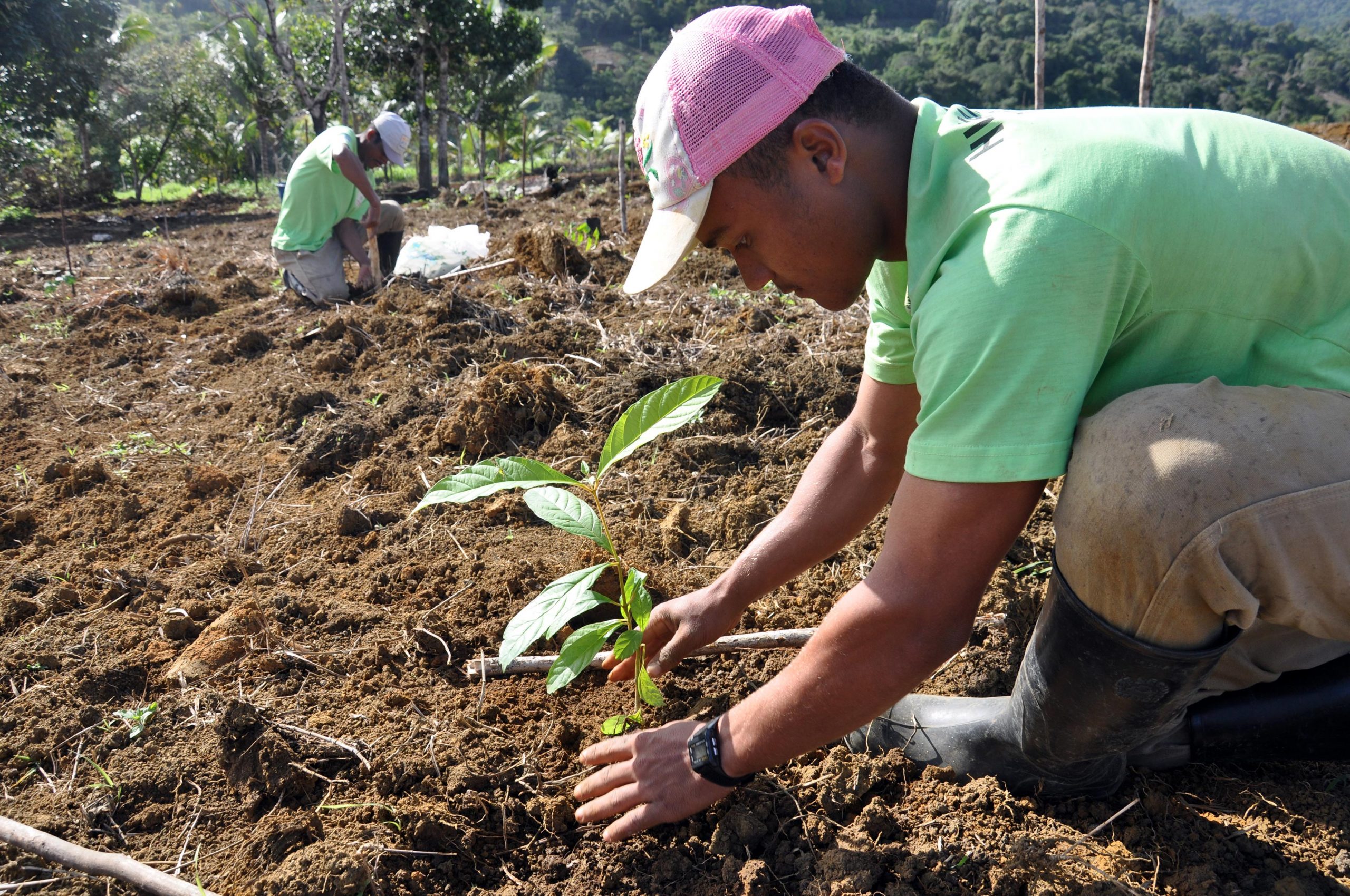
Campaigns to plant 1 trillion trees must be undertaken with care and a commitment to long-term management.
Restoration ecologist Karen Holl has a simple message for anyone who thinks planting 1 trillion trees will reverse the damage of climate change.
“We can’t plant our way out of climate change,” says Holl, professor of environmental studies at UC Santa Cruz and a leading expert in forest restoration. “It is only one piece of the puzzle.”
In a commentary that appears in the May 8 issue of Science, Holl and coauthor Pedro Brancalion, a professor in the Department of Forest Sciences at the University of São Paulo, endorse the benefits of trees but caution against a simplistic view of tree-planting as a panacea for environmental degradation.
“Trees are deeply entrenched in the human psyche,” said Holl, a restoration ecologist who has prepared hundreds of students for careers in environmental stewardship. “It’s very satisfying to go out and put a tree in the ground. It’s a concrete, tangible thing to do.”
But broad-scale tree planting initiatives, such as 1t.org and the Trillion Tree Campaign, must be undertaken carefully and with a commitment to long-term management, if the benefits are to be fully realized.
“Planting trees is not a simple solution,” said Holl. “It’s complicated, and we need to be realistic about what we can and cannot achieve. We need to be thoughtful and plan for the long term.”
On the plus side, planting trees can improve biodiversity, water quality, and increase shade. But depending on where and how it is done, tree planting can also harm native ecosystems and species, reduce water supply, and dispossess local landholders and increase social inequity.
In their commentary, Holl and Brancalion present four principles that should guide forest enhancement initiatives:
- Reduce forest clearing and degradation: Protecting and maintaining intact forests is more efficient, more ecologically sound, and less costly than planting trees, or replanting.
- View tree planting as one part of multifaceted environmental solutions: Enhanced tree cover is one of the best options to offset a portion of the greenhouse gas emissions driven by human activities, but they represent only a small portion of the carbon reductions that are needed–and estimates vary by more than tenfold depending on variables used in modeling.
- Balance ecological and social goals: Acknowledge competing land uses and focus on landscapes with the potential to generate large-scale benefits, such as the Atlantic Forest in Brazil, where regional planning of tree planting initiatives can lead to three times the conservation gains at half the cost.
- Plan, coordinate, and monitor: Work with local stakeholders to resolve conflicting land-use goals and ensure maximum effectiveness over the long term. Planting trees doesn’t ensure they will survive; a review of mangrove forest restoration efforts in Sri Lanka following the 2004 tsunami showed fewer than 10 percent of trees survived in 75 percent of sites.
To be successful, tree-planting initiatives need to engage local stakeholders and confront conflicting goals for land use. “Much of the land proposed for tree planting is already being used to grow crops, harvest timber, and other subsistence activities, so tree planting initiatives need to consider how landowners will earn income,” said Holl. “Otherwise, activities such as agriculture or logging will just move to other lands”
Holl chooses her words carefully when she says she applauds the widespread enthusiasm for “increasing forest cover,” which is not the same thing as planting more trees.
“The first thing we can do is keep existing forests standing, and the second is to allow trees to regenerate in areas that were formerly forests,” said Holl, who specializes in tropical forest restoration. “In many cases, trees will recover on their own–just look at the entire eastern United States that was deforested 200 years ago. Much of that has come back without actively planting trees. Yes, in some highly degraded lands we will need to plant trees, but that should be the last option since it is the most expensive and often is not successful. I’ve spent my life on this. We need to be thoughtful about how we bring the forest back.”
Critically, slowing the pace of climate change requires a comprehensive strategy that starts with burning less fossil fuel, said Holl.
“Trees are a small piece of what needs to be a broader strategy,” said Holl. “We’re better off not releasing greenhouse gases to begin with.”
Never miss a breakthrough: Join the SciTechDaily newsletter.
Follow us on Google and Google News.
2 Comments
Thank you for sharing, it’s great! Large trees are great filters for urban pollutants and fine particulate matter, you can learn more about them here https://theclimateconnection.org/ . They absorb polluting gases (such as carbon monoxide, nitrogen oxides, ozone, and sulfur oxides) and filter small particles from the air, such as dust, soot, or smoke, trapping them on the surface of leaves and bark.
The climate changes, get over it. Humans helped, but its not unnatural. The science guys keep saying humans evolved on earth. So humans are nature. Everything we do is natural. Pointing and blaming isn’t helping. What has changed is that humans are not allowed to migrate to improve their own lot. Borders have killed millions. In the coming water wars, these borders will kill over a billion. We have to let people migrate. Its the number one human right IMO.