
Close Menu
    Facebook X (Twitter) Instagram
    SciTechDaily
    • Biology
    • Chemistry
    • Earth
    • Health
    • Physics
    • Science
    • Space
    • Technology
    Facebook X (Twitter) Pinterest YouTube RSS
    SciTechDaily
    Home»Health»Holographic Imaging Used to Detect Viruses and Antibodies – Could Aid COVID-19 Diagnostics
    Health

    Holographic Imaging Used to Detect Viruses and Antibodies – Could Aid COVID-19 Diagnostics

    By New York UniversityNovember 16, 2020No Comments3 Mins Read
    Facebook Twitter Pinterest Telegram LinkedIn WhatsApp Email Reddit
    Share
    Facebook Twitter LinkedIn Pinterest Telegram Email Reddit
    Viruses and Antibodies Holographic Imaging
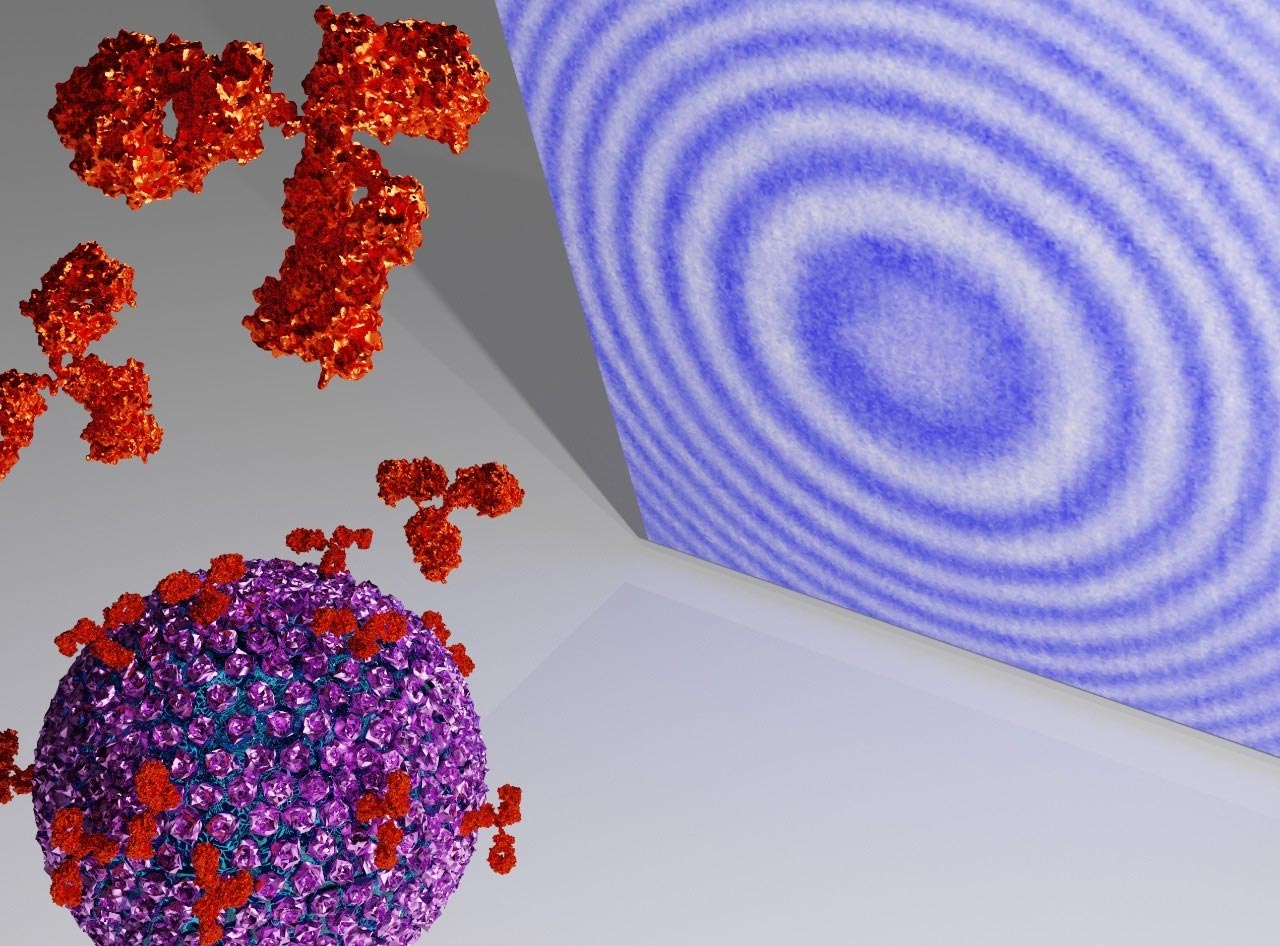
    A rendering of holographic microscopy of a test bead binding antibodies. Credit: Image courtesy of NYU’s David Grier

    A team of NYU scientists has developed a method using holographic imaging to detect both viruses and antibodies. The breakthrough has the potential to aid in medical diagnoses and, specifically, those related to the COVID-19 pandemic.

    Work Has Potential Applications for Medical Diagnostics and COVID-19.

    A team of New York University scientists has developed a method using holographic imaging to detect both viruses and antibodies. The breakthrough has the potential to aid in medical diagnoses and, specifically, those related to the COVID-19 pandemic.

    “Our approach is based on physical principles that have not previously been used for diagnostic testing,” explains David Grier, a professor of physics at NYU and one of the researchers on the project, which is reported in the journal Soft Matter. “We can detect antibodies and viruses by literally watching them stick to specially prepared test beads.”

    If fully realized, this proposed test could be done in under 30 minutes, is highly accurate, and can be performed by minimally trained personnel. Moreover, the method can test for either the virus (current infection) or antibodies (immunity).

    The scientists, who also include NYU doctoral candidates Kaitlynn Snyder and Rushna Quddus as well as NYU Chemistry Professor Kent Kirshenbaum and NYU Physics Professor Andy Hollingsworth, base their test on holographic video microscopy, which uses laser beams to record holograms of their test beads. The surfaces of the beads are activated with biochemical binding sites that attract either antibodies or virus particles, depending on the intended test. Binding antibodies or viruses causes the beads to grow by a few billionths of a meter, which the NYU researchers have shown they can detect through changes in the beads’ holograms.

    “We can analyze a dozen beads per second,” explains Grier, “which means that we can cut the time for a reliable thousand-bead diagnostic test to 20 minutes. And we can measure those changes rapidly, reliably, and inexpensively.”

    The holographic video microscopy is performed by an instrument, xSight, created by Spheryx, a New York-based company Grier co-founded.

    The scientists also note the versatility of their method.

    “This instrument can count virus particles dispersed in patients’ saliva and also detect and differentiate antibodies dissolved in their blood,” adds Grier. “This flexibility is achieved by changing the composition of the test beads to model what we are testing.

    “Each type of bead tests for the presence of a particular target, but can also test for several targets simultaneously. Our holographic analysis distinguishes the different test beads by their size and by their refractive index—an easily controlled optical property.”

    The scientists say that this capability can be used to develop libraries of test beads that may be combined into test kits for mixing with patient samples. This will support doctors in distinguishing among possible diagnoses, speeding patients’ treatment, reducing the risk of misdiagnosis, and cutting the cost of healthcare.

    Reference: ” Holographic immunoassays: direct detection of antibodies binding to colloidal spheres” by Kaitlynn Snyder, Rushna Quddus, Andrew D. Hollingsworth, Kent Kirshenbaum and David G. Grier, 8 October 2020, Soft Matter.
    DOI: 10.1039/D0SM01351J

    The research was supported, in part, by a RAPID Award from the National Science Foundation (DMR-2027013); this support is aimed at addressing the critical shortage of fast, effective, and inexpensive medical diagnostic tests.

    Never miss a breakthrough: Join the SciTechDaily newsletter.
    Follow us on Google and Google News.

    Infectious Diseases New York University Virology
    Share. Facebook Twitter Pinterest LinkedIn Email Reddit

    Related Articles

    Study Shows Treatment With Interferon-α2b Speeds Up Recovery of COVID-19 Patients

    Experts Dire Warning: 250,000,000 People in Africa Will Catch Coronavirus and Up to 190,000 Will Likely Die

    New Genetic Analysis Shows COVID-19 Coronavirus Did Not Spill Over From Pangolins (Scaly Anteaters)

    Team of Biochemists and Virologists Discover Potential Targets for COVID-19 Therapy

    How COVID-19 Kills: New Study Explains the Mechanisms of the New Coronavirus

    Vitamin D Linked to Low Coronavirus Death Rate

    Bat ‘Super Immunity’ May Explain How Bats Carry Coronaviruses Without Getting Sick

    Infection Researchers Identify How Coronaviruses From Animals Need to Change to Spread to Humans

    Progress on AAVCOVID, A Gene-Based Experimental COVID-19 Vaccine

    Leave A Reply Cancel Reply

    • Facebook
    • Twitter
    • Pinterest
    • YouTube

    Don't Miss a Discovery

    Subscribe for the Latest in Science & Tech!

    Trending News

    Scientists Discover Game-Changing New Way To Treat High Cholesterol

    This Small Change to Your Exercise Routine Could Be the Secret to Living Longer

    Scientists Discover 430,000-Year-Old Wooden Tools, Rewriting Human History

    AI Could Detect Early Signs of Alzheimer’s in Under a Minute – Far Before Traditional Tests

    What if Dark Matter Has Two Forms? Bold New Hypothesis Could Explain a Cosmic Mystery

    This Metal Melts in Your Hand – and Scientists Just Discovered Something Strange

    Beef vs. Chicken: Surprising Results From New Prediabetes Study

    Alzheimer’s Breakthrough: Scientists Discover Key Protein May Prevent Toxic Protein Clumps in the Brain

    Follow SciTechDaily
    • Facebook
    • Twitter
    • YouTube
    • Pinterest
    • Newsletter
    • RSS
    SciTech News
    • Biology News
    • Chemistry News
    • Earth News
    • Health News
    • Physics News
    • Science News
    • Space News
    • Technology News
    Recent Posts
    • Revolutionary Imaging Technique Unlocks Secrets of Matter at Extreme Speeds
    • Where Does Mass Come From? Scientists Find Evidence of a New Exotic Nuclear State
    • Quantum Breakthrough: Unhackable Keys Sent Over 120 km Using Quantum Dots
    • Researchers Discover Unknown Beetle Species Just Steps From Their Lab
    • Jellyfish Caught Feasting on Exploding Sea Worms for the First Time
    Copyright © 1998 - 2026 SciTechDaily. All Rights Reserved.
    • Science News
    • About
    • Contact
    • Editorial Board
    • Privacy Policy
    • Terms of Use

    Type above and press Enter to search. Press Esc to cancel.